

CVE-2026-46152 is a Linux kernel Wi-Fi vulnerability published by NVD on May 28, 2026, affecting mac80211 fast-RX handling, where a mistakenly static per-call result variable could be shared by concurrent receive paths and misroute mesh packets. The patch is almost comically small: delete one keyword, change the storage lifetime of one variable, and the race disappears. But the lesson is larger than the diff. Modern wireless stacks are now so parallel, optimized, and feature-dense that a single stray
The Linux kernel has a long tradition of security fixes that look underwhelming in code review and unsettling in production. CVE-2026-46152 belongs to that lineage. The change is not a new bounds check, a redesigned parser, or a mitigation around hostile firmware; it is the removal of
That matters because
The affected path sits in mac80211, the kernel’s common 802.11 wireless subsystem used by many Linux Wi-Fi drivers. This is not a boutique corner of the stack. mac80211 is part of the plumbing that lets Linux laptops, access points, embedded devices, and test rigs speak Wi-Fi without every driver reimplementing the whole protocol machine.
The vulnerability description is narrow: concurrent callers could overwrite each other’s
But fast paths are also where invariants become more brittle. They tend to be optimized around what is supposed to be true: the station is known, the frame is ordinary, the packet can be translated or forwarded without walking every slow-path check. When the surrounding system changes — mesh support added here, parallel receive there — a local assumption can outlive the world that made it safe.
That is what makes CVE-2026-46152 interesting. The bug is not that Linux forgot how to parse Wi-Fi frames. The bug is that a variable representing the result of one invocation was accidentally shared among invocations in code that explicitly expects parallelism. In kernel terms, this is less a failure of imagination than a failure of storage duration.
The timing also matters. The original fix tag cited by the patch points to mesh fast-RX support, which means this was not an ancient artifact merely waiting to be discovered. It came from the pressure to make more Wi-Fi cases eligible for optimized handling. The kernel keeps getting faster because developers move more work into paths like this; the kernel keeps getting riskier because those paths must preserve the same correctness under more concurrency.
For most WindowsForum readers, this is not a Windows vulnerability in the usual sense. It does not apply to Microsoft’s Wi-Fi stack. But it does apply to the Linux systems increasingly found around Windows environments: WSL-adjacent labs, home routers, NAS boxes, hypervisors, Linux-based access points, security appliances, and dual-boot developer hardware. The Windows desktop may not be running mac80211, but the network it trusts often is.
That complexity makes receive-path correctness more important. A packet that has been consumed, queued, or passed along in one semantic state should not later be treated as if it still belongs in a different pipeline. The vulnerability description gives two examples of confusion, both centered on a stale or overwritten result: one path falls through when it should not, while another stops when it should continue.
This is the kind of bug that may never become a dramatic exploit in the wild and still deserves a CVE. Kernel security is not only about shellcode and privilege escalation; it is also about preserving state integrity while untrusted input pounds on the system at line rate. Wi-Fi frames are untrusted input. A receive path is a parser, classifier, transformer, and dispatcher, all operating inside the kernel.
The word “mesh” may tempt some users to ignore the issue if they do not intentionally run 802.11s or mesh networking. That is a reasonable starting point for triage, but not a permission slip to forget the patch. Linux distribution kernels are general-purpose builds. Features compiled in for one workload often coexist with another, and wireless stacks are shared across devices that administrators may not inventory with the same rigor as servers.
A sober reading is that exploitability depends on configuration, driver behavior, concurrency timing, and whether an attacker can get suitable frames processed by the affected path. The NVD entry has not yet assigned CVSS metrics, which is the correct posture for a record still awaiting enrichment. Until distributions publish their own advisories and affected-version matrices, the most honest rating is: specific, real, and probably not equally urgent everywhere.
This has become increasingly common for Linux kernel CVEs. The kernel project now emits CVE records for many fixes that historically might have remained as stable-tree commits and changelog entries. That shift improves traceability, but it also pushes more raw kernel-maintenance data into vulnerability-management systems before the broader ecosystem has finished classifying impact.
For administrators, this creates a practical problem. Vulnerability scanners may flag the CVE before vendors have mapped it cleanly to product builds. Security teams may ask for risk statements before distribution maintainers have shipped kernels. Asset owners may see “Linux kernel Wi-Fi vulnerability” and have to decide whether it matters to a server with no wireless hardware, a router running OpenWrt, or a developer laptop with an enterprise image.
The answer should not be panic. It should be inventory. If the system has no Wi-Fi stack loaded, no relevant hardware, and no mac80211 exposure, the operational risk is very different from a Linux access point or mesh node. If the system is a portable Linux workstation or an embedded wireless device, the calculus changes.
The kernel.org references attached to the CVE show that the fix has been propagated through stable commits. That is the important remediation signal. The score will eventually help dashboards rank the item, but the patch already tells maintainers what changed and why.
The key invariant is that each invocation of
That is especially pernicious because it does not require memory corruption in the classic sense. No buffer needs to overflow. No pointer must be smashed. The bug is semantic corruption: the program’s control flow follows a valid value that belongs to the wrong invocation.
Security tooling is often better at finding the former than the latter. Static analyzers can warn about shared state, concurrency annotations can help, and reviewers can spot suspicious storage classes. But this kind of mistake often survives because the code compiles cleanly, the variable type is correct, and the bug only manifests when timing lines up.
That timing dimension is why packet-processing races can be elusive. A lab test may pass for months. A stress rig may trigger a weird drop or duplicate handling that looks like wireless noise. Only when someone reads the code with the parallelism contract in mind does the flaw become obvious.
Linux is now common in access points, routers, IoT gateways, industrial controllers, test equipment, hyperconverged appliances, and security boxes. Even when the front-end management console is Windows-friendly, the radio stack underneath may be Linux. mac80211 is part of the ecosystem that makes that possible.
This matters for CVE-2026-46152 because the affected subsystem is not limited to hobbyist desktops. A bug in receive handling can matter anywhere Linux is doing Wi-Fi work, especially where devices are exposed to untrusted radio environments. The air is a hostile network segment by default. Anyone nearby can transmit frames; authentication and encryption do not magically make every pre-routing or management edge irrelevant.
That does not mean every Linux Wi-Fi CVE is a campus-wide emergency. It means wireless devices deserve the same patch governance as VPN appliances, firewalls, and hypervisors. If a box routes traffic, bridges clients, or participates in a mesh, it should not sit outside the vulnerability program merely because it looks like “network gear” rather than “Linux.”
Windows administrators should recognize the pattern. The attack surface that matters is no longer bounded by the OS on the user’s screen. A Windows fleet can be affected indirectly by weaknesses in Linux-based infrastructure that supplies connectivity, name resolution, storage, monitoring, or access control. CVE-2026-46152 is not a Windows patch item, but it is absolutely a Windows-environment risk item when Linux Wi-Fi equipment is in the path.
A plausible impact starts with denial of service or packet-processing confusion under specific wireless and mesh conditions. Depending on how the surrounding path behaves, misrouting a frame through the wrong receive handler could produce drops, duplicate handling, unexpected forwarding, or stability problems. Whether that can be shaped into a stronger exploit is not established by the public record.
The presence of concurrency also raises the bar for reliable exploitation. Attackers generally prefer deterministic bugs. Races can be exploited, but they often require control over timing, volume, CPU behavior, and environmental conditions. Over-the-air packet injection can supply volume, but not necessarily precise scheduling inside the target kernel.
Still, security engineers do not get to dismiss races merely because they are annoying to weaponize. Kernel races have a long history of moving from “hard to trigger” to “reliably exploited” once enough people care. The Wi-Fi angle adds another complication: proximity-based attackers can generate traffic without needing credentials in some scenarios, depending on the frame types and path involved.
The responsible conclusion is measured. CVE-2026-46152 is a correctness flaw in a kernel wireless receive path with security relevance. It is not, based on current public information, a reason to shut down Wi-Fi networks. It is a reason to track patched kernels and prioritize exposed Linux wireless devices.
That supply chain is where the one-line fix becomes operationally messy. A commit can exist upstream while a device remains vulnerable because the vendor has not shipped new firmware. A distribution can publish a fixed kernel while a fleet remains exposed because laptops are pinned to an older hardware-enablement stack. A router can be technically patchable but practically abandoned.
For sysadmins, the immediate task is not to cherry-pick a kernel commit into production unless they already own that workflow. It is to identify which systems run Linux kernels with mac80211 enabled and wireless hardware active, then map those systems to vendor update channels. For mainstream distributions, the answer is usually to wait for and deploy the vendor kernel update. For embedded platforms, the answer may require firmware releases or replacing unsupported devices.
This is where CVE scoring sometimes hurts more than it helps. A “medium” score could cause a mesh access point fleet to be ignored, while a “high” score could cause needless noise on servers with no Wi-Fi. The better triage question is simpler: can this system receive and process relevant Wi-Fi traffic through mac80211? If yes, patch it with the next available maintenance window appropriate to its exposure.
The absence of NVD enrichment also means vulnerability teams should avoid building hard policy around the current record alone. Watch distribution advisories. Watch vendor firmware notes. Watch whether downstream maintainers classify the issue as affecting particular kernel branches. The upstream commit is the start of the story, not the complete asset-level answer.
That mixed reality changes patch responsibility. A Windows administrator may not build Linux kernels, but they may own the risk register for devices that run them. They may be the person who has to explain why Wi-Fi instability, mesh weirdness, or vendor firmware lag matters to Windows endpoints that depend on the network.
There is also a cultural point. Microsoft has spent years moving Windows administration toward declarative policy, cloud-managed compliance, and relatively centralized update channels. Linux infrastructure is more fragmented. Some devices update through a package manager, some through a vendor portal, some through a controller, and some not at all. A small kernel CVE exposes that difference.
For organizations using Linux-based wireless gear, the right response is to make wireless infrastructure visible in the same tooling and governance that tracks servers and endpoints. If the device has a kernel, it has a patch lifecycle. If it accepts packets from untrusted radios, it has an attack surface. If it supports business connectivity, it is not a lab toy.
This does not require turning every Windows admin into a kernel engineer. It requires asking vendors better questions: which kernel branch is this firmware based on, are mac80211 stable fixes included, and when will CVE-2026-46152 be addressed? Vendors that cannot answer those questions are telling you something important about their security maturity.
The Stray
The deeper story behind CVE-2026-46152 is performance debt. Every fast path is a bet that a shortcut can preserve the behavior of the longer route. Every concurrency optimization is a bet that shared execution will not accidentally become shared state. Those bets can be good engineering, but they accumulate debt when the surrounding subsystem evolves.
Wireless networking is particularly prone to this. Wi-Fi has grown from simple client connectivity into a dense stack of power saving, roaming, aggregation, encryption, multi-link operation, mesh behavior, offload, monitor modes, and driver-specific quirks. The kernel has to serve tiny embedded chips and high-performance laptops with the same broad architecture.
In that environment, a one-word bug is rarely just a typo. It is a sign that the code’s mental model and the code’s runtime model drifted apart. The function expected per-invocation state; the declaration supplied shared state. The compiler did exactly what it was told. The system did not do what the subsystem contract promised.
This is why kernel maintenance remains such a disciplined, incremental craft. Security work is not only spectacular mitigations and architectural rewrites. It is also catching the single keyword that violates a concurrency promise. The Linux stable process exists because those small corrections need to reach real systems quickly without waiting for the next big release.
The uncomfortable implication is that more such bugs likely exist across operating systems, not just Linux. Windows, Linux, BSD, mobile kernels, hypervisors, and firmware all contain fast paths whose safety depends on assumptions about concurrency and state. CVE-2026-46152 is a Linux record, but the engineering hazard is universal.
Security teams should also resist the urge to wait for perfect metadata. NVD enrichment will eventually fill in more fields, but upstream already describes the bug and the fix. When a vendor update arrives, the best move is to take it through normal kernel or firmware maintenance, especially on devices that process untrusted wireless traffic.
Administrators who maintain custom kernels should verify whether the relevant stable commit has landed in their branch. Those running distribution kernels should track the distribution’s advisory rather than guessing from mainline version numbers alone. Those running vendor appliances should demand firmware status from the vendor, because embedded Linux often hides kernel age behind a polished UI.
The most important operational mistake would be treating this as either a catastrophe or a curiosity. It is neither. It is a small, credible kernel wireless flaw with a clear fix and an impact profile that depends heavily on role and exposure.
static can turn a fast path into a correctness bug with security implications.
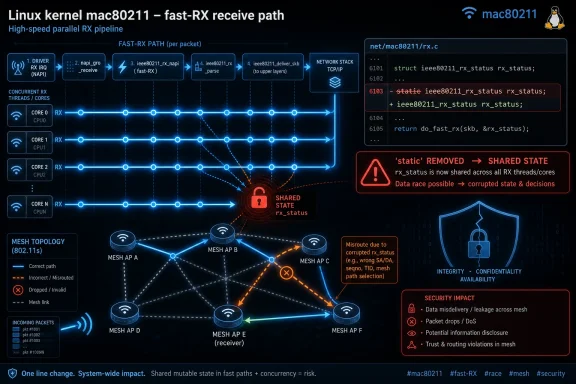 The One-Word Kernel Bug That Says More Than It Should
The Linux kernel has a long tradition of security fixes that look underwhelming in code review and unsettling in production. CVE-2026-46152 belongs to that lineage. The change is not a new bounds check, a redesigned parser, or a mitigation around hostile firmware; it is the removal of static from a local variable in ieee80211_invoke_fast_rx().That matters because
static is not just decoration in C. A function-local static variable is allocated once and shared across calls, rather than created anew for each invocation. In single-threaded code, that can be harmless or intentional. In a hot receive path that is documented as safe for parallel RX, it is the kind of state leak that kernel developers spend decades learning to fear.The affected path sits in mac80211, the kernel’s common 802.11 wireless subsystem used by many Linux Wi-Fi drivers. This is not a boutique corner of the stack. mac80211 is part of the plumbing that lets Linux laptops, access points, embedded devices, and test rigs speak Wi-Fi without every driver reimplementing the whole protocol machine.
The vulnerability description is narrow: concurrent callers could overwrite each other’s
rx_result between mesh data handling and a later switch on that result. The consequences named by the patch are packet-flow confusion: a packet already queued or consumed could fall through into ieee80211_rx_8023(), or a packet meant to continue could instead be treated as queued. That is not a remote-code-execution headline. It is, however, a warning about trust boundaries inside a kernel path that processes packets arriving over the air.Fast Paths Are Where Assumptions Go to Die
The phrase fast-RX should make administrators and kernel watchers sit up a little straighter. Fast paths exist to avoid expensive generic processing when the common case can be handled cheaply. They are performance features, and in networking code they can deliver real wins: fewer branches, fewer transformations, less overhead per frame.But fast paths are also where invariants become more brittle. They tend to be optimized around what is supposed to be true: the station is known, the frame is ordinary, the packet can be translated or forwarded without walking every slow-path check. When the surrounding system changes — mesh support added here, parallel receive there — a local assumption can outlive the world that made it safe.
That is what makes CVE-2026-46152 interesting. The bug is not that Linux forgot how to parse Wi-Fi frames. The bug is that a variable representing the result of one invocation was accidentally shared among invocations in code that explicitly expects parallelism. In kernel terms, this is less a failure of imagination than a failure of storage duration.
The timing also matters. The original fix tag cited by the patch points to mesh fast-RX support, which means this was not an ancient artifact merely waiting to be discovered. It came from the pressure to make more Wi-Fi cases eligible for optimized handling. The kernel keeps getting faster because developers move more work into paths like this; the kernel keeps getting riskier because those paths must preserve the same correctness under more concurrency.
For most WindowsForum readers, this is not a Windows vulnerability in the usual sense. It does not apply to Microsoft’s Wi-Fi stack. But it does apply to the Linux systems increasingly found around Windows environments: WSL-adjacent labs, home routers, NAS boxes, hypervisors, Linux-based access points, security appliances, and dual-boot developer hardware. The Windows desktop may not be running mac80211, but the network it trusts often is.
The Mesh Detail Is Not a Footnote
The description repeatedly references mesh data handling, and that is not incidental. Wi-Fi mesh is a different animal from a standard client-to-access-point model. Mesh nodes forward traffic, maintain peer relationships, and handle frames that may be part of a more complex topology than the usual laptop-to-router exchange.That complexity makes receive-path correctness more important. A packet that has been consumed, queued, or passed along in one semantic state should not later be treated as if it still belongs in a different pipeline. The vulnerability description gives two examples of confusion, both centered on a stale or overwritten result: one path falls through when it should not, while another stops when it should continue.
This is the kind of bug that may never become a dramatic exploit in the wild and still deserves a CVE. Kernel security is not only about shellcode and privilege escalation; it is also about preserving state integrity while untrusted input pounds on the system at line rate. Wi-Fi frames are untrusted input. A receive path is a parser, classifier, transformer, and dispatcher, all operating inside the kernel.
The word “mesh” may tempt some users to ignore the issue if they do not intentionally run 802.11s or mesh networking. That is a reasonable starting point for triage, but not a permission slip to forget the patch. Linux distribution kernels are general-purpose builds. Features compiled in for one workload often coexist with another, and wireless stacks are shared across devices that administrators may not inventory with the same rigor as servers.
A sober reading is that exploitability depends on configuration, driver behavior, concurrency timing, and whether an attacker can get suitable frames processed by the affected path. The NVD entry has not yet assigned CVSS metrics, which is the correct posture for a record still awaiting enrichment. Until distributions publish their own advisories and affected-version matrices, the most honest rating is: specific, real, and probably not equally urgent everywhere.
NVD’s Empty Score Is a Signal, Not an All-Clear
The NVD record for CVE-2026-46152 currently has no CVSS 4.0, 3.x, or 2.0 base score from NIST. That absence is easy to misread. It does not mean the issue is harmless; it means NVD has received the record and has not completed enrichment.This has become increasingly common for Linux kernel CVEs. The kernel project now emits CVE records for many fixes that historically might have remained as stable-tree commits and changelog entries. That shift improves traceability, but it also pushes more raw kernel-maintenance data into vulnerability-management systems before the broader ecosystem has finished classifying impact.
For administrators, this creates a practical problem. Vulnerability scanners may flag the CVE before vendors have mapped it cleanly to product builds. Security teams may ask for risk statements before distribution maintainers have shipped kernels. Asset owners may see “Linux kernel Wi-Fi vulnerability” and have to decide whether it matters to a server with no wireless hardware, a router running OpenWrt, or a developer laptop with an enterprise image.
The answer should not be panic. It should be inventory. If the system has no Wi-Fi stack loaded, no relevant hardware, and no mac80211 exposure, the operational risk is very different from a Linux access point or mesh node. If the system is a portable Linux workstation or an embedded wireless device, the calculus changes.
The kernel.org references attached to the CVE show that the fix has been propagated through stable commits. That is the important remediation signal. The score will eventually help dashboards rank the item, but the patch already tells maintainers what changed and why.
The Patch Is Tiny Because the Invariant Was Huge
The actual code change is one line:static ieee80211_rx_result res; becomes ieee80211_rx_result res;. The former creates one shared instance. The latter creates an automatic variable for each call. In ordinary user-space programming, this is a teaching example; in the kernel, it is a race condition hiding in plain sight.The key invariant is that each invocation of
ieee80211_invoke_fast_rx() must carry its own receive result from the mesh handling step to the subsequent decision point. Once that result can be overwritten by another CPU or concurrent receive context, the function is no longer reasoning about its own packet. It may be reasoning about a neighbor’s packet.That is especially pernicious because it does not require memory corruption in the classic sense. No buffer needs to overflow. No pointer must be smashed. The bug is semantic corruption: the program’s control flow follows a valid value that belongs to the wrong invocation.
Security tooling is often better at finding the former than the latter. Static analyzers can warn about shared state, concurrency annotations can help, and reviewers can spot suspicious storage classes. But this kind of mistake often survives because the code compiles cleanly, the variable type is correct, and the bug only manifests when timing lines up.
That timing dimension is why packet-processing races can be elusive. A lab test may pass for months. A stress rig may trigger a weird drop or duplicate handling that looks like wireless noise. Only when someone reads the code with the parallelism contract in mind does the flaw become obvious.
Linux Wi-Fi Is Infrastructure Now, Not Just Laptop Plumbing
For years, Linux Wi-Fi bugs were treated by many enterprise teams as desktop annoyances. If a laptop failed to roam or a driver crashed after resume, it was a help-desk problem rather than an infrastructure concern. That framing is outdated.Linux is now common in access points, routers, IoT gateways, industrial controllers, test equipment, hyperconverged appliances, and security boxes. Even when the front-end management console is Windows-friendly, the radio stack underneath may be Linux. mac80211 is part of the ecosystem that makes that possible.
This matters for CVE-2026-46152 because the affected subsystem is not limited to hobbyist desktops. A bug in receive handling can matter anywhere Linux is doing Wi-Fi work, especially where devices are exposed to untrusted radio environments. The air is a hostile network segment by default. Anyone nearby can transmit frames; authentication and encryption do not magically make every pre-routing or management edge irrelevant.
That does not mean every Linux Wi-Fi CVE is a campus-wide emergency. It means wireless devices deserve the same patch governance as VPN appliances, firewalls, and hypervisors. If a box routes traffic, bridges clients, or participates in a mesh, it should not sit outside the vulnerability program merely because it looks like “network gear” rather than “Linux.”
Windows administrators should recognize the pattern. The attack surface that matters is no longer bounded by the OS on the user’s screen. A Windows fleet can be affected indirectly by weaknesses in Linux-based infrastructure that supplies connectivity, name resolution, storage, monitoring, or access control. CVE-2026-46152 is not a Windows patch item, but it is absolutely a Windows-environment risk item when Linux Wi-Fi equipment is in the path.
The Security Impact Is Real, but the Exploit Story Is Still Unwritten
The CVE description does not claim privilege escalation, kernel memory disclosure, or remote code execution. It describes incorrect packet handling caused by a shared result variable. That distinction matters. Overstating the bug would be as misleading as ignoring it.A plausible impact starts with denial of service or packet-processing confusion under specific wireless and mesh conditions. Depending on how the surrounding path behaves, misrouting a frame through the wrong receive handler could produce drops, duplicate handling, unexpected forwarding, or stability problems. Whether that can be shaped into a stronger exploit is not established by the public record.
The presence of concurrency also raises the bar for reliable exploitation. Attackers generally prefer deterministic bugs. Races can be exploited, but they often require control over timing, volume, CPU behavior, and environmental conditions. Over-the-air packet injection can supply volume, but not necessarily precise scheduling inside the target kernel.
Still, security engineers do not get to dismiss races merely because they are annoying to weaponize. Kernel races have a long history of moving from “hard to trigger” to “reliably exploited” once enough people care. The Wi-Fi angle adds another complication: proximity-based attackers can generate traffic without needing credentials in some scenarios, depending on the frame types and path involved.
The responsible conclusion is measured. CVE-2026-46152 is a correctness flaw in a kernel wireless receive path with security relevance. It is not, based on current public information, a reason to shut down Wi-Fi networks. It is a reason to track patched kernels and prioritize exposed Linux wireless devices.
Stable Kernels Turn a Code Review Into an Operations Problem
The patch was marked for stable, which is the kernel world’s way of saying this fix should not live only in the newest development tree. Stable backports matter because most users never run mainline Linux directly. They run Ubuntu, Debian, Fedora, Arch, RHEL derivatives, SUSE, Android variants, OpenWrt, vendor kernels, NAS firmware, hypervisor appliances, and countless productized builds.That supply chain is where the one-line fix becomes operationally messy. A commit can exist upstream while a device remains vulnerable because the vendor has not shipped new firmware. A distribution can publish a fixed kernel while a fleet remains exposed because laptops are pinned to an older hardware-enablement stack. A router can be technically patchable but practically abandoned.
For sysadmins, the immediate task is not to cherry-pick a kernel commit into production unless they already own that workflow. It is to identify which systems run Linux kernels with mac80211 enabled and wireless hardware active, then map those systems to vendor update channels. For mainstream distributions, the answer is usually to wait for and deploy the vendor kernel update. For embedded platforms, the answer may require firmware releases or replacing unsupported devices.
This is where CVE scoring sometimes hurts more than it helps. A “medium” score could cause a mesh access point fleet to be ignored, while a “high” score could cause needless noise on servers with no Wi-Fi. The better triage question is simpler: can this system receive and process relevant Wi-Fi traffic through mac80211? If yes, patch it with the next available maintenance window appropriate to its exposure.
The absence of NVD enrichment also means vulnerability teams should avoid building hard policy around the current record alone. Watch distribution advisories. Watch vendor firmware notes. Watch whether downstream maintainers classify the issue as affecting particular kernel branches. The upstream commit is the start of the story, not the complete asset-level answer.
Windows Shops Should Care Because Their Networks Are Mixed
A WindowsForum audience might reasonably ask why a Linux mac80211 CVE belongs here at all. The answer is that modern Windows environments are rarely Windows-only below the desktop layer. The access point in the ceiling, the travel router in a conference kit, the lab bridge under someone’s desk, and the firewall at a branch site may all be Linux systems in disguise.That mixed reality changes patch responsibility. A Windows administrator may not build Linux kernels, but they may own the risk register for devices that run them. They may be the person who has to explain why Wi-Fi instability, mesh weirdness, or vendor firmware lag matters to Windows endpoints that depend on the network.
There is also a cultural point. Microsoft has spent years moving Windows administration toward declarative policy, cloud-managed compliance, and relatively centralized update channels. Linux infrastructure is more fragmented. Some devices update through a package manager, some through a vendor portal, some through a controller, and some not at all. A small kernel CVE exposes that difference.
For organizations using Linux-based wireless gear, the right response is to make wireless infrastructure visible in the same tooling and governance that tracks servers and endpoints. If the device has a kernel, it has a patch lifecycle. If it accepts packets from untrusted radios, it has an attack surface. If it supports business connectivity, it is not a lab toy.
This does not require turning every Windows admin into a kernel engineer. It requires asking vendors better questions: which kernel branch is this firmware based on, are mac80211 stable fixes included, and when will CVE-2026-46152 be addressed? Vendors that cannot answer those questions are telling you something important about their security maturity.
The Stray static Is a Warning About Performance Debt
The deeper story behind CVE-2026-46152 is performance debt. Every fast path is a bet that a shortcut can preserve the behavior of the longer route. Every concurrency optimization is a bet that shared execution will not accidentally become shared state. Those bets can be good engineering, but they accumulate debt when the surrounding subsystem evolves.Wireless networking is particularly prone to this. Wi-Fi has grown from simple client connectivity into a dense stack of power saving, roaming, aggregation, encryption, multi-link operation, mesh behavior, offload, monitor modes, and driver-specific quirks. The kernel has to serve tiny embedded chips and high-performance laptops with the same broad architecture.
In that environment, a one-word bug is rarely just a typo. It is a sign that the code’s mental model and the code’s runtime model drifted apart. The function expected per-invocation state; the declaration supplied shared state. The compiler did exactly what it was told. The system did not do what the subsystem contract promised.
This is why kernel maintenance remains such a disciplined, incremental craft. Security work is not only spectacular mitigations and architectural rewrites. It is also catching the single keyword that violates a concurrency promise. The Linux stable process exists because those small corrections need to reach real systems quickly without waiting for the next big release.
The uncomfortable implication is that more such bugs likely exist across operating systems, not just Linux. Windows, Linux, BSD, mobile kernels, hypervisors, and firmware all contain fast paths whose safety depends on assumptions about concurrency and state. CVE-2026-46152 is a Linux record, but the engineering hazard is universal.
The Patch Window Belongs to Wireless Owners, Not Dashboard Watchers
The practical response to CVE-2026-46152 is straightforward, but it has to be aimed at the right machines. Servers without Wi-Fi hardware should not consume the same emergency attention as Linux mesh nodes. Developer laptops, embedded gateways, test access points, and Linux-based routers deserve closer review.Security teams should also resist the urge to wait for perfect metadata. NVD enrichment will eventually fill in more fields, but upstream already describes the bug and the fix. When a vendor update arrives, the best move is to take it through normal kernel or firmware maintenance, especially on devices that process untrusted wireless traffic.
Administrators who maintain custom kernels should verify whether the relevant stable commit has landed in their branch. Those running distribution kernels should track the distribution’s advisory rather than guessing from mainline version numbers alone. Those running vendor appliances should demand firmware status from the vendor, because embedded Linux often hides kernel age behind a polished UI.
The most important operational mistake would be treating this as either a catastrophe or a curiosity. It is neither. It is a small, credible kernel wireless flaw with a clear fix and an impact profile that depends heavily on role and exposure.
What This One-Line Fix Should Change in the Patch Queue
CVE-2026-46152 will not be remembered as the biggest kernel vulnerability of 2026. It may not even be remembered outside wireless-maintainer circles. But it is exactly the kind of issue that separates mature patch programs from checkbox vulnerability management.- Systems running Linux with active Wi-Fi hardware deserve review once vendor kernels or firmware updates include the mac80211 fix.
- Linux-based access points, mesh nodes, routers, gateways, and wireless test devices should be prioritized above ordinary servers with no radio exposure.
- The lack of an NVD CVSS score on May 28, 2026 should not be treated as evidence that the issue has no security impact.
- Organizations using vendor wireless appliances should ask whether the vendor has incorporated the stable mac80211 fix rather than relying on product version branding.
- Custom-kernel users should verify the specific patch rather than assuming a branch is safe because it is recent.
- Windows-heavy environments should include Linux-powered network infrastructure in vulnerability inventories, because endpoint security depends on the devices that carry endpoint traffic.
References
- Primary source: NVD / Linux Kernel
Published: 2026-05-29T01:07:04-07:00
NVD - CVE-2026-46152
 nvd.nist.gov
- Security advisory: MSRC
Published: 2026-05-29T01:07:04-07:00
Original feed URL
Security Update Guide - Microsoft Security Response Center
 msrc.microsoft.com
- Related coverage: kernel.googlesource.com
- Related coverage: spinics.net

[PATCH] wifi: mac80211: drop stray 'static' from fast-RX rx_result — Linux Kernel
Linux Kernel: [PATCH] wifi: mac80211: drop stray 'static' from fast-RX rx_result
www.spinics.net
- Related coverage: wireless.wiki.kernel.org
- Related coverage: gitlab.com
net/mac80211/rx.c · v6.6.18 · linux-kernel / linux-stable · GitLab
Mirror from linux-stablegitlab.com
- Related coverage: cgit.freedesktop.org
drm-tip - DRM current development and nightly trees
cgit.freedesktop.org
- Related coverage: git.ti.com
ti-linux-kernel/ti-linux-kernel - This repo contains a Linux kernel that has been integrated with outstanding
Texas Instruments Git Open Source Repositoriesgit.ti.com
- Related coverage: wireless.docs.kernel.org
- Related coverage: android.googlesource.com
- Related coverage: kernelnewbies.org
