

CVE-2026-46167 is a newly published Linux kernel vulnerability, dated May 28, 2026 by NVD and sourced from kernel.org, in which the USB printer driver could leak one byte of stale kernel heap memory through the LPGETSTATUS ioctl when queried by local software. The bug is small in the literal sense, but it is not meaningless. It sits at the intersection of USB trust, old printer plumbing, and the kernel’s long war against accidental disclosure. The fix is a one-line allocation change, yet the lesson is larger: the oldest code paths are often where modern security assumptions go to be humbled.
The vulnerable component is
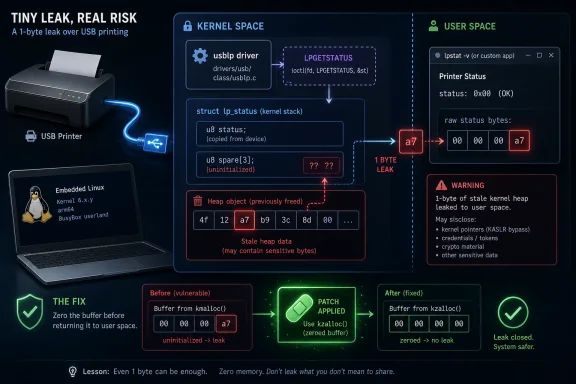
The flaw is not a spectacular buffer overflow, a remote code execution primitive, or a privilege escalation with exploit code doing the rounds. It is an information disclosure bug caused by uninitialized memory. The driver allocated an eight-byte status buffer at device probe time, but did not initialize it before the first status query could be made.
That matters because the driver asked the USB device for one byte of status. If a malicious or malformed printer responded with zero bytes, the driver could still read from the buffer, treat the stale byte as status, sign-extend it into an integer, and copy it back to the calling user-space process. In plain English: the kernel might hand a local process one byte of whatever happened to be sitting in that heap allocation.
One byte will not dump credentials, bypass Secure Boot, or give an attacker root by itself. But kernel information leaks are rarely judged only by their size. They are judged by whether they cross a boundary that should be absolute: kernel memory should not be revealed to user space merely because a peripheral misbehaved.
USB has always been a strange security boundary. Users treat it as a cable. Operating systems treat it as a bus full of devices making claims about identity, capability, and behavior. Security people treat it as an attack surface with a plug on the end.
For most desktop users, the practical risk is narrow. An attacker would generally need either physical access to connect a malicious USB printer-class device or control over a device already attached to the system. In enterprise and lab environments, however, the boundary is less theoretical. Kiosks, shared workstations, embedded Linux boxes, print servers, and industrial systems may all have attached USB peripherals that outlive the machines around them.
That does not make CVE-2026-46167 a panic button. It does make it a useful reminder that drivers for mundane devices remain part of the kernel attack surface. A printer driver can be security-sensitive even when no one has printed a page from the machine in years.
That small change is effective because the vulnerability depends on the buffer having stale contents before the first status read. If the buffer begins life as zeroes, then a zero-length response from a malicious printer no longer causes stale heap data to escape. A later short read may leave the previous device-supplied value in place, but that is not a kernel heap leak; it is just old device status being reused.
This is the kind of fix kernel maintainers like because it does not try to redesign an old interface. It preserves behavior for real printers, including badly behaved ones, while closing the kernel memory disclosure path. That distinction matters because the obvious fix — reject short responses — is not necessarily safe in the messy world of printer firmware.
The patch text makes that tradeoff explicit. Many printers are known to return “incorrect” responses, so strict validation could break working hardware. The kernel’s job, in this case, is not to make printers honest. It is to make their dishonesty harmless.
A modern security review might ask why a status read that receives zero bytes is treated as success at all. The answer is that the helper path collapses the lower-level USB transfer result into a simpler success-or-error value, losing the exact byte count. That behavior is not ideal, but changing it broadly could have consequences for devices that have only ever worked because Linux tolerated their quirks.
This is a recurring kernel theme. The cleanest abstraction is rarely the one that survives contact with hardware. Drivers often encode years of accommodation for devices that misreport lengths, violate specs, or work only because operating systems quietly forgive them.
CVE-2026-46167 shows the security cost of that forgiveness. When a subsystem decides that a short or odd response must not be fatal, it has to be meticulous about what data flows forward. If it cannot trust the device to fill a buffer, it must ensure the buffer starts in a safe state.
Since the Linux kernel became more systematic about assigning CVEs to resolved vulnerabilities, users and administrators have seen a larger stream of kernel CVE records. Some represent high-impact bugs with plausible exploitation paths. Others represent correctness fixes that close security-relevant edge cases but are unlikely to matter outside specialized conditions.
This bug belongs closer to the latter category. It is a real kernel information leak, but a constrained one. It discloses a byte, requires a particular driver path, and depends on interaction with a malicious or misbehaving USB printer-class device. That is far from nothing, but it is also far from the kind of vulnerability that should send every Linux laptop owner racing to unplug everything.
The right response is boring and professional: take the next kernel update from your distribution or vendor, especially if you operate systems that allow USB peripherals, shared access, or untrusted devices. Boring, in kernel security, is often another word for successful.
But Windows environments increasingly contain Linux in the places administrators do not always inventory first. Developer workstations run WSL, though WSL’s kernel and device exposure model differ from a conventional Linux desktop. Hyper-V hosts run Linux guests. NAS appliances, print servers, routers, lab machines, CI runners, containers hosts, and embedded management boxes often run Linux under the desk, in the rack, or behind a web UI.
The more mixed the environment, the less useful it is to think in operating-system tribes. A Windows shop may still rely on Linux-based print infrastructure. A Microsoft-first enterprise may still have Linux appliances with USB ports in conference rooms, warehouses, or manufacturing spaces. A vulnerability in a USB printer driver may not affect Windows endpoints, but it can affect the ecosystem those endpoints depend on.
That is the practical lesson for admins: patch by exposure, not by brand loyalty. If a Linux system has USB printer support enabled or could bind to a malicious USB printer-class device, it belongs in the assessment. If it is a headless cloud VM with no USB stack exposed, the risk is functionally different.
That means exploitation is likely to require either local user-space access, malicious hardware, or both. The exact feasibility depends on system configuration, device permissions, and whether the
Physical access attacks are not magic, but they are not irrelevant. Offices have shared desks. Schools have labs. Hospitals and factories have carts, terminals, and peripherals. Retail and industrial settings often contain machines that are physically accessible but operationally trusted.
The bug also belongs in the family of USB attack scenarios where a device’s identity is part of the exploit surface. A malicious USB gadget can present itself as many kinds of device. If it can get the kernel to bind the relevant driver and then deliver malformed responses, the distinction between “printer” and “attack tool” becomes mostly cosmetic.
This is defensive programming in its least glamorous form. It does not require a new mitigation framework, a compiler feature, or a subsystem rewrite. It simply recognizes that data crossing from kernel space to user space must have a known origin.
That is especially important around ioctl interfaces. Ioctls are flexible, old, and frequently driver-specific. They often exist at the boundary between user-space utilities and hardware-specific kernel code. When something goes wrong there, the failure mode is often not elegant.
The broader kernel has gained many hardening mechanisms over the years, but hardening does not eliminate the need for careful initialization. Memory-safe languages are increasingly discussed in kernel contexts, and compiler-aided initialization features can reduce classes of bugs. Yet C code remains the reality for much of the driver stack, and old C code will continue to have old C failure modes.
Rolling distributions and fast-moving development branches may receive such fixes quickly. Enterprise distributions may backport the one-line change into older supported kernels without changing the visible kernel version in a way casual users expect. Appliance vendors may lag longer, especially when the affected component is not central to their marketed function.
That creates the familiar kernel-patching ambiguity. A system can appear to run an “old” kernel and still include the fix because the vendor backported it. Another system can appear modern but remain vulnerable because it is pinned, customized, or vendor-frozen. Version strings are useful, but they are not a substitute for distribution security advisories and package changelogs.
For administrators, the operational path is straightforward. Track whether your vendor has shipped the relevant kernel update. Prioritize systems with exposed USB ports, printer roles, shared physical access, or untrusted peripheral workflows. Reboot when the updated kernel requires it, because kernel fixes that are installed but not booted are inventory theater.
But underplaying it too much would also miss the point. Kernel infoleaks are the kind of primitive that can become more useful when paired with other bugs. Even a small disclosure can sometimes help defeat address randomization or reveal state, depending on what is leaked and how often the primitive can be exercised. This particular bug appears constrained, but the category has a history.
The better framing is that this is a hygiene flaw with security consequences. It is not a fire alarm. It is a smoke detector chirping because someone found another place where old driver code assumed a buffer would contain something sensible.
That distinction matters in vulnerability communication. Not every CVE deserves emergency maintenance windows. Not every CVE can be ignored because its first description sounds obscure. The useful middle ground is to understand the preconditions, apply normal patch discipline, and avoid turning every kernel CVE into either a catastrophe or a shrug.
That makes it exactly the sort of code security teams should remember. Attack surface is not ranked by glamour. It is ranked by what input it accepts, what privilege it runs with, and what assumptions it makes when the input is wrong.
CVE-2026-46167 also illustrates why maintainers often choose minimal, surgical patches for stable trees. The goal is not to make the driver architecturally perfect. The goal is to remove the leak without breaking printers that people still use. In stable kernel maintenance, the least disruptive correct fix is usually the best fix.
There is an engineering humility in that. The kernel cannot make every legacy device sane. It can, however, make sure legacy weirdness does not expose kernel memory to user space.
 A One-Byte Leak Is Still a Kernel Boundary Failure
The vulnerable component is usblp, the Linux USB printer class driver. It exists to support USB printers through a traditional character-device interface, exposing operations such as status queries to user space. In this case, the relevant operation is LPGETSTATUS, an ioctl used to ask the printer for its status.The flaw is not a spectacular buffer overflow, a remote code execution primitive, or a privilege escalation with exploit code doing the rounds. It is an information disclosure bug caused by uninitialized memory. The driver allocated an eight-byte status buffer at device probe time, but did not initialize it before the first status query could be made.
That matters because the driver asked the USB device for one byte of status. If a malicious or malformed printer responded with zero bytes, the driver could still read from the buffer, treat the stale byte as status, sign-extend it into an integer, and copy it back to the calling user-space process. In plain English: the kernel might hand a local process one byte of whatever happened to be sitting in that heap allocation.
One byte will not dump credentials, bypass Secure Boot, or give an attacker root by itself. But kernel information leaks are rarely judged only by their size. They are judged by whether they cross a boundary that should be absolute: kernel memory should not be revealed to user space merely because a peripheral misbehaved.
The Printer Is the Attacker in This Story
The interesting wrinkle in CVE-2026-46167 is that the hostile actor is not necessarily the local user-space process alone. The triggering condition involves a USB printer, or something pretending to be one, that gives an unexpectedly short response. That makes this a bug about device trust as much as memory hygiene.USB has always been a strange security boundary. Users treat it as a cable. Operating systems treat it as a bus full of devices making claims about identity, capability, and behavior. Security people treat it as an attack surface with a plug on the end.
For most desktop users, the practical risk is narrow. An attacker would generally need either physical access to connect a malicious USB printer-class device or control over a device already attached to the system. In enterprise and lab environments, however, the boundary is less theoretical. Kiosks, shared workstations, embedded Linux boxes, print servers, and industrial systems may all have attached USB peripherals that outlive the machines around them.
That does not make CVE-2026-46167 a panic button. It does make it a useful reminder that drivers for mundane devices remain part of the kernel attack surface. A printer driver can be security-sensitive even when no one has printed a page from the machine in years.
The Fix Says More Than the Bug Report
The patch replaces an uninitialized heap allocation with a zeroed allocation. In kernel terms, that means usingkzalloc() rather than kmalloc() for the status buffer. The difference is simple: allocate memory and leave its old contents alone, or allocate memory and clear it before use.That small change is effective because the vulnerability depends on the buffer having stale contents before the first status read. If the buffer begins life as zeroes, then a zero-length response from a malicious printer no longer causes stale heap data to escape. A later short read may leave the previous device-supplied value in place, but that is not a kernel heap leak; it is just old device status being reused.
This is the kind of fix kernel maintainers like because it does not try to redesign an old interface. It preserves behavior for real printers, including badly behaved ones, while closing the kernel memory disclosure path. That distinction matters because the obvious fix — reject short responses — is not necessarily safe in the messy world of printer firmware.
The patch text makes that tradeoff explicit. Many printers are known to return “incorrect” responses, so strict validation could break working hardware. The kernel’s job, in this case, is not to make printers honest. It is to make their dishonesty harmless.
Compatibility Is the Ghost in the USB Stack
Printer support is full of old assumptions because printers are full of old assumptions. The USB printer class driver is not fashionable code, but it is compatibility code, and compatibility code accumulates exceptions. Those exceptions are where security engineering gets uncomfortable.A modern security review might ask why a status read that receives zero bytes is treated as success at all. The answer is that the helper path collapses the lower-level USB transfer result into a simpler success-or-error value, losing the exact byte count. That behavior is not ideal, but changing it broadly could have consequences for devices that have only ever worked because Linux tolerated their quirks.
This is a recurring kernel theme. The cleanest abstraction is rarely the one that survives contact with hardware. Drivers often encode years of accommodation for devices that misreport lengths, violate specs, or work only because operating systems quietly forgive them.
CVE-2026-46167 shows the security cost of that forgiveness. When a subsystem decides that a short or odd response must not be fatal, it has to be meticulous about what data flows forward. If it cannot trust the device to fill a buffer, it must ensure the buffer starts in a safe state.
Kernel CVEs Have Become More Numerous, Not Always More Terrifying
The NVD entry for CVE-2026-46167 was still awaiting enrichment at publication, with no NVD CVSS score assigned. That absence should not be overread. It does not mean the issue is severe, and it does not mean the issue is harmless. It means the vulnerability record has not yet been fully scored by NVD.Since the Linux kernel became more systematic about assigning CVEs to resolved vulnerabilities, users and administrators have seen a larger stream of kernel CVE records. Some represent high-impact bugs with plausible exploitation paths. Others represent correctness fixes that close security-relevant edge cases but are unlikely to matter outside specialized conditions.
This bug belongs closer to the latter category. It is a real kernel information leak, but a constrained one. It discloses a byte, requires a particular driver path, and depends on interaction with a malicious or misbehaving USB printer-class device. That is far from nothing, but it is also far from the kind of vulnerability that should send every Linux laptop owner racing to unplug everything.
The right response is boring and professional: take the next kernel update from your distribution or vendor, especially if you operate systems that allow USB peripherals, shared access, or untrusted devices. Boring, in kernel security, is often another word for successful.
Windows Users Should Still Care About This Linux Bug
WindowsForum.com readers may reasonably ask why a Linux USB printer-driver CVE belongs in their threat model. The answer is not that Windows is affected by this specific kernel bug. It is not. The affected code is in the Linux kernel’susblp driver.But Windows environments increasingly contain Linux in the places administrators do not always inventory first. Developer workstations run WSL, though WSL’s kernel and device exposure model differ from a conventional Linux desktop. Hyper-V hosts run Linux guests. NAS appliances, print servers, routers, lab machines, CI runners, containers hosts, and embedded management boxes often run Linux under the desk, in the rack, or behind a web UI.
The more mixed the environment, the less useful it is to think in operating-system tribes. A Windows shop may still rely on Linux-based print infrastructure. A Microsoft-first enterprise may still have Linux appliances with USB ports in conference rooms, warehouses, or manufacturing spaces. A vulnerability in a USB printer driver may not affect Windows endpoints, but it can affect the ecosystem those endpoints depend on.
That is the practical lesson for admins: patch by exposure, not by brand loyalty. If a Linux system has USB printer support enabled or could bind to a malicious USB printer-class device, it belongs in the assessment. If it is a headless cloud VM with no USB stack exposed, the risk is functionally different.
The Attack Surface Is Physical, Local, and Annoyingly Real
Security teams often sort vulnerabilities into remote and local categories, then mentally discount the local ones. CVE-2026-46167 shows why that shortcut can be too crude. A local ioctl call is involved, but the device response is also part of the trigger.That means exploitation is likely to require either local user-space access, malicious hardware, or both. The exact feasibility depends on system configuration, device permissions, and whether the
usblp driver is loaded and bound to a device. On many desktops, access to printer devices may be mediated by groups, udev rules, CUPS behavior, or distribution defaults.Physical access attacks are not magic, but they are not irrelevant. Offices have shared desks. Schools have labs. Hospitals and factories have carts, terminals, and peripherals. Retail and industrial settings often contain machines that are physically accessible but operationally trusted.
The bug also belongs in the family of USB attack scenarios where a device’s identity is part of the exploit surface. A malicious USB gadget can present itself as many kinds of device. If it can get the kernel to bind the relevant driver and then deliver malformed responses, the distinction between “printer” and “attack tool” becomes mostly cosmetic.
The One-Line Patch Is a Win for Defensive Defaults
There is a satisfying bluntness to the fix. Zero the buffer at allocation. Do not depend on every possible response path to populate it correctly. Do not depend on every device to behave. Do not let stale heap memory become user-visible state.This is defensive programming in its least glamorous form. It does not require a new mitigation framework, a compiler feature, or a subsystem rewrite. It simply recognizes that data crossing from kernel space to user space must have a known origin.
That is especially important around ioctl interfaces. Ioctls are flexible, old, and frequently driver-specific. They often exist at the boundary between user-space utilities and hardware-specific kernel code. When something goes wrong there, the failure mode is often not elegant.
The broader kernel has gained many hardening mechanisms over the years, but hardening does not eliminate the need for careful initialization. Memory-safe languages are increasingly discussed in kernel contexts, and compiler-aided initialization features can reduce classes of bugs. Yet C code remains the reality for much of the driver stack, and old C code will continue to have old C failure modes.
Distributions Will Decide the Real Patch Timeline
The upstream patch exists, and stable references are already part of the CVE record. For most users, however, the meaningful question is not whether upstream has a fix. It is when their distribution’s kernel package includes it.Rolling distributions and fast-moving development branches may receive such fixes quickly. Enterprise distributions may backport the one-line change into older supported kernels without changing the visible kernel version in a way casual users expect. Appliance vendors may lag longer, especially when the affected component is not central to their marketed function.
That creates the familiar kernel-patching ambiguity. A system can appear to run an “old” kernel and still include the fix because the vendor backported it. Another system can appear modern but remain vulnerable because it is pinned, customized, or vendor-frozen. Version strings are useful, but they are not a substitute for distribution security advisories and package changelogs.
For administrators, the operational path is straightforward. Track whether your vendor has shipped the relevant kernel update. Prioritize systems with exposed USB ports, printer roles, shared physical access, or untrusted peripheral workflows. Reboot when the updated kernel requires it, because kernel fixes that are installed but not booted are inventory theater.
This Is Not the Next Big Linux Panic
CVE-2026-46167 should not be inflated into a dramatic breach narrative. There is no public indication from the provided record that it is being exploited in the wild. NVD has not assigned a severity score yet. The leak is small, the path is specific, and the fix is clear.But underplaying it too much would also miss the point. Kernel infoleaks are the kind of primitive that can become more useful when paired with other bugs. Even a small disclosure can sometimes help defeat address randomization or reveal state, depending on what is leaked and how often the primitive can be exercised. This particular bug appears constrained, but the category has a history.
The better framing is that this is a hygiene flaw with security consequences. It is not a fire alarm. It is a smoke detector chirping because someone found another place where old driver code assumed a buffer would contain something sensible.
That distinction matters in vulnerability communication. Not every CVE deserves emergency maintenance windows. Not every CVE can be ignored because its first description sounds obscure. The useful middle ground is to understand the preconditions, apply normal patch discipline, and avoid turning every kernel CVE into either a catastrophe or a shrug.
The Kernel’s Old Corners Keep Teaching the Same Lesson
Theusblp driver is not the glamorous part of Linux. It is not the scheduler, the network stack, eBPF, KVM, or a shiny filesystem. It is a bridge to printers, many of them old, strange, or barely standards-compliant.That makes it exactly the sort of code security teams should remember. Attack surface is not ranked by glamour. It is ranked by what input it accepts, what privilege it runs with, and what assumptions it makes when the input is wrong.
CVE-2026-46167 also illustrates why maintainers often choose minimal, surgical patches for stable trees. The goal is not to make the driver architecturally perfect. The goal is to remove the leak without breaking printers that people still use. In stable kernel maintenance, the least disruptive correct fix is usually the best fix.
There is an engineering humility in that. The kernel cannot make every legacy device sane. It can, however, make sure legacy weirdness does not expose kernel memory to user space.
The Small USB Printer Bug Leaves a Very Practical Checklist
The concrete advice here is not exotic. Treat this as a kernel update item, not a board-level crisis. The systems most worth checking are the ones where USB peripherals and Linux meet in the real world.- CVE-2026-46167 affects the Linux kernel’s USB printer driver path, not Windows itself.
- The vulnerability can disclose one byte of stale kernel heap memory through the LPGETSTATUS ioctl when a printer-class device returns a zero-length status response.
- The upstream fix changes the status buffer allocation from an uninitialized allocation to a zeroed allocation.
- The most relevant systems are Linux machines with USB printer support, exposed USB ports, shared physical access, or roles as print servers and appliances.
- Administrators should rely on distribution or vendor kernel updates rather than guessing solely from upstream version numbers.
- The issue is best treated as a low-drama but real information-disclosure bug that belongs in normal patch cycles.
References
- Primary source: NVD / Linux Kernel
Published: 2026-05-29T01:07:59-07:00
NVD - CVE-2026-46167
 nvd.nist.gov
- Security advisory: MSRC
Published: 2026-05-29T01:07:59-07:00
Original feed URL
Security Update Guide - Microsoft Security Response Center
 msrc.microsoft.com
- Related coverage: spinics.net

[PATCH 2/2] usb: usblp: fix uninitialized heap leak via LPGETSTATUS ioctl — Linux Kernel
Linux Kernel: [PATCH 2/2] usb: usblp: fix uninitialized heap leak via LPGETSTATUS ioctl
www.spinics.net
- Related coverage: git.bybrooklyn.dev

Brook's Gitea instance
Gitea (Git with a cup of tea) is a painless self-hosted Git service written in Go
git.bybrooklyn.dev
- Related coverage: lists.debian.org
- Related coverage: cve.imfht.com
CVE-2026-43429: USB: usbtmc: Use usb_bulk_msg_killable() with user-specified timeouts - Vulnerability Platform
[中危] Overview A security vulnerability exists in the driver within the Linux kernel. This driver allows users to specify an arbitrarily long timeout value cve.imfht.com
- Related coverage: cve.org
- Related coverage: mail-archive.com
[linux-usb-devel] usblp: Implement the ENOSPC convention
www.mail-archive.com
- Related coverage: android.googlesource.com
- Related coverage: adamdoupe.com
