

CVE-2026-52910 is a newly published Linux kernel vulnerability, received by NVD on June 19, 2026 and modified on June 28, involving unsafe freeing of classic BPF reuseport programs after replacement through socket options. The bug is not a remote “packet from the Internet owns your box” story, but it is exactly the sort of kernel lifetime flaw that keeps defenders awake: local, timing-sensitive, buried in a fast networking path, and scored high because memory corruption in the kernel rarely stays theoretical forever. For WindowsForum readers, the immediate lesson is not that Windows is affected; it is that Linux kernels sitting under WSL, containers, appliances, routers, security tools, and cloud workloads still need the same disciplined patch attention as anything with a Microsoft logo.
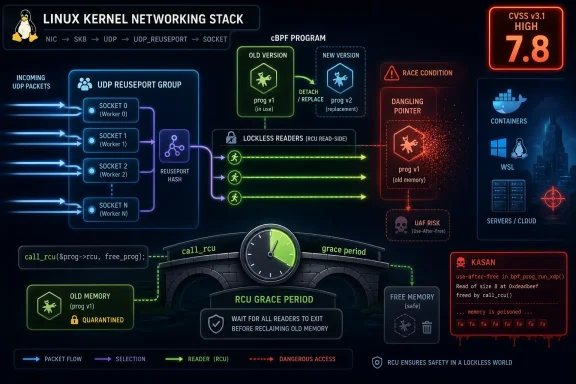
The vulnerability sits in the Linux kernel’s BPF and socket reuseport handling, a part of the networking stack designed for performance and programmability rather than user-facing drama. The triggering scenario described in the disclosure is precise: one thread sends UDP traffic to a reuseport group while another replaces a classic BPF program attached to that group. Under the wrong timing, the old program can be freed before all readers have finished using it.
That is a classic kernel security pattern. The code assumes that because a pointer has been detached from the current owner, the object behind it can be destroyed. But the networking fast path is still racing through a read-side section, and that reader may still dereference memory that has already been released.
The reported failure showed up as a KASAN vmalloc out-of-bounds read in
The assigned CVSS 3.1 vector from kernel.org is high at 7.8, with local attack vector, low complexity, low privileges, no user interaction, and high impact across confidentiality, integrity, and availability. That combination tells the practical story: an attacker already needs some local foothold, but once there, the bug is in a privileged kernel subsystem where the blast radius can be severe.
RCU, or read-copy-update, is one of the kernel’s core concurrency techniques. Its central bargain is simple: readers can run very fast without heavy locking, but writers must wait for a grace period before freeing data that old readers might still see. Break that bargain and the kernel gets speed at the price of a dangling pointer.
The patch logic reflects that. Instead of freeing the classic BPF program immediately with
That distinction matters because it explains why the fix is small but meaningful. The patch does not redesign socket reuseport, disable BPF, or add a giant lock to the UDP path. It restores the intended contract: readers may continue briefly on the old view of the world, so the old object must remain alive long enough for them to finish.
The disclosure notes a difference in cleanup behavior between eBPF and cBPF programs. eBPF programs go through
Reuseport itself is not exotic. Applications use
That makes the affected path both specialized and real. Most desktop users are not hand-attaching classic BPF programs to UDP reuseport groups in their daily lives. But servers, packet-processing systems, high-performance network daemons, test frameworks, and containerized services may exercise paths that ordinary desktop mental models never include.
Local attack surface is still serious. Modern systems often run many semi-trusted workloads side by side: containers, user accounts, CI jobs, browser sandboxes, plugin hosts, and development environments. A vulnerability that starts with “local low-privileged user” may be irrelevant on a locked-down single-user appliance and highly relevant on a shared build host or container platform.
The wording in the disclosure also matters. It describes “various bugs” from freeing without waiting for RCU readers, and the observed report is an out-of-bounds read. Security history teaches that memory lifetime bugs can move along a spectrum: crash-only in one build, information disclosure in another, code execution after heap shaping in a third. The kernel.org score’s high confidentiality, integrity, and availability impacts are an assessment of potential consequences, not a promise that every affected kernel is trivially exploitable.
Administrators should resist both extremes. This is not a reason to panic-reboot every Linux machine in the next five minutes without change control. It is also not a bug to ignore because the reproducer looks like a kernel developer’s lab script. Race bugs in hot paths tend to age badly once attackers and researchers have time to study allocator behavior across kernel versions.
The affected product entry traces the feature history back to Linux 4.5, where reuseport BPF attachment support entered the kernel. The record also marks several stable releases as unaffected once patched, including lines in the 5.10, 5.15, 6.1, and 6.6 families. The exact answer for any given system depends on the distribution’s kernel packaging, backport policy, and livepatch coverage.
This is where Linux vulnerability management diverges from the neat version-number story people wish existed. A Red Hat, Ubuntu, Debian, SUSE, Android, or appliance kernel may carry hundreds or thousands of patches that do not map cleanly to upstream version strings. A kernel calling itself 5.15 can be vulnerable or fixed depending on the vendor’s backport state.
The right operational move is therefore boring and precise: track your vendor advisory, install the kernel update when it is released, and confirm the running kernel after reboot. Merely seeing a high upstream version number is not enough, and merely seeing an old-looking enterprise kernel version is not proof of vulnerability.
WSL deserves a special mention, not because CVE-2026-52910 is known to be a Windows host escape, but because WSL has made Linux kernel maintenance part of Windows workstation hygiene. Developers may run Ubuntu or Debian userlands under a Microsoft-provided Linux kernel and then forget that kernel security is a separate layer from Windows Update’s ordinary monthly rhythm. In managed environments, inventory tools often see the Windows build but not the Linux kernel activity inside developer workflows.
Container hosts are the more obvious concern. Containers share the host kernel, so kernel memory safety bugs cut across the boundary that application teams often assume is solid. If a low-privileged process inside a container can reach the vulnerable path and shape the race, the host kernel is the thing being stressed, not a private guest kernel inside the container.
That does not mean every container platform is equally exposed. Capability restrictions, seccomp profiles, network namespace configuration, BPF restrictions, and socket options policies all affect reachability. But the larger principle remains: a Linux kernel CVE is infrastructure risk, not just a distribution maintainer’s paperwork.
CVE-2026-52910 lands in a particularly nuanced corner because the affected behavior is tied to classic BPF and reuseport program cleanup, not a dramatic new eBPF verifier bypass. The issue is not that user-supplied bytecode runs unchecked through the kernel. It is that a program object’s lifetime did not match the concurrency model around readers.
Still, BPF’s success has increased scrutiny of the surrounding plumbing. Once BPF hooks are part of load balancing, packet steering, tracing, and policy enforcement, memory-management mistakes in those hooks become platform security issues. The more critical the mechanism becomes, the less tolerance there is for “it probably won’t race in practice.”
Microsoft shops have already learned this lesson from their own ecosystem. Powerful extensibility points become security-critical whether they are drivers, filter managers, endpoint agents, browser extensions, kernel callbacks, or packet filters. BPF is Linux’s version of that same bargain: programmability buys capability, and capability demands ruthless lifecycle correctness.
That is the kind of patch that looks almost anticlimactic in a diff. A helper function recovers the program from its auxiliary RCU head, releases the original filter, and frees the program. The immediate free path is replaced with
The elegance of the fix should not obscure the seriousness of the bug. Kernel security is full of tiny patches that repair large assumptions. Adding one grace period can be the difference between a stale pointer dying harmlessly and a stale pointer reading attacker-influenced memory.
This is also why “just add a lock” is rarely the satisfying answer in fast networking code. The UDP receive path, reuseport selection, and BPF hooks exist in performance-sensitive territory. RCU is used precisely because readers need to be cheap. The fix preserves that design while making the writer side pay the necessary lifetime cost.
Security teams should not expect easy log signatures. A successful attempt against a kernel race may leave little more than a crash, a watchdog event, odd kernel warnings, or nothing obvious at all. KASAN made the bug loud in a testing kernel; production kernels typically do not run with that instrumentation because of overhead.
For incident response, the more realistic value is in exposure mapping. Hosts that allow untrusted local code and run network-heavy services deserve attention first. Multi-tenant systems, CI runners, container hosts, shared research machines, and bastion-adjacent utility servers are more interesting than a single-purpose kiosk with no local shell access.
There is also a policy angle. If your environment allows broad use of BPF-related socket features by unprivileged users, this CVE is another reason to review those defaults. Distribution hardening, kernel config, capabilities, seccomp, and container runtime profiles all matter when a vulnerability requires specific local API reachability.
This can frustrate administrators who want advisories to precede patches in a neat sequence. In kernel land, the patch is often the first public artifact that explains the bug in enough detail to matter. The CVE record then becomes a coordination and tracking layer layered on top of the development process.
The result is a vulnerability-management challenge. If your scanners are CVE-driven, they may lag behind the mailing list and stable tree. If your operations are patch-driven, you may apply the fix before the CVE becomes visible in dashboards. Neither model is wrong, but relying on only one gives a distorted picture of risk.
For WindowsForum’s audience, the analogy is familiar from Patch Tuesday in reverse. Microsoft centralizes advisories and patches into a predictable event. Linux kernel security often looks more like a moving river: commits, backports, distro advisories, CVE enrichment, and scanner detection arrive in overlapping waves.
The local vector narrows the attacker’s starting point, but modern infrastructure is full of “local enough” footholds. A compromised web application may execute code as a low-privileged user. A malicious dependency may run during a build. A container escape chain may start with a kernel bug reachable from inside the container. A student or contractor account may have shell access to a shared Linux host.
The vulnerability’s UDP reuseport angle also means defenders should think beyond traditional login shells. High-performance services, packet brokers, DNS infrastructure, telemetry collectors, load balancers, and custom daemons may use reuseport patterns. The classic BPF piece narrows that further, but legacy interfaces have a habit of surviving in unexpected places.
There is no evidence in the supplied record of active exploitation in the wild. That absence is useful but not comforting enough to delay routine patching. Kernel memory-corruption bugs often move from obscure to weaponized when a clear reproducer gives researchers a starting point and stable releases identify the exact fixed code.
For container hosts, review whether containers truly need the capabilities they have. Default seccomp profiles often block some risky system calls, but real-world deployments frequently loosen profiles for convenience, observability agents, or networking workloads. Any exception granted for performance or debugging becomes part of the kernel attack surface.
For developer workstations, the risk calculus is different. Developers often run arbitrary code from package managers, build scripts, test harnesses, and containers. A local kernel CVE may matter more on a developer laptop than on a polished production server precisely because the laptop executes messier code from more sources.
For appliances and embedded Linux devices, the challenge is vendor cadence. Many such devices expose no general shell, but they may still process untrusted traffic and run old kernels. If the vendor ships a fixed firmware image, take it seriously; if the vendor does not publish kernel CVE status, administrators are left balancing replacement, segmentation, and compensating controls.
The NVD affected records include Git commit ranges and semver-style stable release markers, which are useful for automated systems but awkward for humans. If you build your own kernels, you can compare commits directly. If you consume vendor kernels, the vendor advisory is usually the authoritative source.
Administrators should verify both the installed package and the running kernel. Linux systems often install a patched kernel but continue running the old one until reboot. In fleets with long uptimes, that gap between “patched on disk” and “patched in memory” is not a bookkeeping detail; it is the difference between fixed and vulnerable.
The same caveat applies to livepatching. Livepatch can reduce reboot pressure for many kernel vulnerabilities, but coverage is specific. Do not assume a livepatch service has covered CVE-2026-52910 unless the provider says so. The patch touches a networking/BPF cleanup path, and livepatch feasibility depends on provider implementation, kernel build, and risk tradeoffs.
The blind spots are predictable. Security scanners may catch cloud VMs but miss WSL. Endpoint tools may inventory Windows builds but not the Linux kernel under developer tooling. Appliance dashboards may report firmware versions without mapping them to upstream kernel CVEs. Kubernetes teams may patch container images while forgetting that this class of bug lives below the container image layer.
The operational priority should follow exposure. Shared Linux systems and container hosts come first. Internet-facing services with a local post-compromise path come next. Developer workstations deserve attention because software supply-chain attacks often begin by executing code in build environments. Low-interactivity appliances are not immune, but their urgency depends on vendor status and access model.
That prioritization is not complacency. It is the difference between treating every CVE as an equal emergency and understanding how this specific bug would have to be reached. CVE-2026-52910 is high severity because kernel memory corruption can be catastrophic, but its local and specialized trigger gives defenders room to patch methodically rather than theatrically.
That message scales beyond this one CVE. Modern operating systems are built from layers of performance optimizations whose safety depends on careful sequencing. Socket load balancing, programmable packet selection, zero-copy paths, lockless reads, deferred frees, and per-CPU data structures are all attempts to make machines faster without making them fragile. Security bugs emerge when those attempts lose track of time.
For the security industry, this is why memory safety remains such a stubborn problem in kernels. Even when individual components are well understood, the transitions between them are treacherous. A program object moves from attached to detached. A reader moves from old state to new state. A grace period starts and ends. One missing wait turns that choreography into a crash report.
For administrators, the lesson is simpler: patch the kernel, reboot when required, and do not let scanner ambiguity become an excuse for delay. The vulnerability is narrow enough to prioritize intelligently, but serious enough that “local only” should not lull anyone into ignoring it.
 A Small Race in the Kernel Becomes a Big Security Conversation
The vulnerability sits in the Linux kernel’s BPF and socket reuseport handling, a part of the networking stack designed for performance and programmability rather than user-facing drama. The triggering scenario described in the disclosure is precise: one thread sends UDP traffic to a reuseport group while another replaces a classic BPF program attached to that group. Under the wrong timing, the old program can be freed before all readers have finished using it.That is a classic kernel security pattern. The code assumes that because a pointer has been detached from the current owner, the object behind it can be destroyed. But the networking fast path is still racing through a read-side section, and that reader may still dereference memory that has already been released.
The reported failure showed up as a KASAN vmalloc out-of-bounds read in
reuseport_select_sock, during UDP receive processing. KASAN reports are not exploit write-ups; they are the kernel’s tripwire shouting that a memory safety assumption has broken. Still, when the broken assumption lives in code reachable from socket operations and packet processing, security teams have to treat it as more than a tidy cleanup bug.The assigned CVSS 3.1 vector from kernel.org is high at 7.8, with local attack vector, low complexity, low privileges, no user interaction, and high impact across confidentiality, integrity, and availability. That combination tells the practical story: an attacker already needs some local foothold, but once there, the bug is in a privileged kernel subsystem where the blast radius can be severe.
The Bug Is Really About Time, Not BPF Mysticism
BPF has become a magnet for security headlines, but CVE-2026-52910 is less about the spooky power of BPF and more about object lifetime discipline. The failure is that a classic BPF reuseport program can be freed immediately after detachment even though code protected by RCU may still be reading it.RCU, or read-copy-update, is one of the kernel’s core concurrency techniques. Its central bargain is simple: readers can run very fast without heavy locking, but writers must wait for a grace period before freeing data that old readers might still see. Break that bargain and the kernel gets speed at the price of a dangling pointer.
The patch logic reflects that. Instead of freeing the classic BPF program immediately with
bpf_release_orig_filter() and bpf_prog_free(), the fix defers that destruction through an RCU callback. The data structure is detached, but the memory is not reclaimed until the kernel can be confident pre-existing readers are out of the danger zone.That distinction matters because it explains why the fix is small but meaningful. The patch does not redesign socket reuseport, disable BPF, or add a giant lock to the UDP path. It restores the intended contract: readers may continue briefly on the old view of the world, so the old object must remain alive long enough for them to finish.
Classic BPF Is the Awkward Legacy Still in the Hot Path
Modern eBPF receives most of the attention, partly because it is powerful, heavily developed, and now central to observability, networking, and security tooling. But CVE-2026-52910 concerns cBPF, the older “classic” BPF model, in a reuseport path that still matters to real networking code. That is what makes the issue interesting: the risky object is not some fashionable new extension but a legacy mechanism still wired into performance-sensitive socket behavior.The disclosure notes a difference in cleanup behavior between eBPF and cBPF programs. eBPF programs go through
bpf_prog_put() and deferred destruction stages, while the classic BPF path was freed more directly. In ordinary code review, that sort of asymmetry is easy to miss because both branches are “freeing a BPF program.” In concurrent kernel code, the exact shape of the free path is the difference between safe teardown and use-after-free territory.Reuseport itself is not exotic. Applications use
SO_REUSEPORT to spread incoming traffic across multiple sockets, often to scale UDP or TCP services across worker threads or processes. BPF can be attached to influence which socket receives a packet, giving applications smarter load distribution than a simple hash.That makes the affected path both specialized and real. Most desktop users are not hand-attaching classic BPF programs to UDP reuseport groups in their daily lives. But servers, packet-processing systems, high-performance network daemons, test frameworks, and containerized services may exercise paths that ordinary desktop mental models never include.
The Exploitability Question Is Narrower Than the Severity Score
The high CVSS score should not be read as proof that a copy-and-paste privilege escalation exploit exists. The described reproducer is a race: set up a UDP reuseport group with a classic BPF program, replace it with a new one, and send packets concurrently. That is controlled, local activity, not drive-by exploitation from a hostile network packet alone.Local attack surface is still serious. Modern systems often run many semi-trusted workloads side by side: containers, user accounts, CI jobs, browser sandboxes, plugin hosts, and development environments. A vulnerability that starts with “local low-privileged user” may be irrelevant on a locked-down single-user appliance and highly relevant on a shared build host or container platform.
The wording in the disclosure also matters. It describes “various bugs” from freeing without waiting for RCU readers, and the observed report is an out-of-bounds read. Security history teaches that memory lifetime bugs can move along a spectrum: crash-only in one build, information disclosure in another, code execution after heap shaping in a third. The kernel.org score’s high confidentiality, integrity, and availability impacts are an assessment of potential consequences, not a promise that every affected kernel is trivially exploitable.
Administrators should resist both extremes. This is not a reason to panic-reboot every Linux machine in the next five minutes without change control. It is also not a bug to ignore because the reproducer looks like a kernel developer’s lab script. Race bugs in hot paths tend to age badly once attackers and researchers have time to study allocator behavior across kernel versions.
Stable Kernels Turn One Patch Into a Fleet Problem
The NVD record lists multiple stable-tree commit references and affected version ranges, which is typical for Linux kernel CVEs. A fix lands in mainline or a development branch, then gets backported across supported stable series. For defenders, that means the meaningful question is not “is Linux affected?” but “which kernel build am I actually running, and has my vendor shipped the backport?”The affected product entry traces the feature history back to Linux 4.5, where reuseport BPF attachment support entered the kernel. The record also marks several stable releases as unaffected once patched, including lines in the 5.10, 5.15, 6.1, and 6.6 families. The exact answer for any given system depends on the distribution’s kernel packaging, backport policy, and livepatch coverage.
This is where Linux vulnerability management diverges from the neat version-number story people wish existed. A Red Hat, Ubuntu, Debian, SUSE, Android, or appliance kernel may carry hundreds or thousands of patches that do not map cleanly to upstream version strings. A kernel calling itself 5.15 can be vulnerable or fixed depending on the vendor’s backport state.
The right operational move is therefore boring and precise: track your vendor advisory, install the kernel update when it is released, and confirm the running kernel after reboot. Merely seeing a high upstream version number is not enough, and merely seeing an old-looking enterprise kernel version is not proof of vulnerability.
Windows Shops Still Have Linux Exposure Hiding in Plain Sight
Windows-centric administrators sometimes treat Linux kernel CVEs as somebody else’s weather. That posture is harder to defend in 2026. Even organizations that standardize on Windows clients and Active Directory often run Linux somewhere important: Kubernetes nodes, reverse proxies, developer workstations, WSL instances, network appliances, security sensors, backup servers, NAS devices, and cloud images.WSL deserves a special mention, not because CVE-2026-52910 is known to be a Windows host escape, but because WSL has made Linux kernel maintenance part of Windows workstation hygiene. Developers may run Ubuntu or Debian userlands under a Microsoft-provided Linux kernel and then forget that kernel security is a separate layer from Windows Update’s ordinary monthly rhythm. In managed environments, inventory tools often see the Windows build but not the Linux kernel activity inside developer workflows.
Container hosts are the more obvious concern. Containers share the host kernel, so kernel memory safety bugs cut across the boundary that application teams often assume is solid. If a low-privileged process inside a container can reach the vulnerable path and shape the race, the host kernel is the thing being stressed, not a private guest kernel inside the container.
That does not mean every container platform is equally exposed. Capability restrictions, seccomp profiles, network namespace configuration, BPF restrictions, and socket options policies all affect reachability. But the larger principle remains: a Linux kernel CVE is infrastructure risk, not just a distribution maintainer’s paperwork.
BPF’s Security Story Is Still a Trade, Not a Verdict
It is tempting to turn every BPF-related CVE into a referendum on BPF itself. That is too easy. BPF has enabled major improvements in observability, traffic control, security monitoring, and application performance. It has also expanded the amount of programmable logic operating near extremely privileged kernel paths.CVE-2026-52910 lands in a particularly nuanced corner because the affected behavior is tied to classic BPF and reuseport program cleanup, not a dramatic new eBPF verifier bypass. The issue is not that user-supplied bytecode runs unchecked through the kernel. It is that a program object’s lifetime did not match the concurrency model around readers.
Still, BPF’s success has increased scrutiny of the surrounding plumbing. Once BPF hooks are part of load balancing, packet steering, tracing, and policy enforcement, memory-management mistakes in those hooks become platform security issues. The more critical the mechanism becomes, the less tolerance there is for “it probably won’t race in practice.”
Microsoft shops have already learned this lesson from their own ecosystem. Powerful extensibility points become security-critical whether they are drivers, filter managers, endpoint agents, browser extensions, kernel callbacks, or packet filters. BPF is Linux’s version of that same bargain: programmability buys capability, and capability demands ruthless lifecycle correctness.
The Patch Is Small Because the Kernel Already Had the Right Idea
One reason this bug is instructive is that the fix follows an established kernel pattern rather than inventing a new defense. The patched code adds an RCU callback for freeing classic BPF reuseport programs. In plain English, it says: if this object may still be visible to RCU readers, schedule final destruction after the grace period.That is the kind of patch that looks almost anticlimactic in a diff. A helper function recovers the program from its auxiliary RCU head, releases the original filter, and frees the program. The immediate free path is replaced with
call_rcu() when the program was classic BPF; otherwise the eBPF path continues through bpf_prog_put().The elegance of the fix should not obscure the seriousness of the bug. Kernel security is full of tiny patches that repair large assumptions. Adding one grace period can be the difference between a stale pointer dying harmlessly and a stale pointer reading attacker-influenced memory.
This is also why “just add a lock” is rarely the satisfying answer in fast networking code. The UDP receive path, reuseport selection, and BPF hooks exist in performance-sensitive territory. RCU is used precisely because readers need to be cheap. The fix preserves that design while making the writer side pay the necessary lifetime cost.
The Reproducer Tells Defenders Where to Look
The disclosed reproducer pattern is useful because it translates the vulnerability from abstract kernel language into observable behavior. It involves UDP, a reuseport group, a classic BPF program, program replacement through socket options, and concurrent packet sending. That combination is not every workload, but it is concrete enough for kernel teams and vendors to test.Security teams should not expect easy log signatures. A successful attempt against a kernel race may leave little more than a crash, a watchdog event, odd kernel warnings, or nothing obvious at all. KASAN made the bug loud in a testing kernel; production kernels typically do not run with that instrumentation because of overhead.
For incident response, the more realistic value is in exposure mapping. Hosts that allow untrusted local code and run network-heavy services deserve attention first. Multi-tenant systems, CI runners, container hosts, shared research machines, and bastion-adjacent utility servers are more interesting than a single-purpose kiosk with no local shell access.
There is also a policy angle. If your environment allows broad use of BPF-related socket features by unprivileged users, this CVE is another reason to review those defaults. Distribution hardening, kernel config, capabilities, seccomp, and container runtime profiles all matter when a vulnerability requires specific local API reachability.
The CVE Timing Shows the New Kernel Disclosure Normal
The chronology is brisk. The patch discussion appeared on the networking lists in late April 2026, the CVE was received by NVD on June 19, and the NVD entry was modified on June 28 with the kernel.org CVSS vector. That rhythm reflects the modern kernel CVE pipeline: many resolved kernel bugs now receive CVE identifiers after the fix path is already underway or backported.This can frustrate administrators who want advisories to precede patches in a neat sequence. In kernel land, the patch is often the first public artifact that explains the bug in enough detail to matter. The CVE record then becomes a coordination and tracking layer layered on top of the development process.
The result is a vulnerability-management challenge. If your scanners are CVE-driven, they may lag behind the mailing list and stable tree. If your operations are patch-driven, you may apply the fix before the CVE becomes visible in dashboards. Neither model is wrong, but relying on only one gives a distorted picture of risk.
For WindowsForum’s audience, the analogy is familiar from Patch Tuesday in reverse. Microsoft centralizes advisories and patches into a predictable event. Linux kernel security often looks more like a moving river: commits, backports, distro advisories, CVE enrichment, and scanner detection arrive in overlapping waves.
The Practical Risk Lives on Shared Systems
The machines most exposed to CVE-2026-52910 are not necessarily the machines with the most network traffic. They are the machines where local code execution is routine and privilege boundaries matter. A developer laptop running WSL and containers, a Kubernetes worker node, a shared lab box, or a CI runner can be more interesting than a locked-down edge appliance that exposes only a narrow service.The local vector narrows the attacker’s starting point, but modern infrastructure is full of “local enough” footholds. A compromised web application may execute code as a low-privileged user. A malicious dependency may run during a build. A container escape chain may start with a kernel bug reachable from inside the container. A student or contractor account may have shell access to a shared Linux host.
The vulnerability’s UDP reuseport angle also means defenders should think beyond traditional login shells. High-performance services, packet brokers, DNS infrastructure, telemetry collectors, load balancers, and custom daemons may use reuseport patterns. The classic BPF piece narrows that further, but legacy interfaces have a habit of surviving in unexpected places.
There is no evidence in the supplied record of active exploitation in the wild. That absence is useful but not comforting enough to delay routine patching. Kernel memory-corruption bugs often move from obscure to weaponized when a clear reproducer gives researchers a starting point and stable releases identify the exact fixed code.
Mitigation Without Patching Is Mostly About Reducing Local Reach
The clean fix is a patched kernel. Everything else is exposure reduction, and exposure reduction should be described honestly. You may be able to reduce risk by restricting untrusted local code, tightening container profiles, limiting capabilities, or constraining BPF and socket-related operations, but those measures depend heavily on workload and distribution behavior.For container hosts, review whether containers truly need the capabilities they have. Default seccomp profiles often block some risky system calls, but real-world deployments frequently loosen profiles for convenience, observability agents, or networking workloads. Any exception granted for performance or debugging becomes part of the kernel attack surface.
For developer workstations, the risk calculus is different. Developers often run arbitrary code from package managers, build scripts, test harnesses, and containers. A local kernel CVE may matter more on a developer laptop than on a polished production server precisely because the laptop executes messier code from more sources.
For appliances and embedded Linux devices, the challenge is vendor cadence. Many such devices expose no general shell, but they may still process untrusted traffic and run old kernels. If the vendor ships a fixed firmware image, take it seriously; if the vendor does not publish kernel CVE status, administrators are left balancing replacement, segmentation, and compensating controls.
The Kernel Version Is Not the Whole Truth
One of the most common mistakes in Linux CVE handling is treating upstream kernel versions as a simple vulnerable-or-safe ladder. Enterprise distributions routinely backport security fixes without changing the major kernel version in a way that casual users expect. Conversely, custom kernels and appliance builds may carry old code in surprising places.The NVD affected records include Git commit ranges and semver-style stable release markers, which are useful for automated systems but awkward for humans. If you build your own kernels, you can compare commits directly. If you consume vendor kernels, the vendor advisory is usually the authoritative source.
Administrators should verify both the installed package and the running kernel. Linux systems often install a patched kernel but continue running the old one until reboot. In fleets with long uptimes, that gap between “patched on disk” and “patched in memory” is not a bookkeeping detail; it is the difference between fixed and vulnerable.
The same caveat applies to livepatching. Livepatch can reduce reboot pressure for many kernel vulnerabilities, but coverage is specific. Do not assume a livepatch service has covered CVE-2026-52910 unless the provider says so. The patch touches a networking/BPF cleanup path, and livepatch feasibility depends on provider implementation, kernel build, and risk tradeoffs.
This Is the Kind of Linux CVE Windows Admins Cannot Ignore
A Windows-first shop does not need to become a kernel development shop to handle CVE-2026-52910 intelligently. It does need a Linux inventory that is honest. That means knowing which hosts run Linux kernels, which workloads are multi-tenant, which systems allow local code execution, and which vendors own the update stream.The blind spots are predictable. Security scanners may catch cloud VMs but miss WSL. Endpoint tools may inventory Windows builds but not the Linux kernel under developer tooling. Appliance dashboards may report firmware versions without mapping them to upstream kernel CVEs. Kubernetes teams may patch container images while forgetting that this class of bug lives below the container image layer.
The operational priority should follow exposure. Shared Linux systems and container hosts come first. Internet-facing services with a local post-compromise path come next. Developer workstations deserve attention because software supply-chain attacks often begin by executing code in build environments. Low-interactivity appliances are not immune, but their urgency depends on vendor status and access model.
That prioritization is not complacency. It is the difference between treating every CVE as an equal emergency and understanding how this specific bug would have to be reached. CVE-2026-52910 is high severity because kernel memory corruption can be catastrophic, but its local and specialized trigger gives defenders room to patch methodically rather than theatrically.
The Grace Period Is the Message
CVE-2026-52910 is ultimately a story about honoring a concurrency contract. RCU lets the Linux kernel move quickly through read-heavy paths, but it only works when writers delay destruction until readers are done. The bug violated that rule for classic BPF reuseport programs; the fix restores it.That message scales beyond this one CVE. Modern operating systems are built from layers of performance optimizations whose safety depends on careful sequencing. Socket load balancing, programmable packet selection, zero-copy paths, lockless reads, deferred frees, and per-CPU data structures are all attempts to make machines faster without making them fragile. Security bugs emerge when those attempts lose track of time.
For the security industry, this is why memory safety remains such a stubborn problem in kernels. Even when individual components are well understood, the transitions between them are treacherous. A program object moves from attached to detached. A reader moves from old state to new state. A grace period starts and ends. One missing wait turns that choreography into a crash report.
For administrators, the lesson is simpler: patch the kernel, reboot when required, and do not let scanner ambiguity become an excuse for delay. The vulnerability is narrow enough to prioritize intelligently, but serious enough that “local only” should not lull anyone into ignoring it.
The Admin’s Map Through This Particular Kernel Trap
The practical response to CVE-2026-52910 is not glamorous, but it is concrete. Treat it as a high-severity local kernel vulnerability whose urgency rises sharply on shared and containerized systems.- Inventory Linux kernels across servers, cloud instances, container hosts, appliances, and developer machines rather than limiting review to traditional Linux servers.
- Prioritize systems where untrusted or semi-trusted local code can run, including CI workers, Kubernetes nodes, shared shells, and WSL-heavy developer workstations.
- Follow distribution and vendor advisories instead of relying only on upstream version numbers, because backports can make old-looking enterprise kernels fixed.
- Confirm the running kernel after updates, since installing a patched package does not protect a system that has not rebooted or otherwise activated the fix.
- Treat capability, seccomp, and BPF restrictions as exposure reducers rather than substitutes for the kernel patch.
- Watch for crashes or kernel warnings around UDP, reuseport, and BPF-heavy workloads, but do not expect reliable detection from ordinary application logs.
References
- Primary source: NVD / Linux Kernel
Published: 2026-06-29T01:05:09-07:00
NVD - CVE-2026-52910
 nvd.nist.gov
- Security advisory: MSRC
Published: 2026-06-29T01:05:09-07:00
Original feed URL
Security Update Guide - Microsoft Security Response Center
 msrc.microsoft.com
- Related coverage: cvefeed.io
CVE-2026-52910 - bpf: Free reuseport cBPF prog after RCU grace period.
In the Linux kernel, the following vulnerability has been resolved: bpf: Free reuseport cBPF prog after RCU grace period. Eulgyu Kim reported the splat below with a repro. [0] The repro sets up a UDP reuseport group with a cBPF prog and replaces it with a new one while another …cvefeed.io - Related coverage: vuldb.com
CVE-2026-52910 Linux Kernel bpf sock_reuseport.c sk_reuseport_prog_free out-of-bounds
A security flaw has been discovered in Linux Kernel up to 7.0.12. This vulnerability is cataloged as CVE-2026-52910. It is suggested to upgrade the affected component.vuldb.com
