

Microsoft has listed CVE-2026-58283 as a spoofing vulnerability in Microsoft Edge, the Chromium-based browser used across Windows, macOS, Linux, iOS, and Android, with the public Security Update Guide entry serving as the authoritative disclosure point for administrators tracking the issue. The more interesting part is not that Edge has another CVE; it is what Microsoft is, and is not, telling defenders at the moment of publication. In a browser world where the difference between “annoying UI trick” and “credential-stealing foothold” can be one convincing prompt, confidence in the facts becomes part of the risk.
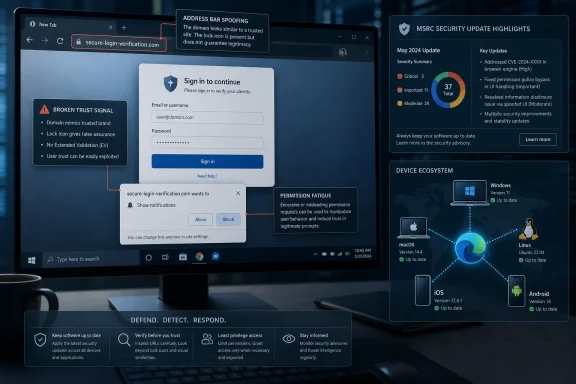
Spoofing vulnerabilities rarely get the visceral reaction that remote code execution bugs do. They do not promise instant shell access, domain compromise, or wormable panic. But in a browser, spoofing lives exactly where users make trust decisions: the address bar, the download prompt, the permission dialog, the identity indicator, the sign-in flow, or the interstitial warning.
That makes CVE-2026-58283 worth watching even before every technical detail is public. Microsoft’s Security Update Guide identifies it as a Microsoft Edge Chromium-based spoofing vulnerability, and MSRC is the correct place to anchor that fact. Until Microsoft or Chromium provides a deeper breakdown, defenders should treat the entry as a confirmed vendor acknowledgment rather than a complete technical dossier.
The user-facing nature of spoofing is the point. Modern attacks often do not need to smash memory if they can convince a user to approve the wrong thing, trust the wrong origin, open the wrong file, or type credentials into the wrong place. A browser spoofing flaw is not necessarily catastrophic on its own, but it can make the attacker’s social engineering dramatically more believable.
A CVE can be real without being fully explained. The vendor may acknowledge the issue, assign a severity, and ship or prepare an update while withholding root-cause details to avoid handing attackers a roadmap. In other cases, early information comes from external researchers, bug bounty reports, crash telemetry, coordinated disclosure, or downstream Chromium commits that hint at the vulnerable component without spelling out exploitation.
For CVE-2026-58283, the safest reading is that Microsoft’s public listing confirms the vulnerability category and affected product family, while the broader technical shape remains constrained by what MSRC has chosen to disclose. That is not unusual. Browser vendors routinely limit detail around security fixes, especially when a bug may be easy to weaponize once the patch is diffed.
The confidence metric is therefore not bureaucratic filler. It tells administrators how much of the public story is firm, how much is inferred, and how much attacker knowledge may already exist outside the vendor’s advisory.
That is why spoofing defects can punch above their severity labels. If an attacker can make a malicious page look like a trusted site, obscure the real origin, fake a permission state, misrepresent a download, or create ambiguity in browser chrome, the exploit chain shifts from pure code execution to persuasion. The browser still enforces many security boundaries, but the user may be nudged into crossing one voluntarily.
Edge inherits both strengths and risks from Chromium. Microsoft benefits from Google’s massive investment in Chromium security, sandboxing, site isolation, and rapid patch cadence. But Edge also has Microsoft-specific surfaces: integration with Windows, Microsoft accounts, enterprise policies, Defender SmartScreen, sidebar features, Copilot-adjacent experiences, sync, identity, and management controls.
That hybrid identity is why Edge CVEs should not be dismissed as merely “Chrome bugs with a Microsoft logo.” Some Edge vulnerabilities are Chromium-shared. Others are Edge-specific. The public title for CVE-2026-58283 points to Microsoft Edge Chromium-based, which tells admins where to look first: browser versioning, deployment rings, managed update policies, and any Microsoft-specific browser configuration that changes exposure.
That creates an uncomfortable window for defenders. The moment a CVE is public, attackers have a label to track. The moment a patch ships, they may have enough material to reverse-engineer the bug. The defensive answer is not to wait for a perfect write-up; it is to compress the time between disclosure and deployment.
Edge complicates this in enterprise environments because browser updating is often treated as less strategic than operating-system patching. Windows Update, Microsoft Intune, Configuration Manager, Group Policy, and Edge update policies can all influence whether endpoints receive browser fixes quickly. A fleet that is disciplined about Patch Tuesday but permissive about browser drift may still carry avoidable exposure.
That is especially true for shared workstations, kiosk systems, VDI pools, and servers where Edge exists “just in case.” Browsers on non-primary systems are easy to forget, but attackers do not care whether a browser is someone’s daily driver. If it can render hostile content or be invoked by another application, it is part of the attack surface.
That sounds mundane because it is. Most browser security failures in the enterprise are not failures of cryptography or exploit analysis. They are failures of inventory, ownership, and update hygiene.
A spoofing bug also interacts with user education in a way that memory corruption bugs do not. If the vulnerability affects a trust cue, then standard advice like “check the address bar” may be less reliable until patched. If it affects a dialog or permission prompt, then training that relies on recognizing normal browser UI may be temporarily weakened. The defensive posture should assume that affected users may see something convincing enough to defeat ordinary suspicion.
This is where security teams should avoid both extremes. It is not helpful to describe every spoofing vulnerability as a credential-theft apocalypse. It is equally wrong to treat spoofing as cosmetic. In the browser, visual truth is part of the security model.
But sparse language should not be mistaken for low importance. A vendor-confirmed CVE in a widely deployed browser deserves operational attention precisely because Edge is everywhere in Microsoft-managed environments. Even organizations that standardize on another browser frequently keep Edge installed, updated, and available through Windows integration.
The Chromium-based architecture also means timing matters. Google, Microsoft, and other Chromium vendors often ship fixes on staggered schedules depending on branch, platform, and vendor-specific code. Administrators should not assume that “Chromium” automatically means all Chromium-based browsers are fixed at once, or that Chrome coverage implies Edge coverage.
For Edge, the vendor of record is Microsoft. That means the MSRC entry and Microsoft Edge release notes are the sources that matter for enterprise remediation decisions. If NVD, scanner plugins, or third-party dashboards lag behind, that should not delay patching once Microsoft has published the relevant fix path.
That asymmetry is not theoretical. Browser vulnerabilities are routinely exploited through chains, not in isolation. A spoofing flaw may help deliver a malicious file, increase the success rate of a phishing campaign, bypass a warning, or make a permission grant appear safer than it is. It may not be the payload; it may be the setup.
This is why confidence in technical details matters. A confirmed vendor advisory with limited detail means the vulnerability is real, but public exploitability may be uncertain. A researcher-published proof of concept changes the calculus. Evidence of exploitation in the wild changes it again. The same CVE can move from “patch in the normal browser window” to “accelerate deployment and hunt for related activity” as confidence and attacker knowledge increase.
For now, CVE-2026-58283 should be handled as a confirmed Microsoft Edge issue whose precise abuse path should not be overclaimed. The correct posture is disciplined urgency: update, verify, monitor, and resist inventing details the advisory does not provide.
A spoofing vulnerability in a niche application may require a narrow lure. A spoofing vulnerability in a default or near-default browser can be folded into ordinary web traffic, help-desk impersonation, SaaS login flows, fake document portals, or malicious ads. Attackers do not need every user to be fooled. They need enough users in the right places.
Admins should also remember that Edge update posture varies by platform. Windows desktops may be governed one way, macOS another, Linux another, and mobile devices through separate app-store or MDM channels. If an organization permits Edge sync or uses Microsoft account integration across platforms, inconsistent patching can create uneven exposure.
The boring work is therefore the important work. Confirm the fixed Edge version when Microsoft publishes or updates the advisory. Make sure stable, extended stable, beta, dev, and mobile channels are accounted for if they exist in the environment. Then check telemetry, not policy intent, because update policies are not the same as installed versions.
This is especially relevant when the public record is sparse. A scanner may identify the CVE but not explain it. It may flag an endpoint but not distinguish between Edge channels. It may rely on installed version strings that do not reflect whether the vulnerable component is reachable. None of that makes scanners useless; it makes them one input.
For Edge, administrators have better sources of truth. Management tooling can report installed versions. Edge update policies can show whether machines are eligible for automatic updates. Browser release notes and MSRC entries can establish the fixed build once Microsoft publishes the necessary detail. The operational goal is to reconcile those sources quickly.
The worst outcome is a familiar one: a CVE exists, the update exists, the scanner eventually flags machines, but no one owns remediation because “browser patching” sits between endpoint management, security operations, and application teams. CVE-2026-58283 is exactly the kind of issue that should expose that ownership gap before a more severe browser bug does.
The better message to users is temporary and practical. Be skeptical of unexpected sign-in prompts, file downloads, and permission requests. Avoid entering credentials after following unsolicited links. Report browser behavior that looks visually wrong, especially around address bars, dialogs, certificate warnings, or Microsoft account prompts. But do not pretend that careful eyeballing can compensate for a vendor-confirmed spoofing vulnerability.
For administrators, the more durable lesson is design-oriented. Reduce the number of moments where a user’s visual judgment is the only control. Conditional access, phishing-resistant authentication, application control, safe links, DNS filtering, download reputation, and least-privilege endpoints all help absorb the failure of a single browser trust cue.
That layered model is not glamorous. It is also the only realistic model for browsers, because browsers are designed to interpret hostile input all day.
The concrete response is straightforward. Treat MSRC as the source of authority, verify Edge update status across managed and unmanaged endpoints, and watch for Microsoft updates to the advisory. If Microsoft later adds exploitability notes, affected version detail, acknowledgements, or mitigation guidance, adjust priority accordingly.
Security teams should also document the uncertainty. That sounds bureaucratic, but it prevents bad decisions. “Vendor-confirmed spoofing vulnerability; technical details limited; patch verification in progress” is more useful than either “critical emergency” or “nothing to see here.”
 Microsoft’s Edge Disclosure Is a Reminder That Spoofing Is Still Security-Critical
Spoofing vulnerabilities rarely get the visceral reaction that remote code execution bugs do. They do not promise instant shell access, domain compromise, or wormable panic. But in a browser, spoofing lives exactly where users make trust decisions: the address bar, the download prompt, the permission dialog, the identity indicator, the sign-in flow, or the interstitial warning.That makes CVE-2026-58283 worth watching even before every technical detail is public. Microsoft’s Security Update Guide identifies it as a Microsoft Edge Chromium-based spoofing vulnerability, and MSRC is the correct place to anchor that fact. Until Microsoft or Chromium provides a deeper breakdown, defenders should treat the entry as a confirmed vendor acknowledgment rather than a complete technical dossier.
The user-facing nature of spoofing is the point. Modern attacks often do not need to smash memory if they can convince a user to approve the wrong thing, trust the wrong origin, open the wrong file, or type credentials into the wrong place. A browser spoofing flaw is not necessarily catastrophic on its own, but it can make the attacker’s social engineering dramatically more believable.
The Confidence Metric Is Doing More Work Than the CVE Title
The text attached to this vulnerability focuses on a metric that measures confidence in the existence of the vulnerability and the credibility of the known technical details. That framing matters. Security teams often read CVE titles as if they are complete facts, when in reality many CVE records begin life as thin public markers.A CVE can be real without being fully explained. The vendor may acknowledge the issue, assign a severity, and ship or prepare an update while withholding root-cause details to avoid handing attackers a roadmap. In other cases, early information comes from external researchers, bug bounty reports, crash telemetry, coordinated disclosure, or downstream Chromium commits that hint at the vulnerable component without spelling out exploitation.
For CVE-2026-58283, the safest reading is that Microsoft’s public listing confirms the vulnerability category and affected product family, while the broader technical shape remains constrained by what MSRC has chosen to disclose. That is not unusual. Browser vendors routinely limit detail around security fixes, especially when a bug may be easy to weaponize once the patch is diffed.
The confidence metric is therefore not bureaucratic filler. It tells administrators how much of the public story is firm, how much is inferred, and how much attacker knowledge may already exist outside the vendor’s advisory.
Spoofing Bugs Turn the Browser Into a Stage Set
A browser is partly a rendering engine, partly an application platform, and partly a trust machine. Users do not inspect TLS handshakes, certificate chains, origin policies, or browser internals. They glance at visual cues and act.That is why spoofing defects can punch above their severity labels. If an attacker can make a malicious page look like a trusted site, obscure the real origin, fake a permission state, misrepresent a download, or create ambiguity in browser chrome, the exploit chain shifts from pure code execution to persuasion. The browser still enforces many security boundaries, but the user may be nudged into crossing one voluntarily.
Edge inherits both strengths and risks from Chromium. Microsoft benefits from Google’s massive investment in Chromium security, sandboxing, site isolation, and rapid patch cadence. But Edge also has Microsoft-specific surfaces: integration with Windows, Microsoft accounts, enterprise policies, Defender SmartScreen, sidebar features, Copilot-adjacent experiences, sync, identity, and management controls.
That hybrid identity is why Edge CVEs should not be dismissed as merely “Chrome bugs with a Microsoft logo.” Some Edge vulnerabilities are Chromium-shared. Others are Edge-specific. The public title for CVE-2026-58283 points to Microsoft Edge Chromium-based, which tells admins where to look first: browser versioning, deployment rings, managed update policies, and any Microsoft-specific browser configuration that changes exposure.
The Patch Is Usually the Disclosure
For browser vulnerabilities, the update often says more than the advisory. Security researchers and attackers alike know how to compare patched and unpatched builds, inspect Chromium commits, and infer root causes from changed code. Vendors know this too, which is why advisories often stay terse until a fix is broadly available.That creates an uncomfortable window for defenders. The moment a CVE is public, attackers have a label to track. The moment a patch ships, they may have enough material to reverse-engineer the bug. The defensive answer is not to wait for a perfect write-up; it is to compress the time between disclosure and deployment.
Edge complicates this in enterprise environments because browser updating is often treated as less strategic than operating-system patching. Windows Update, Microsoft Intune, Configuration Manager, Group Policy, and Edge update policies can all influence whether endpoints receive browser fixes quickly. A fleet that is disciplined about Patch Tuesday but permissive about browser drift may still carry avoidable exposure.
That is especially true for shared workstations, kiosk systems, VDI pools, and servers where Edge exists “just in case.” Browsers on non-primary systems are easy to forget, but attackers do not care whether a browser is someone’s daily driver. If it can render hostile content or be invoked by another application, it is part of the attack surface.
Enterprise Risk Is Less About Panic Than Inventory
The practical question for administrators is not whether every Edge spoofing CVE deserves an emergency war room. It is whether the organization can answer basic questions quickly: which Edge versions are deployed, which update channels are in use, which machines are lagging, and whether any business process depends on delayed browser updates.That sounds mundane because it is. Most browser security failures in the enterprise are not failures of cryptography or exploit analysis. They are failures of inventory, ownership, and update hygiene.
A spoofing bug also interacts with user education in a way that memory corruption bugs do not. If the vulnerability affects a trust cue, then standard advice like “check the address bar” may be less reliable until patched. If it affects a dialog or permission prompt, then training that relies on recognizing normal browser UI may be temporarily weakened. The defensive posture should assume that affected users may see something convincing enough to defeat ordinary suspicion.
This is where security teams should avoid both extremes. It is not helpful to describe every spoofing vulnerability as a credential-theft apocalypse. It is equally wrong to treat spoofing as cosmetic. In the browser, visual truth is part of the security model.
Microsoft’s Sparse Language Is a Defensive Choice, Not a Comfort Blanket
MSRC advisories often frustrate administrators because they present just enough detail to drive patching, but not enough to satisfy technical curiosity. That tradeoff is deliberate. The more specific the public advisory, the easier it may be for attackers to reproduce the issue before defenders finish updating.But sparse language should not be mistaken for low importance. A vendor-confirmed CVE in a widely deployed browser deserves operational attention precisely because Edge is everywhere in Microsoft-managed environments. Even organizations that standardize on another browser frequently keep Edge installed, updated, and available through Windows integration.
The Chromium-based architecture also means timing matters. Google, Microsoft, and other Chromium vendors often ship fixes on staggered schedules depending on branch, platform, and vendor-specific code. Administrators should not assume that “Chromium” automatically means all Chromium-based browsers are fixed at once, or that Chrome coverage implies Edge coverage.
For Edge, the vendor of record is Microsoft. That means the MSRC entry and Microsoft Edge release notes are the sources that matter for enterprise remediation decisions. If NVD, scanner plugins, or third-party dashboards lag behind, that should not delay patching once Microsoft has published the relevant fix path.
The Real Attacker Advantage Is Ambiguity
The supplied metric description points to a larger truth about vulnerability management: attackers thrive in ambiguity. If defenders know only that a spoofing bug exists, they may underreact because the impact is unclear. If attackers can infer more from patches, telemetry, or private research, they may move faster than the public record suggests.That asymmetry is not theoretical. Browser vulnerabilities are routinely exploited through chains, not in isolation. A spoofing flaw may help deliver a malicious file, increase the success rate of a phishing campaign, bypass a warning, or make a permission grant appear safer than it is. It may not be the payload; it may be the setup.
This is why confidence in technical details matters. A confirmed vendor advisory with limited detail means the vulnerability is real, but public exploitability may be uncertain. A researcher-published proof of concept changes the calculus. Evidence of exploitation in the wild changes it again. The same CVE can move from “patch in the normal browser window” to “accelerate deployment and hunt for related activity” as confidence and attacker knowledge increase.
For now, CVE-2026-58283 should be handled as a confirmed Microsoft Edge issue whose precise abuse path should not be overclaimed. The correct posture is disciplined urgency: update, verify, monitor, and resist inventing details the advisory does not provide.
Edge’s Enterprise Footprint Makes Small UI Bugs Large
Microsoft Edge is not just another application on modern Windows systems. It is the default browser on many machines, a managed enterprise browser in Microsoft 365 environments, and a component tied into identity, search, PDF viewing, web apps, and administrative workflows. That reach changes the economics of even moderately severe vulnerabilities.A spoofing vulnerability in a niche application may require a narrow lure. A spoofing vulnerability in a default or near-default browser can be folded into ordinary web traffic, help-desk impersonation, SaaS login flows, fake document portals, or malicious ads. Attackers do not need every user to be fooled. They need enough users in the right places.
Admins should also remember that Edge update posture varies by platform. Windows desktops may be governed one way, macOS another, Linux another, and mobile devices through separate app-store or MDM channels. If an organization permits Edge sync or uses Microsoft account integration across platforms, inconsistent patching can create uneven exposure.
The boring work is therefore the important work. Confirm the fixed Edge version when Microsoft publishes or updates the advisory. Make sure stable, extended stable, beta, dev, and mobile channels are accounted for if they exist in the environment. Then check telemetry, not policy intent, because update policies are not the same as installed versions.
The Scanner Will Not Save You From Timing
Vulnerability scanners are useful, but they are often late to browser CVEs. Plugin coverage may depend on NVD enrichment, vendor feed parsing, local version detection, or authenticated scan quality. In the interval between Microsoft’s disclosure and full scanner coverage, organizations that wait for a red dashboard may be waiting for yesterday’s risk model.This is especially relevant when the public record is sparse. A scanner may identify the CVE but not explain it. It may flag an endpoint but not distinguish between Edge channels. It may rely on installed version strings that do not reflect whether the vulnerable component is reachable. None of that makes scanners useless; it makes them one input.
For Edge, administrators have better sources of truth. Management tooling can report installed versions. Edge update policies can show whether machines are eligible for automatic updates. Browser release notes and MSRC entries can establish the fixed build once Microsoft publishes the necessary detail. The operational goal is to reconcile those sources quickly.
The worst outcome is a familiar one: a CVE exists, the update exists, the scanner eventually flags machines, but no one owns remediation because “browser patching” sits between endpoint management, security operations, and application teams. CVE-2026-58283 is exactly the kind of issue that should expose that ownership gap before a more severe browser bug does.
Users Cannot Be Trained Around a Broken Trust Signal
Security awareness has a role, but it is not a substitute for patching a spoofing flaw. If the vulnerability affects how Edge represents trust, origin, permission, or identity, then user training may be asking people to rely on a signal the browser cannot reliably provide. That is an unfair defensive model.The better message to users is temporary and practical. Be skeptical of unexpected sign-in prompts, file downloads, and permission requests. Avoid entering credentials after following unsolicited links. Report browser behavior that looks visually wrong, especially around address bars, dialogs, certificate warnings, or Microsoft account prompts. But do not pretend that careful eyeballing can compensate for a vendor-confirmed spoofing vulnerability.
For administrators, the more durable lesson is design-oriented. Reduce the number of moments where a user’s visual judgment is the only control. Conditional access, phishing-resistant authentication, application control, safe links, DNS filtering, download reputation, and least-privilege endpoints all help absorb the failure of a single browser trust cue.
That layered model is not glamorous. It is also the only realistic model for browsers, because browsers are designed to interpret hostile input all day.
The Useful Answer Is Faster Than the Perfect Advisory
CVE-2026-58283 does not need to be the most severe vulnerability of the year to be operationally important. It is a reminder that the browser remains the front door for enterprise compromise, and that spoofing bugs attack the human-machine boundary where many defenses are weakest. Microsoft’s disclosure gives defenders enough to act, even if it does not yet give them enough to satisfy every technical question.The concrete response is straightforward. Treat MSRC as the source of authority, verify Edge update status across managed and unmanaged endpoints, and watch for Microsoft updates to the advisory. If Microsoft later adds exploitability notes, affected version detail, acknowledgements, or mitigation guidance, adjust priority accordingly.
Security teams should also document the uncertainty. That sounds bureaucratic, but it prevents bad decisions. “Vendor-confirmed spoofing vulnerability; technical details limited; patch verification in progress” is more useful than either “critical emergency” or “nothing to see here.”
The Edge CVE That Tests the Plumbing, Not the Headlines
The right response to CVE-2026-58283 is not drama. It is proof that your browser update pipeline works when the advisory is thin, the category is easy to underestimate, and the affected product is installed almost everywhere.- Microsoft has publicly listed CVE-2026-58283 as a Microsoft Edge Chromium-based spoofing vulnerability through MSRC.
- The confidence framing matters because it separates confirmed existence from fully public technical detail.
- Spoofing vulnerabilities in browsers can materially increase phishing, credential theft, and unsafe user approvals even when they do not execute code directly.
- Enterprises should verify installed Edge versions rather than relying only on policy settings or scanner timing.
- User training should be treated as a supporting control, not a workaround for a browser trust-signal flaw.
- The most important follow-up is to monitor Microsoft’s advisory and Edge release information for fixed-version and exploitability updates.
References
- Primary source: MSRC
Published: 2026-07-03T07:00:00-07:00
Security Update Guide - Microsoft Security Response Center
 msrc.microsoft.com
- Related coverage: www2.gov.bc.ca
- Related coverage: manuals.supernaeyeglass.com
- Related coverage: buildings.honeywell.com
The purpose of this document is to identify the patches that have been delivered by Microsoft® which have been tested against Pro-Watch
PDF documentbuildings.honeywell.com
- Related coverage: hivepro.com
- Official source: microsoft.com
MSRC - Microsoft Security Response Center
The Microsoft Security Response Center is part of the defender community and on the front line of security response evolution. For over twenty years, we have been engaged with security researchers working to protect customers and the broader ecosystem.www.microsoft.com
- Official source: learn.microsoft.com
Security Advisories and Bulletins | Microsoft Learn
learn.microsoft.com - Related coverage: howtofix.guide
Microsoft Defender CVE-2026-41091 and CVE-2026-45498 Exploited
Microsoft Defender CVE-2026-41091 and CVE-2026-45498 are exploited. Verify Engine 1.1.26040.8, Platform 4.18.26040.7, and update endpoints.howtofix.guide
