

CVE-2026-58284 is a Microsoft Edge Chromium-based remote code execution vulnerability published by Microsoft’s Security Response Center on July 3, 2026, affecting Edge versions earlier than 150.0.4078.48 and carrying a CVSS 3.1 score reported by vulnerability aggregators as 8.3. The important story is not merely that another browser RCE exists; it is that Edge’s security boundary now lives at the intersection of Microsoft’s enterprise estate and Google’s Chromium cadence. Microsoft has acknowledged the issue, but the public technical detail remains thin, which makes patch discipline—not exploit theorizing—the practical center of gravity.
Edge stopped being “just the browser” years ago. In most Windows 10 and Windows 11 environments, it is the default PDF handler, the WebView2 runtime companion, the browser wired into Microsoft 365 workflows, and the piece of Chromium that Microsoft can update outside the traditional Windows cumulative-update rhythm. That makes an Edge RCE qualitatively different from an optional third-party browser flaw.
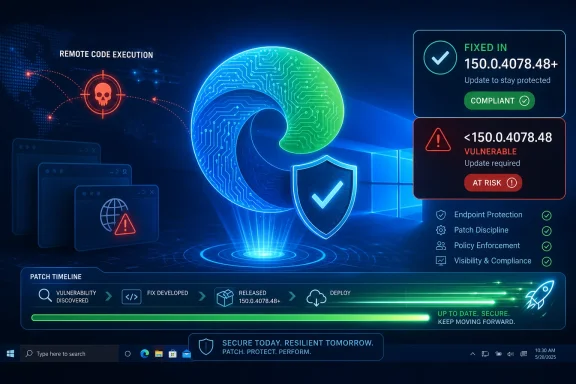
Microsoft’s Security Response Center lists CVE-2026-58284 as a remote code execution vulnerability in Microsoft Edge (Chromium-based). Vulnerability databases including Vulners describe the affected product range as Microsoft Edge versions prior to 150.0.4078.48, with Microsoft named as the source of the advisory. That version boundary is the first practical fact administrators need: if your fleet is below that build, the advisory is not theoretical.
The CVSS score matters, but not in the simplistic way dashboards often present it. An 8.3 high-severity browser RCE is serious because the attack vector is network-adjacent in practice: users browse, click, preview, authenticate, and carry active sessions through the browser all day. But a browser RCE also tends to sit behind layers of exploit conditions, sandbox boundaries, and user interaction assumptions that can make the difference between “patch now” and “panic now.”
The correct answer is still patch now. Browser vulnerabilities age badly once a vendor advisory lands, because defenders and attackers are suddenly reading the same metadata.
That does not mean the public understands the bug. At the time of publication, public summaries identify the affected product, impact class, version range, and remediation boundary, but do not provide a full root-cause narrative. Vulners classifies the weakness under CWE-285, commonly associated with improper authorization, while the MSRC title frames the consequence as remote code execution. Those two facts can coexist, but they should not be overread into a working exploit theory.
This is where security writing often gets sloppy. “Remote code execution” is an outcome category, not a proof-of-concept. It tells defenders what could happen if the vulnerability is successfully exploited, not necessarily how reliable exploitation is, whether sandbox escape is included, or whether an attacker can reach the bug without user interaction.
Microsoft’s public handling is also consistent with browser security norms. Vendors frequently suppress exploit-level details while patches are propagating, especially for vulnerabilities in high-volume client software. That frustrates researchers and vulnerability managers who want precision, but it reduces the chance that advisory text becomes an exploit development roadmap.
But Chromium also makes Edge part of a vast shared attack economy. A vulnerability class that matters in Chrome may matter in Edge, Brave, Opera, Vivaldi, and Electron-derived software depending on where the bug lives. Even when a CVE is branded as Microsoft Edge, defenders should ask whether the affected component is Microsoft-specific, Chromium-derived, or part of a shared rendering/runtime layer.
CVE-2026-58284’s public label does not settle that question. Microsoft’s advisory names Edge Chromium-based, and aggregator data points to Microsoft Edge before build 150.0.4078.48. Without more detail from Microsoft, Google’s Chromium project, or a researcher write-up, the safe conclusion is narrower: update Edge, verify the version, and avoid inventing a root cause that the advisory does not support.
That restraint matters for enterprise triage. If a vulnerability is mischaracterized as a simple “Chrome bug,” administrators may assume Chrome patching covers them while ignoring Edge channels installed by default across Windows endpoints. If it is mischaracterized as uniquely Microsoft, teams may miss broader Chromium exposure elsewhere in the estate.
Edge updating is usually quiet until it is not. Consumer machines tend to pick up browser updates automatically, but managed devices may be held by policy, blocked by network inspection, pinned by application compatibility rules, or delayed by change-control windows. The result is a familiar enterprise paradox: the product designed to update rapidly can be made slow by the very tooling meant to control risk.
Administrators should treat Edge’s version as a first-class patch metric, not an assumption inherited from Windows Update state. A fully current Windows cumulative update does not automatically prove that Edge itself is on the fixed browser build. In estates using Microsoft Intune, Configuration Manager, Group Policy, or third-party endpoint management, the browser version should be queried directly.
This is especially true for shared workstations, VDI images, kiosks, and devices that are frequently reverted to a known state. A golden image built before the fix can keep reintroducing the vulnerable browser line unless the image itself is refreshed. The browser updater may repair that state eventually, but “eventually” is not a control when a CVE has already been published.
The modern phishing economy is built to supply that interaction at scale. Attackers do not need to compromise every user; they need to land the right lure in front of the right endpoint before the patch reaches it. That is why browser RCEs sit uncomfortably between endpoint management and human behavior.
Enterprise mitigations can reduce exposure, but they rarely erase it. SmartScreen, site isolation, exploit protection, extension controls, web filtering, and least-privilege browsing all add friction. Yet a browser remains a deliberately porous application, designed to fetch untrusted code and media from the internet and render it in real time.
The practical lesson is that training users not to click is not a substitute for updating the browser. Awareness campaigns help, but they should be treated as a compensating layer while the real fix moves through the fleet.
For CVE-2026-58284, Microsoft’s publication makes the existence of the vulnerability credible enough for immediate action. The public does not need a proof-of-concept to justify patching. In fact, waiting for exploit code is usually a sign that a patch program has become reactive rather than risk-based.
But the limited technical detail should temper secondary claims. Without Microsoft disclosing exploitation status, a researcher report, or a known exploited catalog entry, it would be irresponsible to claim active exploitation. The honest position is more disciplined: this is a vendor-acknowledged Edge RCE with a fixed version identified, and defenders should close the gap before more detail circulates.
That is the uncomfortable middle ground many security teams live in. The vulnerability is real enough to patch urgently, but not public enough to model precisely. Good security operations can function in that ambiguity.
That split model is not a defect; it is the price of faster remediation. The trouble is that reporting and compliance dashboards often lag behind that reality. A machine can look “green” for Windows updates while still running an older Edge build, especially if the organization’s compliance logic is keyed to OS cumulative updates rather than application version inventory.
There is also a cultural problem. Many users and even some administrators still think of Edge as bundled Windows furniture rather than a fast-moving application. That perception is dangerous because browsers now carry a patch velocity closer to cloud software than classic desktop components.
The safest operational posture is to audit Edge like Chrome: by channel, build, update policy, and restart state. If the binary is updated but the browser has not restarted, the endpoint may not actually be running the fixed code. That small detail has derailed more browser remediation efforts than most vendors like to admit.
Windows Server environments deserve a careful look as well. Administrators sometimes use browsers on servers for convenience, despite years of security guidance pushing the other way. If Edge is installed and reachable by an administrator account, a browser RCE becomes more than a desktop concern.
The same is true for WebView2-dependent applications. CVE-2026-58284 is listed against Microsoft Edge, not necessarily every WebView2 runtime deployment, so defenders should avoid claiming direct exposure without confirmation. But the operational lesson remains: Chromium-based components are now embedded throughout the Windows software stack, and browser-family patching is no longer confined to a blue “e” icon on the taskbar.
For regulated environments, the audit trail matters. Security teams should record the vulnerable version range, the fixed build, the date Microsoft published the advisory, and the date the organization reached compliance. That evidence will matter if the vulnerability later appears in exploit telemetry or incident-response questions.
For Edge, the patch availability is the most important variable. A fixed version is identified, the product has an automatic update path, and remediation can be verified by build number. That makes this a tractable problem if organizations move quickly.
The deeper danger is false precision. If teams spend their first hours debating whether 8.3 is “high enough” for emergency change, they may miss the simpler fact that browsers are high-exposure software with short exploit-development timelines after disclosure. The right comparison is not between this CVE and every other high-severity item in a scanner report; it is between an exposed browser today and a fixed browser after a controlled update.
That is why mature vulnerability management programs increasingly prioritize exploitability context, exposure, and fix friction alongside CVSS. CVE-2026-58284 checks enough boxes to move fast even without a public exploit.
The simplest verification path is Edge’s About page, which triggers update checks and displays the installed version. Users should be on 150.0.4078.48 or later based on the affected-version data circulating from Microsoft-linked vulnerability records. If the browser says an update is available, apply it and restart the browser rather than leaving it pending in the background.
This is also a good moment to remove unnecessary extensions. Extensions are not the cause of this CVE based on public information, but every browser incident is a reminder that extensions expand the attack surface and can complicate incident triage. A lean browser is easier to secure than one carrying years of forgotten add-ons.
Home users should also be wary of “security update” pop-ups on random websites. Edge updates should come through the browser’s own update mechanism or Microsoft-managed channels, not through downloaded installers pushed by scareware pages.
Microsoft and Google have both spent years shrinking browser patch windows because the model demands it. Modern browsers update frequently, quietly, and sometimes annoyingly because the alternative is a world where every rendering engine bug waits for a monthly maintenance event. CVE-2026-58284 is another test of whether organizations have accepted that reality.
Binary diffing is not magic, but it changes the disclosure equation. If an attacker can compare vulnerable and fixed builds, the absence of public exploit details may buy time, not safety. That is why the first 24 to 72 hours after disclosure are disproportionately important for high-exposure client software.
For security leaders, the lesson is to measure time-to-version, not merely ticket closure. A remediation ticket closed because an update policy exists is not the same as evidence that endpoints are running the fixed Edge build. The browser’s About dialog, enterprise inventory, or endpoint telemetry should tell the truth.
The clearest near-term moves are concrete:
That should change how Windows administrators talk about browsers. Edge is not an accessory application; it is a privileged internet-facing runtime that follows users across identity, documents, SaaS apps, and local files. A remote code execution bug in that layer deserves faster treatment than yet another line item in a vulnerability export.
Microsoft’s advisory leaves some technical questions unanswered, and that is normal at this stage. What is not unanswered is the operational requirement. The fixed build is known, the affected range is known, and the product’s update machinery exists precisely for moments like this.
The next phase will decide whether CVE-2026-58284 becomes a brief patch-management footnote or another example of how slowly “automatic” updates can move through real-world Windows estates. For now, the smart bet is to verify Edge directly, close the version gap, and assume that every quiet browser RCE becomes louder the longer it remains unpatched.
 Microsoft’s Browser Is Now a Windows Security Surface
Edge stopped being “just the browser” years ago. In most Windows 10 and Windows 11 environments, it is the default PDF handler, the WebView2 runtime companion, the browser wired into Microsoft 365 workflows, and the piece of Chromium that Microsoft can update outside the traditional Windows cumulative-update rhythm. That makes an Edge RCE qualitatively different from an optional third-party browser flaw.Microsoft’s Security Response Center lists CVE-2026-58284 as a remote code execution vulnerability in Microsoft Edge (Chromium-based). Vulnerability databases including Vulners describe the affected product range as Microsoft Edge versions prior to 150.0.4078.48, with Microsoft named as the source of the advisory. That version boundary is the first practical fact administrators need: if your fleet is below that build, the advisory is not theoretical.
The CVSS score matters, but not in the simplistic way dashboards often present it. An 8.3 high-severity browser RCE is serious because the attack vector is network-adjacent in practice: users browse, click, preview, authenticate, and carry active sessions through the browser all day. But a browser RCE also tends to sit behind layers of exploit conditions, sandbox boundaries, and user interaction assumptions that can make the difference between “patch now” and “panic now.”
The correct answer is still patch now. Browser vulnerabilities age badly once a vendor advisory lands, because defenders and attackers are suddenly reading the same metadata.
The Sparse Advisory Is a Signal, Not an Omission
The user-supplied MSRC text describes a metric that measures confidence in the existence of a vulnerability and the credibility of known technical details. That language maps to one of the least glamorous but most useful parts of vulnerability scoring: whether the industry is dealing with rumor, partial research, or vendor-confirmed fact. In this case, Microsoft’s acknowledgement moves the issue out of the speculative bucket.That does not mean the public understands the bug. At the time of publication, public summaries identify the affected product, impact class, version range, and remediation boundary, but do not provide a full root-cause narrative. Vulners classifies the weakness under CWE-285, commonly associated with improper authorization, while the MSRC title frames the consequence as remote code execution. Those two facts can coexist, but they should not be overread into a working exploit theory.
This is where security writing often gets sloppy. “Remote code execution” is an outcome category, not a proof-of-concept. It tells defenders what could happen if the vulnerability is successfully exploited, not necessarily how reliable exploitation is, whether sandbox escape is included, or whether an attacker can reach the bug without user interaction.
Microsoft’s public handling is also consistent with browser security norms. Vendors frequently suppress exploit-level details while patches are propagating, especially for vulnerabilities in high-volume client software. That frustrates researchers and vulnerability managers who want precision, but it reduces the chance that advisory text becomes an exploit development roadmap.
Edge’s Chromium Inheritance Cuts Both Ways
The Chromium base gives Edge a faster security metabolism than the old EdgeHTML era ever had. Microsoft can absorb upstream Chromium fixes, ship browser updates independently, and move users forward without waiting for the next Patch Tuesday. That is a genuine win for consumer security and for enterprises that allow Edge to update automatically.But Chromium also makes Edge part of a vast shared attack economy. A vulnerability class that matters in Chrome may matter in Edge, Brave, Opera, Vivaldi, and Electron-derived software depending on where the bug lives. Even when a CVE is branded as Microsoft Edge, defenders should ask whether the affected component is Microsoft-specific, Chromium-derived, or part of a shared rendering/runtime layer.
CVE-2026-58284’s public label does not settle that question. Microsoft’s advisory names Edge Chromium-based, and aggregator data points to Microsoft Edge before build 150.0.4078.48. Without more detail from Microsoft, Google’s Chromium project, or a researcher write-up, the safe conclusion is narrower: update Edge, verify the version, and avoid inventing a root cause that the advisory does not support.
That restraint matters for enterprise triage. If a vulnerability is mischaracterized as a simple “Chrome bug,” administrators may assume Chrome patching covers them while ignoring Edge channels installed by default across Windows endpoints. If it is mischaracterized as uniquely Microsoft, teams may miss broader Chromium exposure elsewhere in the estate.
The Version Number Is the Operational Story
For most WindowsForum readers, the useful dividing line is not the CVE prose; it is the build number. Microsoft Edge versions below 150.0.4078.48 are reported as affected, and the fixed line begins at that build. That should drive inventory queries, endpoint compliance rules, and help-desk scripts.Edge updating is usually quiet until it is not. Consumer machines tend to pick up browser updates automatically, but managed devices may be held by policy, blocked by network inspection, pinned by application compatibility rules, or delayed by change-control windows. The result is a familiar enterprise paradox: the product designed to update rapidly can be made slow by the very tooling meant to control risk.
Administrators should treat Edge’s version as a first-class patch metric, not an assumption inherited from Windows Update state. A fully current Windows cumulative update does not automatically prove that Edge itself is on the fixed browser build. In estates using Microsoft Intune, Configuration Manager, Group Policy, or third-party endpoint management, the browser version should be queried directly.
This is especially true for shared workstations, VDI images, kiosks, and devices that are frequently reverted to a known state. A golden image built before the fix can keep reintroducing the vulnerable browser line unless the image itself is refreshed. The browser updater may repair that state eventually, but “eventually” is not a control when a CVE has already been published.
User Interaction Still Leaves a Wide Attack Lane
Many browser RCEs require some form of user interaction, and vulnerability summaries for related Edge issues published around the same period emphasize that pattern. That should not comfort anyone too much. In browser security, “user interaction required” often means opening a page, following a link, viewing hostile content, or interacting with a document rendered through browser components.The modern phishing economy is built to supply that interaction at scale. Attackers do not need to compromise every user; they need to land the right lure in front of the right endpoint before the patch reaches it. That is why browser RCEs sit uncomfortably between endpoint management and human behavior.
Enterprise mitigations can reduce exposure, but they rarely erase it. SmartScreen, site isolation, exploit protection, extension controls, web filtering, and least-privilege browsing all add friction. Yet a browser remains a deliberately porous application, designed to fetch untrusted code and media from the internet and render it in real time.
The practical lesson is that training users not to click is not a substitute for updating the browser. Awareness campaigns help, but they should be treated as a compensating layer while the real fix moves through the fleet.
The Confidence Metric Changes the Triage Conversation
The description supplied with the advisory is about confidence: how certain the community is that the vulnerability exists, and how credible the technical details are. That is a valuable lens because CVEs do not all arrive with the same evidentiary weight. Some begin as vendor-confirmed advisories; others emerge from third-party reports, bug bounty notes, exploit rumors, or incomplete disclosure records.For CVE-2026-58284, Microsoft’s publication makes the existence of the vulnerability credible enough for immediate action. The public does not need a proof-of-concept to justify patching. In fact, waiting for exploit code is usually a sign that a patch program has become reactive rather than risk-based.
But the limited technical detail should temper secondary claims. Without Microsoft disclosing exploitation status, a researcher report, or a known exploited catalog entry, it would be irresponsible to claim active exploitation. The honest position is more disciplined: this is a vendor-acknowledged Edge RCE with a fixed version identified, and defenders should close the gap before more detail circulates.
That is the uncomfortable middle ground many security teams live in. The vulnerability is real enough to patch urgently, but not public enough to model precisely. Good security operations can function in that ambiguity.
Microsoft’s Split Patch Model Still Trips Up Fleets
Windows administrators have spent decades organizing around Patch Tuesday. Browser security does not respect that calendar. Edge stable-channel updates can land on their own schedule, and the most important browser fix of the month may not align neatly with the operating system rollup.That split model is not a defect; it is the price of faster remediation. The trouble is that reporting and compliance dashboards often lag behind that reality. A machine can look “green” for Windows updates while still running an older Edge build, especially if the organization’s compliance logic is keyed to OS cumulative updates rather than application version inventory.
There is also a cultural problem. Many users and even some administrators still think of Edge as bundled Windows furniture rather than a fast-moving application. That perception is dangerous because browsers now carry a patch velocity closer to cloud software than classic desktop components.
The safest operational posture is to audit Edge like Chrome: by channel, build, update policy, and restart state. If the binary is updated but the browser has not restarted, the endpoint may not actually be running the fixed code. That small detail has derailed more browser remediation efforts than most vendors like to admit.
The Enterprise Risk Is Concentrated in the Boring Places
The riskiest machines are not always the executive laptops that security teams watch most closely. They are often the under-loved endpoints: conference-room PCs, lab machines, kiosk systems, warehouse terminals, jump boxes used “just for browsing documentation,” and VDI pools refreshed from stale images. Edge may be present, available, and vulnerable even where it is not the primary browser.Windows Server environments deserve a careful look as well. Administrators sometimes use browsers on servers for convenience, despite years of security guidance pushing the other way. If Edge is installed and reachable by an administrator account, a browser RCE becomes more than a desktop concern.
The same is true for WebView2-dependent applications. CVE-2026-58284 is listed against Microsoft Edge, not necessarily every WebView2 runtime deployment, so defenders should avoid claiming direct exposure without confirmation. But the operational lesson remains: Chromium-based components are now embedded throughout the Windows software stack, and browser-family patching is no longer confined to a blue “e” icon on the taskbar.
For regulated environments, the audit trail matters. Security teams should record the vulnerable version range, the fixed build, the date Microsoft published the advisory, and the date the organization reached compliance. That evidence will matter if the vulnerability later appears in exploit telemetry or incident-response questions.
Security Teams Should Resist CVSS Theater
A CVSS score of 8.3 is enough to put CVE-2026-58284 high on the remediation list, but CVSS should not be treated as a mechanical commandment. Scores compress many assumptions into one number. Two vulnerabilities with similar scores can pose very different risks depending on exploit maturity, asset exposure, compensating controls, and patch availability.For Edge, the patch availability is the most important variable. A fixed version is identified, the product has an automatic update path, and remediation can be verified by build number. That makes this a tractable problem if organizations move quickly.
The deeper danger is false precision. If teams spend their first hours debating whether 8.3 is “high enough” for emergency change, they may miss the simpler fact that browsers are high-exposure software with short exploit-development timelines after disclosure. The right comparison is not between this CVE and every other high-severity item in a scanner report; it is between an exposed browser today and a fixed browser after a controlled update.
That is why mature vulnerability management programs increasingly prioritize exploitability context, exposure, and fix friction alongside CVSS. CVE-2026-58284 checks enough boxes to move fast even without a public exploit.
Home Users Have the Simplest Job and the Least Visibility
For home users, the advice is less complicated: update Edge and restart it. The difficulty is that many users do not know which version they are running, do not recognize that Edge updates separately from Windows, and may assume that rebooting after Windows Update covers everything. It often does not.The simplest verification path is Edge’s About page, which triggers update checks and displays the installed version. Users should be on 150.0.4078.48 or later based on the affected-version data circulating from Microsoft-linked vulnerability records. If the browser says an update is available, apply it and restart the browser rather than leaving it pending in the background.
This is also a good moment to remove unnecessary extensions. Extensions are not the cause of this CVE based on public information, but every browser incident is a reminder that extensions expand the attack surface and can complicate incident triage. A lean browser is easier to secure than one carrying years of forgotten add-ons.
Home users should also be wary of “security update” pop-ups on random websites. Edge updates should come through the browser’s own update mechanism or Microsoft-managed channels, not through downloaded installers pushed by scareware pages.
The Patch Window Is Where the Real Race Happens
Once a vendor publishes a browser RCE advisory, two clocks start. Defenders begin measuring how long it takes to reach fixed builds, while attackers and researchers begin mining public clues, binary diffs, and related code changes. The winner is often determined less by brilliance than by automation.Microsoft and Google have both spent years shrinking browser patch windows because the model demands it. Modern browsers update frequently, quietly, and sometimes annoyingly because the alternative is a world where every rendering engine bug waits for a monthly maintenance event. CVE-2026-58284 is another test of whether organizations have accepted that reality.
Binary diffing is not magic, but it changes the disclosure equation. If an attacker can compare vulnerable and fixed builds, the absence of public exploit details may buy time, not safety. That is why the first 24 to 72 hours after disclosure are disproportionately important for high-exposure client software.
For security leaders, the lesson is to measure time-to-version, not merely ticket closure. A remediation ticket closed because an update policy exists is not the same as evidence that endpoints are running the fixed Edge build. The browser’s About dialog, enterprise inventory, or endpoint telemetry should tell the truth.
The Practical Playbook Is Shorter Than the Advisory Trail
CVE-2026-58284 does not require a grand strategy session. It requires a disciplined browser update cycle, direct verification, and honest reporting about exceptions. The organizations that handle it well will not be the ones with the longest vulnerability write-up; they will be the ones that can answer, by Monday morning, which machines still run Edge below the fixed version.The clearest near-term moves are concrete:
- Confirm whether Microsoft Edge is running version 150.0.4078.48 or later on managed Windows endpoints.
- Treat Edge version inventory separately from Windows cumulative-update compliance.
- Force or encourage a browser restart where updates have installed but the old process remains active.
- Refresh golden images, VDI pools, kiosks, and shared devices that may preserve older Edge builds.
- Avoid claiming active exploitation unless Microsoft, CISA, or another credible source confirms it.
- Document exceptions and compensating controls for machines that cannot immediately receive the fixed build.
Microsoft’s Edge Bet Raises the Stakes for Every Quiet Browser Fix
The broader lesson from CVE-2026-58284 is that Microsoft’s Chromium bet has made Edge both easier to secure and harder to ignore. The browser can move quickly, inherit a mature security architecture, and receive fixes without waiting for Windows itself. At the same time, it has become a core part of the Windows attack surface, present by default and entangled with daily work.That should change how Windows administrators talk about browsers. Edge is not an accessory application; it is a privileged internet-facing runtime that follows users across identity, documents, SaaS apps, and local files. A remote code execution bug in that layer deserves faster treatment than yet another line item in a vulnerability export.
Microsoft’s advisory leaves some technical questions unanswered, and that is normal at this stage. What is not unanswered is the operational requirement. The fixed build is known, the affected range is known, and the product’s update machinery exists precisely for moments like this.
The next phase will decide whether CVE-2026-58284 becomes a brief patch-management footnote or another example of how slowly “automatic” updates can move through real-world Windows estates. For now, the smart bet is to verify Edge directly, close the version gap, and assume that every quiet browser RCE becomes louder the longer it remains unpatched.
References
- Primary source: MSRC
Published: 2026-07-03T07:00:00-07:00
Security Update Guide - Microsoft Security Response Center
 msrc.microsoft.com
- Related coverage: securityvulnerability.io
CVE-2026-58294 : Remote Code Execution Vulnerability in Microsoft Edge by Microsoft
Learn about the remote code execution vulnerability affecting Microsoft Edge. Stay informed about CVE-2026-58294 and enhance your cybersecurity measures.securityvulnerability.io - Related coverage: hkcert.org
Microsoft Edge Multiple Vulnerabilities
Multiple vulnerabilities were identified in Microsoft Edge. A remote attacker could exploit some of these vulnerabilities to trigger remote code execution, denial of service condition, security restriction bypass, data manipulation, sensitive informationwww.hkcert.org - Related coverage: threats.kaspersky.com
Kaspersky Threats — KLA91012
threats.kaspersky.com
- Related coverage: cve.circl.lu
Vulnerability-Lookup
Vulnerability-Lookup - Fast vulnerability lookup correlation from different sources.cve.circl.lu - Related coverage: windowsforum.com
CVE-2026-57984 Edge RCE: Patch Urgently and Verify Fixed Builds | Windows Forum
CVE-2026-57984 is a Microsoft Edge (Chromium-based) remote code execution vulnerability listed by Microsoft’s Security Response Center in its Security...windowsforum.com
- Related coverage: www2.gov.bc.ca
- Related coverage: aha.org
h isac tlp white microsoft edge addresses exploited zero day vulnerability cve 2024 7971 8 23 2024
PDF documentwww.aha.org
- Related coverage: mphasis.com
