

The Wall Between Chat Systems Was Always an Enterprise Tax
The modern workplace did not end up with too many chat apps because IT departments lacked discipline. It happened because collaboration boundaries rarely match corporate boundaries. A manufacturer may run Microsoft 365 internally, a design agency may live in Google Workspace, a supplier may use Slack, and the joint project still needs daily decisions, files, meetings, and escalation paths.
For years, the workaround was administrative duct tape. Someone created guest accounts. Someone else forwarded emails. A project manager copied status updates from one system into another. The result was not just inconvenience; it was a measurable loss of context, accountability, and security.
Teams became the gravitational center for many Windows-heavy organizations because it sat inside Microsoft 365, inherited Microsoft identity controls, and became the default place where meetings, files, chats, and apps converged. Google Chat, meanwhile, has been trying to become the same kind of connective tissue for Workspace customers. The problem is that neither side won the whole world.
That is why this Google-NextPlane release matters. It is not simply another bridge for messages. It is an admission that the collaboration platform of record is often different on each side of a business relationship, and that enterprise software has to make that reality survivable.
Google’s Move Is Less About Chat Than About Reducing Switching Costs
Google’s public framing is straightforward: Workspace users need to collaborate with customers, partners, and suppliers who use Microsoft Teams. OpenHub is presented as the interoperability layer that lets Chat users reach external Teams tenants without abandoning the tools they already use. That is true, but it is also the smallest version of the story.
The larger version is that Google is trying to make Workspace less risky in Microsoft-dominated environments. If a company is considering Workspace but fears that key partners live in Teams, the lack of fluid Teams connectivity becomes a procurement objection. Remove that objection, and Google has one less reason to lose the deal before it begins.
This is a classic challenger move. Microsoft benefits when Teams is treated as the unavoidable collaboration default. Google benefits when Teams becomes just another endpoint. Interoperability, in that sense, is not neutral plumbing; it is a competitive weapon dressed as customer convenience.
The same dynamic has played out before in email, calendaring, document formats, and video conferencing. Vendors resist interoperability when lock-in is profitable and embrace it when openness helps them pry customers away from a rival. The rhetoric is always about productivity. The business logic is usually about leverage.
NextPlane Becomes the Diplomat Between Two Sovereign Clouds
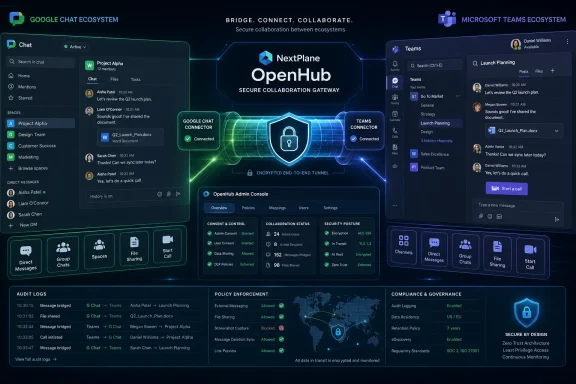
The most interesting part of the announcement is not that Google Chat and Teams can exchange messages. Third-party bridges have existed in one form or another for years. The more meaningful claim is that OpenHub can do it with the features enterprises actually care about: presence, direct messages, group chats, Channels and Spaces, file sharing, and meeting or call initiation.
Presence is especially important because it is the tiny signal that makes real-time work feel alive. A green dot, an away state, or an in-meeting indicator changes whether someone sends a quick message, waits, or escalates. Without presence, cross-platform messaging feels like email wearing a chat costume.
File sharing is the next practical test. Corporate collaboration is rarely just text. It includes drafts, screenshots, purchase orders, diagrams, logs, spreadsheets, and the inevitable “latest-final-v3” attachment that somehow determines the fate of a deployment. If files cannot cross the boundary cleanly, users route around the platform.
Voice and video initiation add another layer. The announcement does not magically mean every Teams and Google calling feature becomes identical across tenants, but it does suggest that the bridge is moving beyond asynchronous chat. That matters because many business conversations follow a familiar rhythm: message, clarify, escalate to a call, return to the thread with decisions. If the bridge breaks at escalation, users go back to app-switching.
The Admin Story Is the Real Product
Consumer users tend to judge messaging by whether the message arrives. Enterprise administrators judge it by who authorized the connection, where the data moved, which identities were used, what logs exist, and how quickly the whole thing can be shut down when a partner relationship ends. That is where Google’s announcement spends its most consequential language.
OpenHub is described as a dedicated single-tenant service that can run in a customer-owned Google Cloud Project. The important phrase is customer control. Google and NextPlane are trying to reassure IT that this is not a mystery relay operated from someone else’s opaque collaboration cloud.
The implementation also avoids several patterns that make security teams nervous: fake user accounts, NextPlane-controlled identities, cross-tenant impersonation, and proxy Teams tenants. Those phrases may not excite end users, but they are precisely the kinds of details that determine whether a regulated organization will even consider deployment.
This is also why management through the Google Admin console and Microsoft Teams admin center matters. A separate portal is not just another bookmark. It is another control plane, another audit surface, another training burden, and another source of configuration drift. By keeping administration inside the existing consoles, the vendors are selling not merely interoperability, but operational normality.
For WindowsForum readers who live in tenant settings, conditional access policies, guest access rules, DLP exceptions, retention policies, and audit logs, this is the part to scrutinize. The user story is “I can message a partner from Chat.” The admin story is “Can I prove this connection was approved, scoped, logged, governed, and revoked correctly?”
Microsoft Teams Is Becoming Infrastructure, Whether Microsoft Likes It or Not
Microsoft has spent years turning Teams into more than a chat client. It is a front end for meetings, telephony, SharePoint files, Loop components, Microsoft 365 apps, Copilot experiences, and line-of-business workflows. In many organizations, Teams is now the place where work appears to happen, even when the underlying work is scattered across half a dozen services.
That ubiquity creates a paradox. The more important Teams becomes, the more pressure there is for non-Microsoft systems to connect to it. Teams may be a product in Microsoft’s portfolio, but for customers and partners it increasingly functions like infrastructure.
Infrastructure is judged differently from an app. Users expect it to interoperate. Admins expect predictable controls. Regulators and procurement teams ask whether market power is being used to fence off adjacent services. Competitors look for ways to make the dominant platform less dominant by turning it into a reachable endpoint.
Google’s move leans into that pressure. It does not displace Teams inside Microsoft 365 tenants. Instead, it says Workspace customers can keep using Google Chat while still engaging Teams organizations externally. That is a subtle but important reframing: Teams remains important, but it stops being the only acceptable place where the conversation can occur.
Microsoft has its own external access and federation mechanisms, and Teams already supports collaboration across organizational boundaries in Microsoft-centric scenarios. But the Google-NextPlane arrangement is different because it is explicitly cross-suite. It is not asking the outside party to become a Microsoft guest in the usual sense, nor asking a Google shop to abandon Chat for Teams just to satisfy a partner.
The Feature List Is Strong, but the Edge Cases Will Decide Adoption
Interop announcements always sound cleaner in a blog post than they feel in production. The hard questions begin after the first successful demo. How do edits behave? What happens to deleted messages? Which files are scanned by which security stack? How are retention and eDiscovery handled across platforms? What is the user experience when one side changes policy midstream?
Even basic terminology hides complexity. Microsoft Teams has teams and channels; Google Chat has spaces. They overlap conceptually but are not identical administrative or social objects. Mapping one to the other is less like translating words and more like translating office customs.
Presence sounds simple until each platform has different rules for meetings, focus time, idle detection, mobile state, and calendar integration. File sharing sounds simple until permissions, link scopes, malware scanning, document ownership, and external sharing policies collide. Calls sound simple until licensing, meeting policies, recording rules, transcription settings, and compliance boundaries get involved.
None of that makes the release unimportant. It makes the release real. Enterprises do not need perfect symmetry between platforms; they need predictable behavior, documented limitations, and failure modes that do not surprise auditors or strand users.
The most likely early adopters are organizations already living with high-friction partner collaboration. Joint ventures, professional services firms, supply-chain-heavy manufacturers, public-sector contractors, and companies mid-migration between Workspace and Microsoft 365 all have reasons to test this quickly. If the alternative is dozens of guest accounts and a swamp of email forwards, even imperfect interoperability can look attractive.
Licensing Keeps the Bridge From Becoming a Public Road
There is one caveat that deserves more attention than it will probably get: separate NextPlane licensing is required. That makes this less like a native internet standard and more like a managed enterprise service. The bridge is available, but it is not free pavement.
That licensing requirement will shape adoption. Large organizations with painful cross-platform workflows may see the cost as modest compared with lost productivity and account-management overhead. Smaller businesses may decide that guest access and email are ugly but good enough.
It also means interoperability remains a product category rather than a universal expectation. In an ideal world, business chat systems would speak common protocols as naturally as email servers do. In the real world, collaboration platforms are packed with proprietary features, identity assumptions, compliance hooks, and monetized surfaces. Bridging them requires engineering, support, and commercial relationships.
That is not necessarily a scandal. Someone has to maintain the integration when Google changes an API, Microsoft modifies a permission model, or a new compliance requirement lands. But it does mean buyers should treat OpenHub as another dependency in their collaboration architecture, not as invisible plumbing.
For IT leaders, the procurement question is not simply “How much does this cost?” It is “Which workflows justify a paid interoperability layer, and which users should remain inside ordinary external access patterns?” Blanket deployment may be less sensible than targeted use for teams that work constantly across tenant and suite boundaries.
The Security Promise Will Meet the Reality of Human Behavior
The security case for this kind of interoperability is stronger than it may first appear. When official channels are too hard to use, employees improvise. They create personal accounts, move files through consumer services, paste sensitive details into unmanaged chats, and make project decisions in places IT cannot see. A governed bridge can reduce that shadow collaboration.
But interoperability can also widen the blast radius if configured carelessly. A single Workspace environment connecting to multiple external Teams tenants is powerful precisely because it centralizes many relationships through one layer. That makes policy design, approval workflows, and periodic review essential.
Administrators should think in terms of external collaboration lifecycle management. Who approves a connection? Is it tied to a business sponsor? Does it expire? Are users automatically removed when they leave a project? Are logs reviewed? Does the organization understand what data can traverse the bridge and what remains blocked?
The absence of fake users and proxy tenants is encouraging, because it suggests the design respects identity boundaries rather than papering over them. Still, every bridge becomes part of the threat model. Attackers go where trust already exists, and partner collaboration is a rich target because it sits between organizations with different risk tolerances.
This is where Windows and Microsoft 365 administrators should resist both hype and reflexive dismissal. The right posture is not “never connect anything” or “interop solves everything.” It is careful scoping, pilot testing, documentation, and alignment with existing conditional access, data protection, and incident response practices.
Google’s Timing Fits a Broader Campaign Against Suite Gravity
Google’s Workspace strategy in 2026 is not just to improve Docs, Gmail, Meet, and Chat in isolation. It is to argue that Workspace can participate in heterogeneous enterprise environments without forcing customers to choose between purity and practicality. Interoperability with Teams is one part of that argument.
This comes as AI features are also pushing suites toward deeper lock-in. Microsoft wants Copilot to make Microsoft 365 feel like the natural operating layer for knowledge work. Google wants Gemini in Workspace to do the same for its ecosystem. The more AI agents depend on mail, calendars, documents, chats, meetings, and identity context, the more valuable the suite boundary becomes.
That makes cross-platform collaboration politically and technically important. If AI assistants are trained to summarize, route, schedule, and act across workplace context, then a conversation stranded in another platform is not just inconvenient. It is missing context for automation.
Interop could therefore become a prerequisite for credible enterprise AI workflows. A project that spans a Google Workspace company and a Microsoft 365 partner cannot be fully understood by either side’s AI tools if the collaboration record is fragmented. The bridge between Chat and Teams is not marketed primarily as an AI feature, but it lives in the same strategic neighborhood.
The uncomfortable truth for vendors is that customers do not experience work as a single-vendor graph. They experience it as a messy network of employers, contractors, regulators, vendors, customers, and devices. AI may make that mess more visible, not less.
The Old Guest Account Model Is Showing Its Age
Guest access was the collaboration breakthrough of the previous era. Instead of emailing files back and forth, an organization could invite outsiders into a controlled workspace. For many scenarios, that still works well. But guest access assumes that one organization’s platform becomes the venue and everyone else temporarily enters it.
That model breaks down when collaboration is symmetrical. A supplier does not always want to become a guest in a customer’s tenant. A consultancy may serve ten clients and cannot live productively as a guest in ten different Teams environments. A joint venture may need persistent collaboration without declaring one parent company’s platform the sovereign space.
The pain is not only technical. Guest accounts create cognitive overhead. Users must switch tenants, track where notifications appear, remember which identity has access to which file, and navigate different policy environments. Anyone who has spent a day hopping between Teams tenants knows that “you have access” is not the same as “you can work fluidly.”
Interop attacks that problem from the other direction. Instead of moving people into the same platform, it lets them remain in their native platform while exchanging the collaboration artifacts that matter. That is a more realistic model for multi-company work.
It is also a more politically palatable model. Organizations care about control, branding, data residency, and user training. Asking each company to keep its own collaboration home while opening governed doors to others may be easier than asking one side to become a guest indefinitely.
Windows Shops Should Read This as a Teams Governance Story
Because the original report comes from a Chrome OS and Google-focused outlet, it would be easy for WindowsForum readers to file this under “Workspace news.” That would be a mistake. Any feature that changes how Google Chat reaches Microsoft Teams changes the operating environment for Teams administrators.
If a partner’s Google Workspace tenant can now connect into your Teams environment through an approved OpenHub configuration, your Teams governance model needs to account for that. External collaboration is no longer just “another Microsoft tenant” or “a guest user in our directory.” It may be a cross-platform relationship with its own licensing, service architecture, and administrative ownership.
The first practical question is consent. The feature requires administrator authorization on both sides, which is good news. But admin consent is not a strategy by itself. Organizations need a policy for when to approve these connections, which teams may request them, and what contractual or compliance review is required before flipping the switch.
The second question is support. When a message does not arrive, a file fails, or a presence state looks wrong, whose help desk owns the ticket? Microsoft? Google? NextPlane? The customer’s identity team? The partner’s admin? Without a support model, interoperability becomes the place where tickets go to age.
The third question is records. Collaboration tools are now systems of record for business decisions. If important communications traverse Chat and Teams, legal, compliance, and security teams will want to understand retention, discovery, export, and audit behavior. The worst time to answer those questions is during an investigation.
This Is Not the End of Lock-In, but It May Change Its Shape
It would be naïve to declare that the walled garden is dead. Microsoft and Google still have every incentive to make their own suites feel more complete, more intelligent, and more valuable when used end to end. Interoperability does not erase platform competition; it relocates it.
The new lock-in may be less about whether you can send a message across platforms and more about where identity, compliance, AI context, workflow automation, and administrative policy live. Vendors may concede the visible layer of communication while competing fiercely over the control layer beneath it.
That is why OpenHub’s architecture matters. A bridge that respects customer-managed identities and existing admin consoles is more attractive than one that creates a new proprietary island. But it is still a commercial layer with its own roadmap and dependencies. The wall may be lower, but the gate has a vendor badge on it.
Customers should welcome the shift while staying clear-eyed. Cross-platform messaging is not the same as true open standards. It is a negotiated pathway between large ecosystems, maintained by a specialist vendor and governed by the permissions each platform exposes. That can be very useful without being liberating in the grand philosophical sense.
Still, practical interoperability has a way of changing expectations. Once users learn that Chat and Teams can talk across company lines, they will be less patient with excuses elsewhere. Slack, Zoom, Webex, Teams, Chat, and whatever AI-native collaboration tools arrive next will all face the same question: can you meet my partners where they already work?
The Chat–Teams Bridge Gives IT a New Set of Homework
The most concrete lesson from this release is that cross-platform collaboration is becoming an administrative design choice, not an exception handled by improvisation. Organizations that already struggle with external tenants, guest sprawl, and fragmented partner workflows should treat this as a reason to revisit policy, not merely as a feature to enable.
- Organizations using Google Workspace can now connect Google Chat users with external Microsoft Teams tenants through NextPlane OpenHub, provided administrators on both sides authorize the integration.
- The supported experience goes beyond basic messaging and includes presence, direct chats, group conversations, Channels and Spaces, file sharing, and call or meeting initiation.
- The architecture is aimed at enterprise buyers, with a dedicated single-tenant model, customer-controlled deployment options, and management through existing Google and Microsoft admin consoles.
- Separate NextPlane licensing is required, so adoption will likely concentrate first among organizations with persistent, high-value cross-platform collaboration needs.
- Teams administrators should treat this as part of their external access and governance planning, even if the initiative begins on a partner’s Google Workspace side.
- The biggest risks are not the headline features but the operational details: support ownership, logging, retention, policy alignment, offboarding, and user education.
The falling barrier between Google Chat and Microsoft Teams does not mean the collaboration wars are over; it means the battlefield is moving from the chat window to the governance layer beneath it. For users, the win is obvious: fewer guest accounts, fewer missed messages, and less ritual app-switching to satisfy someone else’s vendor choice. For IT, the win is conditional on disciplined deployment. The future of enterprise collaboration is not one platform conquering all the others, but a negotiated mesh of platforms that must be secure, auditable, and humane enough for people to actually use.