

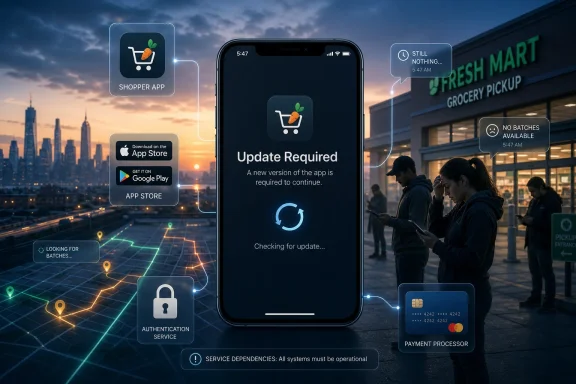
Instacart users and shoppers reported a short-lived app outage early Tuesday, June 2, with complaints beginning shortly after 3 a.m. Eastern time, peaking around the 6 a.m. hour, and fading to near zero by about 8 a.m. The visible symptom was not a classic “site down” failure but an update loop: the app demanded a new version that many users said was unavailable or ineffective after installation. That distinction matters, because modern outages increasingly look less like a server going dark and more like a client, release gate, feature flag, or authentication rule misfiring at scale. For a grocery platform that depends on real-time coordination between customers, shoppers, stores, payments, maps, chat, and inventory systems, even a brief morning glitch is a reminder that convenience is now an operational dependency.
The reports clustered in the early morning, a time window when fewer customers may be placing grocery orders but many gig workers are already checking for batches, preparing for the day, or relying on the app to decide whether work is available. Downdetector-style signals are imperfect because they measure user complaints rather than infrastructure telemetry, but they are useful when a specific symptom repeats across locations and accounts. In this case, users described an app that insisted on an update, redirected them to an app store, and then returned them to the same demand.
That is not the same as a blank screen or an overloaded checkout page. It suggests the app was alive enough to enforce a rule, but the ecosystem around that rule was out of sync. The app believed a newer build was required; the store, device, cached metadata, or backend rollout path did not consistently provide one. For users, the distinction is academic. For engineers, it is the difference between a data-center incident and a release-management incident.
By around 8 a.m. Eastern, complaint volume had reportedly fallen back toward normal. That points to either a quick server-side mitigation, a corrected app-store rollout state, a rollback of a required-version gate, or a gradual propagation fix. Instacart had not, in the material available Tuesday morning, offered a detailed public postmortem explaining the root cause. That leaves the strongest conclusion narrow but important: a mandatory app-update path appears to have locked some users out for several hours.
The Instacart complaints fit this modern pattern. Users were not saying, in large numbers, that every screen was unreachable. They were saying the app demanded an update that either did not exist for them or did not satisfy the app after it was installed. That is the kind of loop that feels absurd to a user because the instruction is clear, the user follows it, and the system refuses to acknowledge compliance.
The problem is especially painful on mobile because app distribution is not instantaneous. Apple’s App Store and Google Play have their own review, caching, regional propagation, device compatibility, and phased-release behaviors. A backend can decide in seconds that version X is now required, but the app-store ecosystem may not make version X equally visible to every device at the same moment. If the enforcement switch flips before the distribution layer is ready, the user gets trapped between two authorities that disagree.
For a grocery app, the damage is not merely annoyance. A customer may be waiting on food, medicine, household essentials, or a pickup window. A shopper may be locked out of earning during a narrow morning window. A retailer may see orders delayed without having direct control over the platform connecting them to customers.
When that app fails, shoppers do not merely lose a convenience; they lose access to the job site. There is no office to walk into, no manager to radio, and often no meaningful offline mode that lets work continue. A shopper stuck in an update loop is not “experiencing degraded service” in the abstract. They are unavailable to accept work, unable to complete pending tasks, or forced to gamble on whether reinstalling, restarting, or waiting will preserve their account state and active orders.
That asymmetry is a core weakness of gig platforms. The platform can treat a short outage as operational noise if it resolves quickly and does not materially affect quarterly numbers. Workers experience the same outage as lost income at the exact moment it happens. The app is the workplace, the time clock, the dispatch board, the payment terminal, and the supervisor. When it loops, so does the worker’s day.
Instacart is hardly unique here. Ride-hailing, food delivery, package delivery, field-service, and marketplace platforms all compress labor coordination into a mobile client. The more work becomes mediated by apps, the more release engineering becomes labor policy by other means. A botched version gate can decide who earns and who waits.
In an update-loop incident, reinstalling may do nothing because the issue is not corrupt local storage. The app may be correctly reading a backend rule that says the installed version is unacceptable. If the app store is not presenting the expected version, the user cannot solve the problem locally. They can only keep pulling the same lever and hope the system changes elsewhere.
This is where outage communication matters. A banner on the support site, a status page note, or a prominent social post can stop thousands of users from wasting time on useless remedies. It can also protect support teams from being overwhelmed by duplicate complaints. When the failure is obvious to users but invisible in official channels, social media becomes the status page.
Downdetector, Reddit, X, and community forums are noisy instruments, but they fill the vacuum left by sparse vendor communication. Users do not flock to them because they are precise; they go there because they need confirmation that the problem is not their device, account, password, phone carrier, or home Wi-Fi. The first reassurance people want during an app incident is simple: it is not just me.
Scale is also why release hygiene matters. A small version-check bug affecting a subset of iOS or Android users can still reach thousands of people. A problem that appears for only certain regions, device builds, app-store states, or account cohorts may not show up as a total outage in internal dashboards. Yet from the outside, it looks widespread because the affected users all hit the same hard stop.
Modern platform reliability is no longer just about uptime. A service can be “up” while a critical percentage of users cannot pass a client gate. APIs can respond, databases can be healthy, and cloud infrastructure can be green while the real customer journey is blocked at the front door. That is why user-experience telemetry and synthetic testing across app versions matter as much as server metrics.
There is also a partner dimension. Retailers that rely on Instacart for digital ordering and fulfillment do not own the customer-facing app path. If a platform bug suppresses demand or blocks shoppers, the retailer may see operational consequences without direct technical control. That is the price of outsourcing convenience to a marketplace layer.
The trouble is that many companies maintain separate communication cultures for enterprise partners, investors, developers, customers, and workers. A technical status page may exist for some integrations while the consumer app audience gets only support prompts and social replies. That segmentation may make organizational sense, but it looks evasive during a real-time incident.
Instacart’s user-facing support account reportedly directed affected users to send direct messages. That can help individual account issues, but it is a poor substitute for a public acknowledgement when the symptom is collective. A DM workflow treats the outage as a series of private cases. A public incident note treats it as a system condition.
The difference matters because trust is cumulative. Users are more forgiving of short outages than of unexplained ones. Shoppers are more forgiving of a bug than of being told, implicitly, to troubleshoot alone while everyone else reports the same loop. Transparency does not eliminate failure, but it reduces the sense that the platform is asking users to debug its release process for free.
Every app-first business now runs a choreography between backend services, mobile clients, app stores, identity providers, fraud systems, payment rails, notification services, analytics SDKs, and feature-flag platforms. Users experience that choreography as one icon on a phone. When any part falls out of step, the icon becomes a locked door.
The safest version-enforcement systems are conservative. They account for app-store propagation delays, device compatibility, staged rollouts, regional caches, and fallback rules. They allow a grace period unless there is an urgent security or data-integrity reason to block older clients immediately. They also include a fast rollback path that does not require users to wait for a new binary.
That last point is critical. If a mobile app can be bricked by a server-side “minimum required version” value, the company must be able to unbrick it just as quickly. Otherwise, the safety mechanism becomes the incident.
Microsoft has spent years trying to balance forced updates against operational continuity. Enterprises demand control because they know a badly timed requirement can halt work. Consumers tolerate less control because the platform promises simplicity. Instacart’s reported update loop is what happens when simplicity meets mandatory compliance and the user has no administrative escape hatch.
There is also a lesson for anyone building Windows apps, progressive web apps, or cross-platform services. Do not assume that an update prompt is harmless. If the prompt blocks the core workflow, it is an outage surface. If the update is unavailable, incompatible, or not recognized, the app has created a dead end.
The same applies to Microsoft Store apps, WinUI clients, Electron wrappers, and browser-based enterprise tools. The client may be only one part of the stack, but it is the part the user touches. A healthy backend cannot compensate for a broken front gate.
 The Outage Was Brief, but the Failure Mode Was Telling
The reports clustered in the early morning, a time window when fewer customers may be placing grocery orders but many gig workers are already checking for batches, preparing for the day, or relying on the app to decide whether work is available. Downdetector-style signals are imperfect because they measure user complaints rather than infrastructure telemetry, but they are useful when a specific symptom repeats across locations and accounts. In this case, users described an app that insisted on an update, redirected them to an app store, and then returned them to the same demand.That is not the same as a blank screen or an overloaded checkout page. It suggests the app was alive enough to enforce a rule, but the ecosystem around that rule was out of sync. The app believed a newer build was required; the store, device, cached metadata, or backend rollout path did not consistently provide one. For users, the distinction is academic. For engineers, it is the difference between a data-center incident and a release-management incident.
By around 8 a.m. Eastern, complaint volume had reportedly fallen back toward normal. That points to either a quick server-side mitigation, a corrected app-store rollout state, a rollback of a required-version gate, or a gradual propagation fix. Instacart had not, in the material available Tuesday morning, offered a detailed public postmortem explaining the root cause. That leaves the strongest conclusion narrow but important: a mandatory app-update path appears to have locked some users out for several hours.
The Mandatory Update Has Become the New Single Point of Failure
Consumer apps used to fail because servers were down. Now they often fail because the company has built a maze of version checks, kill switches, fraud controls, account protections, experiment flags, and staged rollouts around the server. Those systems are useful; they let platforms retire unsafe builds, push urgent fixes, and prevent incompatible clients from touching production APIs. They also create a brittle boundary where a bad decision can strand perfectly functional software outside the gates.The Instacart complaints fit this modern pattern. Users were not saying, in large numbers, that every screen was unreachable. They were saying the app demanded an update that either did not exist for them or did not satisfy the app after it was installed. That is the kind of loop that feels absurd to a user because the instruction is clear, the user follows it, and the system refuses to acknowledge compliance.
The problem is especially painful on mobile because app distribution is not instantaneous. Apple’s App Store and Google Play have their own review, caching, regional propagation, device compatibility, and phased-release behaviors. A backend can decide in seconds that version X is now required, but the app-store ecosystem may not make version X equally visible to every device at the same moment. If the enforcement switch flips before the distribution layer is ready, the user gets trapped between two authorities that disagree.
For a grocery app, the damage is not merely annoyance. A customer may be waiting on food, medicine, household essentials, or a pickup window. A shopper may be locked out of earning during a narrow morning window. A retailer may see orders delayed without having direct control over the platform connecting them to customers.
Gig Workers Feel Outages Before Customers Do
The customer story is obvious: someone opens Instacart to order groceries and cannot get in. The shopper story is more operationally severe. Instacart’s marketplace depends on independent shoppers being available at the right time, near the right stores, with the app functioning as dispatcher, scanner, route planner, payment credential, messaging tool, and proof-of-work system.When that app fails, shoppers do not merely lose a convenience; they lose access to the job site. There is no office to walk into, no manager to radio, and often no meaningful offline mode that lets work continue. A shopper stuck in an update loop is not “experiencing degraded service” in the abstract. They are unavailable to accept work, unable to complete pending tasks, or forced to gamble on whether reinstalling, restarting, or waiting will preserve their account state and active orders.
That asymmetry is a core weakness of gig platforms. The platform can treat a short outage as operational noise if it resolves quickly and does not materially affect quarterly numbers. Workers experience the same outage as lost income at the exact moment it happens. The app is the workplace, the time clock, the dispatch board, the payment terminal, and the supervisor. When it loops, so does the worker’s day.
Instacart is hardly unique here. Ride-hailing, food delivery, package delivery, field-service, and marketplace platforms all compress labor coordination into a mobile client. The more work becomes mediated by apps, the more release engineering becomes labor policy by other means. A botched version gate can decide who earns and who waits.
The Consumer Internet Has Outgrown the “Try Reinstalling” Era
The reported troubleshooting cycle was familiar: update the app, reinstall it, restart the phone, try again, contact support, check social media, compare notes with other users. That routine has become the folk medicine of app-dependent life. It sometimes works, but it also shifts investigative burden from the platform to the user.In an update-loop incident, reinstalling may do nothing because the issue is not corrupt local storage. The app may be correctly reading a backend rule that says the installed version is unacceptable. If the app store is not presenting the expected version, the user cannot solve the problem locally. They can only keep pulling the same lever and hope the system changes elsewhere.
This is where outage communication matters. A banner on the support site, a status page note, or a prominent social post can stop thousands of users from wasting time on useless remedies. It can also protect support teams from being overwhelmed by duplicate complaints. When the failure is obvious to users but invisible in official channels, social media becomes the status page.
Downdetector, Reddit, X, and community forums are noisy instruments, but they fill the vacuum left by sparse vendor communication. Users do not flock to them because they are precise; they go there because they need confirmation that the problem is not their device, account, password, phone carrier, or home Wi-Fi. The first reassurance people want during an app incident is simple: it is not just me.
Instacart’s Scale Makes Small Release Errors Look Big
Instacart presents itself not merely as a delivery app but as grocery infrastructure. The company says it connects consumers with a large network of retailers, stores, and shoppers across thousands of cities. That scale is the pitch to customers and partners: groceries can be ordered from many retailers, fulfilled locally, and coordinated through a single digital layer.Scale is also why release hygiene matters. A small version-check bug affecting a subset of iOS or Android users can still reach thousands of people. A problem that appears for only certain regions, device builds, app-store states, or account cohorts may not show up as a total outage in internal dashboards. Yet from the outside, it looks widespread because the affected users all hit the same hard stop.
Modern platform reliability is no longer just about uptime. A service can be “up” while a critical percentage of users cannot pass a client gate. APIs can respond, databases can be healthy, and cloud infrastructure can be green while the real customer journey is blocked at the front door. That is why user-experience telemetry and synthetic testing across app versions matter as much as server metrics.
There is also a partner dimension. Retailers that rely on Instacart for digital ordering and fulfillment do not own the customer-facing app path. If a platform bug suppresses demand or blocks shoppers, the retailer may see operational consequences without direct technical control. That is the price of outsourcing convenience to a marketplace layer.
The Status Page Problem Is Really a Trust Problem
Enterprise technology buyers understand status pages. Consumers do not need a full incident dashboard, but they do need timely acknowledgement when a major path breaks. Gig workers need it even more because their income depends on knowing whether to wait, switch apps, drive to a hotspot, or abandon the platform for the morning.The trouble is that many companies maintain separate communication cultures for enterprise partners, investors, developers, customers, and workers. A technical status page may exist for some integrations while the consumer app audience gets only support prompts and social replies. That segmentation may make organizational sense, but it looks evasive during a real-time incident.
Instacart’s user-facing support account reportedly directed affected users to send direct messages. That can help individual account issues, but it is a poor substitute for a public acknowledgement when the symptom is collective. A DM workflow treats the outage as a series of private cases. A public incident note treats it as a system condition.
The difference matters because trust is cumulative. Users are more forgiving of short outages than of unexplained ones. Shoppers are more forgiving of a bug than of being told, implicitly, to troubleshoot alone while everyone else reports the same loop. Transparency does not eliminate failure, but it reduces the sense that the platform is asking users to debug its release process for free.
The Update Loop Is a Warning for Every App-First Business
The Instacart incident is useful precisely because it appears to have been brief. Catastrophic outages invite obvious lessons about redundancy, cloud dependency, and disaster recovery. Short app-gate failures are easier to dismiss, but they reveal the everyday fragility of mobile-first operations.Every app-first business now runs a choreography between backend services, mobile clients, app stores, identity providers, fraud systems, payment rails, notification services, analytics SDKs, and feature-flag platforms. Users experience that choreography as one icon on a phone. When any part falls out of step, the icon becomes a locked door.
The safest version-enforcement systems are conservative. They account for app-store propagation delays, device compatibility, staged rollouts, regional caches, and fallback rules. They allow a grace period unless there is an urgent security or data-integrity reason to block older clients immediately. They also include a fast rollback path that does not require users to wait for a new binary.
That last point is critical. If a mobile app can be bricked by a server-side “minimum required version” value, the company must be able to unbrick it just as quickly. Otherwise, the safety mechanism becomes the incident.
Windows Users Should Recognize the Pattern
This may sound distant from Windows, but the pattern is familiar to anyone who has managed PCs at scale. Windows administrators know the pain of update rings, compliance deadlines, phased deployments, driver compatibility, Store app propagation, and policies that look clean in a dashboard but fail on real endpoints. The consumer mobile world is now living the same lifecycle-management problem, just with groceries and gig labor attached.Microsoft has spent years trying to balance forced updates against operational continuity. Enterprises demand control because they know a badly timed requirement can halt work. Consumers tolerate less control because the platform promises simplicity. Instacart’s reported update loop is what happens when simplicity meets mandatory compliance and the user has no administrative escape hatch.
There is also a lesson for anyone building Windows apps, progressive web apps, or cross-platform services. Do not assume that an update prompt is harmless. If the prompt blocks the core workflow, it is an outage surface. If the update is unavailable, incompatible, or not recognized, the app has created a dead end.
The same applies to Microsoft Store apps, WinUI clients, Electron wrappers, and browser-based enterprise tools. The client may be only one part of the stack, but it is the part the user touches. A healthy backend cannot compensate for a broken front gate.
A Morning Grocery Glitch Becomes a Release-Engineering Case Study
The concrete lessons from Tuesday morning are less about Instacart alone than about the operational model it represents. App-mediated services need to treat version gates as production-critical infrastructure, not housekeeping.- The reported outage began shortly after 3 a.m. Eastern on June 2 and faded by around 8 a.m., making it brief but disruptive for early users and shoppers.
- The dominant symptom was an app update loop, with users saying the app required an update that was unavailable or ineffective after installation.
- The incident appears more consistent with a client-release or version-enforcement problem than with a simple all-systems-down failure.
- Public user reports became the practical status layer because detailed official explanation was limited during the incident window.
- Gig workers are disproportionately exposed to these failures because the app is their dispatch system, workplace interface, and income gateway.
- Any platform that can remotely require a minimum app version needs a rollback mechanism, propagation safeguards, and user-visible incident communication.
The Convenience Economy Runs on Invisible Gates
Instacart’s Tuesday morning trouble will likely be remembered, if at all, as a small outage that cleared before much of the country had finished breakfast. But small outages are often the cleanest windows into bigger dependencies. A grocery app that loops on an update is not just a buggy app; it is a reminder that daily life now flows through invisible gates controlled by release systems, compatibility rules, and platform decisions most users never see. The next phase of reliability work for companies like Instacart is not merely preventing downtime, but designing failure paths that let people keep ordering, shopping, earning, and recovering when the gatekeeper itself gets confused.References
- Primary source: aol.com
Published: 2026-06-02T11:50:06.188153
Users reporting problems with Instacart this morning. Here's the latest - AOL
According to Downdetector, Instacart users began complaining about the app shortly after 3 a.m., June 2, and problems persisted after.www.aol.com - Related coverage: docs.instacart.com
Subscribe to updates to the status page | Instacart Docs
Subscribe to updates about platform components available to you on the Instacart Enterprise Status page. You can receive notifications by email, text message, or webhook. You can also manage your subscription by choosing which components you want to be notified about or by unsubscribing from all...docs.instacart.com
- Related coverage: isdown.app
Is Instacart Down? Check current status and user reports
Check if Instacart is down right now. Live Instacart status, real-time outage detection, and instant alerts when Instacart has issues. Free 14-day trial. isdown.app
- Related coverage: tech.yahoo.com
Users reporting problems with Instacart this morning. What we know
According to Downdetector, Instacart users began complaining about the app shortly after 3 a.m., June 2, and problems persisted after.tech.yahoo.com - Related coverage: outage.com
Is Instacart Down? Real-Time Status & Outage Map
Current status for Instacart: Systems are operational. Check real-time outage reports and troubleshooting tips.www.outage.com - Related coverage: justuseapp.com
Instacart app not working? crashes or has problems? | 2026 Solutions
Shop online & get your groceries delivered directly to your door in as fast as 2 hours. Plus, your first grocery delivery is free! And it's safe—contactless delivery is available. Is Instacart: Groceries & Food not working? down or has issues? We have made it super easy to fix...justuseapp.com
- Related coverage: outage.now

Instacart down? Current status and outage map
See if Instacart is down or it's just you. Check current status and outage map. Post yours and see other's reports and complaints
outage.now
- Related coverage: upordownorme.com
Instacart.com - Is Instacart Down right now, up or me. Down detector
Up or Down Detector for Instacart.com. Quickly Check Instacart.com live. is it Up or Down or Me. Check if Instacart down online or offline, to find out whether it is down right now. Instacart.com down Detector. Detect problems with Instacart and response times.www.upordownorme.com - Related coverage: downtime.expert
Is Instacart down? Real-time outages and issues | Downtime Expert
Browse real-time outages and issues for Instacart. Having issues? See what's going on. downtime.expert
- Related coverage: downscanner.com
Is Instacart Down Right Now? Live Outage Reports & Status
Instacart down or not working? See if others are having the same issue. Check service status and recent user reports.downscanner.com
- Related coverage: investors.instacart.com
- Related coverage: mintz.com
- Related coverage: company.instacart.com
Newsroom - Page 2 | Instacart
Latest press releases and company announcements from Instacart.company.instacart.com - Related coverage: ftc.gov
Instacart
The Federal Trade Commission announced that grocery delivery provider Instacart will pay $60 million in refunds to consumers to settle allegations that the company engaged in numerous unlawful tactics that harmed shoppers and raised the cost of grocery shopping for Americans. Instacart will be...www.ftc.gov - Related coverage: outage.report

Instacart down? Outage map, service status, incidents history
See if Instacart is down or it's just you. Check current status and outage map. Post yours and see other's reports and complaints
outage.report
- Related coverage: servicealert.ai
Is Instacart Down? Live Status
Is Instacart down? No, all systems operational. Real-time status, outage history, and instant alerts for Instacart.servicealert.ai - Related coverage: apistatuscheck.com
Is Instacart Down? Instacart Status & Outage History (2026)
Is Instacart down right now? Live status check with real-time monitoring, outage history, and instant alerts. See current Instacart incidents and uptime stats.apistatuscheck.com
