

Microsoft has pushed Copilot Studio deeper into the contact center with the general availability of real-time voice agents for Dynamics 365 Contact Center, a move that turns voice automation from a scripted IVR upgrade into a live, interruptible, speech-to-speech AI experience. The launch is initially bounded to North America, but its significance is broader: Microsoft is now positioning voice as the proving ground for enterprise-grade agentic AI. For customer experience leaders, the message is clear: the next phase of contact center modernization will be judged not by how many channels a platform supports, but by how well it handles the messy, emotional, fast-moving reality of phone conversations.
Voice has always been the hardest channel to automate well because it gives customers no place to hide their frustration and no patience for technical seams. A chatbot can pause, rephrase, or ask a clarifying question without immediately exposing its machinery; a voice system that hesitates, talks over a caller, or loses context becomes a liability within seconds. That is why Microsoft’s new real-time voice agents matter beyond the normal rhythm of feature launches.
The announcement builds on Microsoft’s 2024 launch of Dynamics 365 Contact Center, a Copilot-first cloud contact center designed to combine self-service, routing, agent assist, analytics, and operational tooling under one Microsoft cloud architecture. That product already leaned heavily on Microsoft’s acquisitions and investments around Nuance, Azure AI, Power Platform, and Dynamics 365. The latest voice capability now extends that strategy from “AI-assisted service” into a more direct claim: AI can participate in live customer conversations as an active frontline worker.
Historically, enterprise contact centers have modernized in waves. First came telephony and queue management, then CRM integration, then omnichannel routing, then cloud migration, and most recently generative AI summarization and agent assist. Each wave promised lower cost and better experiences, but voice often remained the stubborn exception because real conversations are nonlinear, emotionally loaded, and operationally risky.
Microsoft is trying to close that gap by treating voice agents as part of a broader agentic customer experience stack rather than a standalone bot. The company’s framing is important: Copilot Studio authors the agent, Dynamics 365 Contact Center deploys it into live service operations, and business systems supply the data and actions needed to resolve the call. That combination is Microsoft’s answer to a long-standing contact center problem: automation that can greet a caller but cannot finish the job.
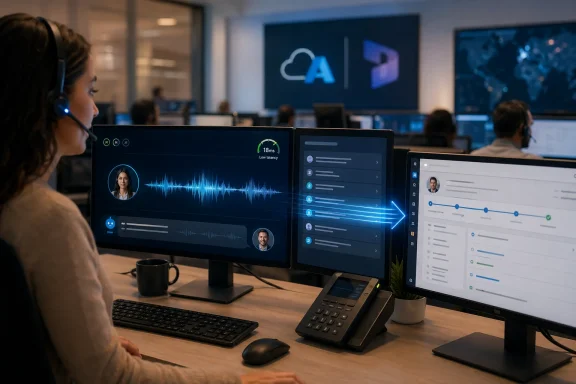
Microsoft’s pitch is that real-time voice agents can support more natural turn-taking while still preserving the guardrails that enterprises need. The core idea is not simply speech recognition plus a generated response. It is a streaming, multimodal interaction where the caller’s audio can be interpreted and answered in real time, reducing the awkward latency that makes many AI phone systems feel artificial.
This distinction matters because latency is not merely a technical metric in voice; it is a customer trust metric. A two-second delay after every answer can make an otherwise accurate system feel confused. A system that cannot handle interruption may appear rude or incompetent even if the underlying data is correct.
Key failure points in legacy automation include:
This is where Microsoft’s move becomes strategically important. If Copilot Studio voice agents can handle routine calls with more fluidity while escalating complex cases with full context, the contact center economics could change substantially. If they cannot, enterprises risk creating a new generation of voice automation that sounds more human but fails in more visible ways.
The agents are intended to move from intent to action to confirmation within one live interaction. In practical terms, that means a caller might ask about an order, interrupt with a billing question, update an address, and then confirm delivery instructions without being forced back to the beginning of a script. The value is not just natural language understanding; it is continuity.
Microsoft’s documentation also points to a blend of generative and deterministic design. That is an important enterprise compromise. Businesses want flexible conversations, but they still need predictable steps for payments, identity checks, regulated disclosures, and compliance-sensitive workflows.
The launch package centers on several core capabilities:
The most practical feature for buyers is context carryover during escalation. When a voice agent hands a call to a human customer service representative, the conversation history, intent, and progress should move with it. That is the operational unlock Microsoft is emphasizing, because customers judge automation harshly when a human agent asks them to start again.
Microsoft’s handoff framing is aimed directly at this weakness. In many contact centers, automation functions as a front door but not a memory layer. Customers authenticate, explain, select options, wait, and then repeat the same information to a human agent because the systems behind the scenes are fragmented.
With Dynamics 365 Contact Center, Microsoft wants to make context portable across AI and human support. That fits the broader Dynamics strategy of treating customer interaction data, operational workflows, and AI assistance as parts of one service layer. For Microsoft customers already invested in Dynamics 365, Power Platform, Microsoft Teams, and Azure, this is the most compelling part of the proposition.
A good escalation model should preserve:
The best AI voice deployments will likely treat escalation as a designed path, not an exception. A customer asking for a refund, reporting fraud, or expressing distress may need a person quickly, but the AI should still help prepare the human agent. In that model, automation becomes a triage and context engine rather than a wall between customer and company.
Microsoft says the release uses an Azure Foundry GPT real-time model as part of the system. Copilot Studio supplies the agent instructions, configured knowledge, tools, and topics, while Dynamics 365 Contact Center supplies the telephony and orchestration layer. That division of labor is central to Microsoft’s strategy because it allows business users to design behavior while IT maintains governance over deployment and integration.
This architecture also changes how teams should think about testing. It is no longer enough to validate a set of typed prompts. Teams must test accents, interruptions, background noise, emotional tone, silence, corrections, and mid-call changes of intent.
A realistic test plan should include:
That is why deterministic topics remain important in Copilot Studio. The most durable deployments will combine scripted reliability for regulated moments with real-time reasoning for conversational flexibility. In other words, the goal is not to replace workflows with AI; it is to let AI navigate workflows more naturally.
Microsoft documentation indicates that, as of April 2026, the real-time voice AI model is hosted in North America only. North American customers receive full support without extra configuration, while customers outside North America may need to allow cross-geo processing. Organizations operating under strict EU data boundary requirements face a sharper limitation because the current model hosting pattern may prevent use of real-time voice in those environments.
This matters especially for multinational enterprises that standardize contact center platforms across regions. A U.S. rollout may be feasible now, while an EU deployment may require waiting for regional model availability or making different architectural decisions. Buyers should not assume that a global Dynamics 365 footprint automatically means global real-time voice readiness.
Questions procurement teams should ask include:
Enterprises should treat responsible AI controls as part of launch readiness, not post-launch tuning. That includes defining prohibited use cases, escalation thresholds, quality review processes, and fallback language. In regulated industries, legal and compliance teams should be involved before the first production call, not after the first complaint.
If a caller asks to reschedule a delivery, the voice agent should not merely answer a question. It should check eligibility, retrieve order data, offer available slots, update the system, confirm the change, and create a traceable record. That is the difference between conversational decoration and operational automation.
For enterprises already using Microsoft tools, this may reduce the integration burden. Copilot Studio, Power Automate, Dataverse, Dynamics 365, Azure, and Microsoft Teams can form a familiar control plane for IT and business teams. The advantage is not that Microsoft owns every system, but that it can present a unified layer across many of them.
Enterprise use cases likely to emerge first include:
The best deployments will not frame AI as a simple headcount replacement. They will redesign roles around human judgment, empathy, exception handling, and customer recovery. Supervisors will also need new skills in conversation analytics, AI evaluation, prompt governance, and workflow optimization.
Microsoft’s emphasis on interruptions and natural speech recognizes a basic truth: customers often speak before the system is ready. They correct themselves, add details, or abandon one path for another. Voice automation that demands perfect turn-taking trains customers to say “representative” as quickly as possible.
A better AI voice experience should allow the caller to speak normally while still guiding the interaction. That means the system must know when to ask a concise clarification, when to act, and when to stop trying and escalate. The art is not sounding human; the art is being useful.
Customer experience gains may include:
Enterprises should make escalation transparent and humane. If a customer is angry, vulnerable, confused, or dealing with a high-stakes issue, the system should not treat containment as the only success metric. A resolved call is not always an automated call.
The company is trying to shift the buying conversation away from standalone CCaaS features and toward enterprise AI orchestration. If AI agents can be built in Copilot Studio and reused across customer service, sales, marketing, operations, and internal workflows, Microsoft can argue that contact center AI should not live in a silo. That argument will resonate with CIOs already rationalizing vendor sprawl.
Rivals will respond by emphasizing depth, maturity, telephony reliability, workforce engagement, analytics, and industry-specific contact center expertise. Microsoft must prove that its broad platform approach does not come at the expense of contact center nuance. In voice, small imperfections become big objections.
Competitive evaluation should now focus on:
That does not guarantee success. Contact center buyers are pragmatic and deeply sensitive to uptime, call quality, reporting, and operational control. Microsoft must win not only the AI vision debate but also the everyday reliability test.
Buyers should model best-case and worst-case usage before expanding from pilot to production. A voice agent that handles high-volume billing calls may consume differently than an agent that only supports appointment confirmations. Cost governance should include caps, monitoring, scenario prioritization, and careful measurement of value delivered.
A sensible rollout sequence looks like this:
IT still needs environment management, data access controls, identity policies, auditability, lifecycle processes, and change review. A small wording change in a voice agent can affect thousands of customer conversations. In that sense, voice agent governance should look more like software release management than chatbot experimentation.
The roadmap into Microsoft Teams Phone is especially notable. If Microsoft can bring real-time voice agents into Teams-based telephony scenarios, the technology could expand beyond external customer service into internal help desks, employee support, branch operations, and departmental workflows. That would make voice agents part of everyday enterprise communications rather than only formal contact center deployments.
Important signals to monitor include:
Microsoft’s advantage is that it can tie voice AI to a broad enterprise stack. Its challenge is that contact center specialists will not concede the operational high ground easily. The companies that win this next phase will be those that make AI voice feel less like a novelty and more like a reliable service colleague.
The launch of real-time voice agents in Copilot Studio is a significant step in Microsoft’s bid to make Dynamics 365 Contact Center a serious AI-native service platform. The technology promises more fluid conversations, better context handoff, and deeper integration with business workflows, but it also raises hard questions about compliance, cost, governance, and customer trust. If Microsoft executes well, voice could become the place where agentic AI proves its enterprise value; if it falls short, customers will hear the cracks immediately.
Source: CX Today Microsoft Copilot Studio Launches Realtime Voice Agents for Dynamics 365 Contact Center
 Overview
Voice has always been the hardest channel to automate well because it gives customers no place to hide their frustration and no patience for technical seams. A chatbot can pause, rephrase, or ask a clarifying question without immediately exposing its machinery; a voice system that hesitates, talks over a caller, or loses context becomes a liability within seconds. That is why Microsoft’s new real-time voice agents matter beyond the normal rhythm of feature launches.The announcement builds on Microsoft’s 2024 launch of Dynamics 365 Contact Center, a Copilot-first cloud contact center designed to combine self-service, routing, agent assist, analytics, and operational tooling under one Microsoft cloud architecture. That product already leaned heavily on Microsoft’s acquisitions and investments around Nuance, Azure AI, Power Platform, and Dynamics 365. The latest voice capability now extends that strategy from “AI-assisted service” into a more direct claim: AI can participate in live customer conversations as an active frontline worker.
Historically, enterprise contact centers have modernized in waves. First came telephony and queue management, then CRM integration, then omnichannel routing, then cloud migration, and most recently generative AI summarization and agent assist. Each wave promised lower cost and better experiences, but voice often remained the stubborn exception because real conversations are nonlinear, emotionally loaded, and operationally risky.
Microsoft is trying to close that gap by treating voice agents as part of a broader agentic customer experience stack rather than a standalone bot. The company’s framing is important: Copilot Studio authors the agent, Dynamics 365 Contact Center deploys it into live service operations, and business systems supply the data and actions needed to resolve the call. That combination is Microsoft’s answer to a long-standing contact center problem: automation that can greet a caller but cannot finish the job.
Why Real-Time Voice Is the Critical Test
The limits of classic IVR
Traditional interactive voice response systems were built around control, not conversation. They work best when callers accept a narrow menu, provide predictable information, and stay inside the structure of the flow. That architecture was useful for routing and simple transactions, but it was never designed for customers who interrupt, correct themselves, change topics, or disclose the real reason for the call only after two minutes of frustration.Microsoft’s pitch is that real-time voice agents can support more natural turn-taking while still preserving the guardrails that enterprises need. The core idea is not simply speech recognition plus a generated response. It is a streaming, multimodal interaction where the caller’s audio can be interpreted and answered in real time, reducing the awkward latency that makes many AI phone systems feel artificial.
This distinction matters because latency is not merely a technical metric in voice; it is a customer trust metric. A two-second delay after every answer can make an otherwise accurate system feel confused. A system that cannot handle interruption may appear rude or incompetent even if the underlying data is correct.
Key failure points in legacy automation include:
- Rigid menu trees that force callers to adapt to the system.
- Long pauses that create uncertainty and repeat prompts.
- Context loss during transfers to human agents.
- Poor interruption handling when callers speak naturally.
- Limited system integration that prevents true resolution.
- Escalation friction that makes customers repeat the same story.
Why the phone still matters
For years, industry vendors tried to steer customers toward lower-cost digital channels, but voice never disappeared. It became the escalation channel for difficult, urgent, emotional, or high-value situations. That means the phone is no longer just one channel among many; it is often the moment where customer loyalty is won or lost.This is where Microsoft’s move becomes strategically important. If Copilot Studio voice agents can handle routine calls with more fluidity while escalating complex cases with full context, the contact center economics could change substantially. If they cannot, enterprises risk creating a new generation of voice automation that sounds more human but fails in more visible ways.
What Microsoft Is Actually Shipping
A premium mode for spoken conversations
Microsoft describes real-time voice agents as a premium mode within Copilot Studio voice agents, optimized for low-latency, interruptible, speech-to-speech conversations with real-time reasoning. The word “premium” is doing several jobs here. It signals more advanced model usage, a higher-value use case, and a likely consumption pattern that differs from basic deterministic voice flows.The agents are intended to move from intent to action to confirmation within one live interaction. In practical terms, that means a caller might ask about an order, interrupt with a billing question, update an address, and then confirm delivery instructions without being forced back to the beginning of a script. The value is not just natural language understanding; it is continuity.
Microsoft’s documentation also points to a blend of generative and deterministic design. That is an important enterprise compromise. Businesses want flexible conversations, but they still need predictable steps for payments, identity checks, regulated disclosures, and compliance-sensitive workflows.
The launch package centers on several core capabilities:
- Natural language understanding without requiring fixed phrases.
- Voice-first design for spoken interactions rather than adapted chat flows.
- Real-time responsiveness with more natural pauses and turn-taking.
- Context awareness across the conversation.
- Flexible integration with CRMs, knowledge bases, APIs, and Power Automate.
- Deterministic control through structured topics and guided flows.
Dynamics 365 Contact Center as the first home
At launch, these experiences run through Dynamics 365 Contact Center, where Microsoft controls the contact center orchestration layer, telephony integration, routing, and handoff experience. That matters because real-time AI voice is only as useful as the workflow around it. A brilliant conversation that cannot transfer, authenticate, update a record, or trigger a process is still a dead end.The most practical feature for buyers is context carryover during escalation. When a voice agent hands a call to a human customer service representative, the conversation history, intent, and progress should move with it. That is the operational unlock Microsoft is emphasizing, because customers judge automation harshly when a human agent asks them to start again.
Context Handoff Is the Real Differentiator
Automation should not erase the customer’s effort
A voice agent that resolves simple calls can reduce queue volume, but a voice agent that escalates poorly can increase frustration and agent workload. The contact center does not win if containment goes up while customer satisfaction goes down. The real measure is whether the entire journey becomes shorter, clearer, and less repetitive.Microsoft’s handoff framing is aimed directly at this weakness. In many contact centers, automation functions as a front door but not a memory layer. Customers authenticate, explain, select options, wait, and then repeat the same information to a human agent because the systems behind the scenes are fragmented.
With Dynamics 365 Contact Center, Microsoft wants to make context portable across AI and human support. That fits the broader Dynamics strategy of treating customer interaction data, operational workflows, and AI assistance as parts of one service layer. For Microsoft customers already invested in Dynamics 365, Power Platform, Microsoft Teams, and Azure, this is the most compelling part of the proposition.
A good escalation model should preserve:
- Caller identity and authentication status where policy allows.
- Stated intent and inferred reason for contact.
- Steps already completed by the voice agent.
- Relevant account, order, or case data retrieved during the call.
- Sentiment and urgency signals useful for routing.
- Transcript and summary for agent review.
Why handoff quality shapes trust
Customers do not separate the bot experience from the human experience. To them, it is one company, one phone call, and one outcome. That is why a failed handoff damages the brand even if the AI agent performed its assigned task correctly.The best AI voice deployments will likely treat escalation as a designed path, not an exception. A customer asking for a refund, reporting fraud, or expressing distress may need a person quickly, but the AI should still help prepare the human agent. In that model, automation becomes a triage and context engine rather than a wall between customer and company.
The Technical Architecture Behind the Shift
Speech-to-speech changes the interaction model
The most important technical change is the use of a real-time speech-to-speech architecture rather than the older chained pattern of speech-to-text, language processing, response generation, and text-to-speech. The older approach can work, but each stage adds latency and introduces potential mismatch. A real-time multimodal model can process streaming audio and generate streaming audio responses with less visible friction.Microsoft says the release uses an Azure Foundry GPT real-time model as part of the system. Copilot Studio supplies the agent instructions, configured knowledge, tools, and topics, while Dynamics 365 Contact Center supplies the telephony and orchestration layer. That division of labor is central to Microsoft’s strategy because it allows business users to design behavior while IT maintains governance over deployment and integration.
This architecture also changes how teams should think about testing. It is no longer enough to validate a set of typed prompts. Teams must test accents, interruptions, background noise, emotional tone, silence, corrections, and mid-call changes of intent.
A realistic test plan should include:
- Barge-in behavior when callers interrupt the agent.
- Ambiguous requests that require clarification.
- Multi-intent conversations that shift between topics.
- Tool failures when a CRM or workflow is unavailable.
- Escalation triggers for sensitive or high-risk scenarios.
- Compliance scripts that must be delivered accurately.
Deterministic control still matters
Generative AI can make voice feel fluid, but contact centers are built on operational accountability. A bank cannot let an AI improvise around payment rules. A healthcare provider cannot let a voice agent blur eligibility language. A public-sector service cannot accept inconsistent answers as the price of convenience.That is why deterministic topics remain important in Copilot Studio. The most durable deployments will combine scripted reliability for regulated moments with real-time reasoning for conversational flexibility. In other words, the goal is not to replace workflows with AI; it is to let AI navigate workflows more naturally.
Regional Availability and Compliance Boundaries
North America first, with important caveats
The first rollout is materially limited. Microsoft says real-time voice agents are generally available in North America first for Dynamics 365 Contact Center, with additional language support, regions, and touchpoints expanding over time. For global organizations, that availability statement is not a footnote; it is a procurement and compliance issue.Microsoft documentation indicates that, as of April 2026, the real-time voice AI model is hosted in North America only. North American customers receive full support without extra configuration, while customers outside North America may need to allow cross-geo processing. Organizations operating under strict EU data boundary requirements face a sharper limitation because the current model hosting pattern may prevent use of real-time voice in those environments.
This matters especially for multinational enterprises that standardize contact center platforms across regions. A U.S. rollout may be feasible now, while an EU deployment may require waiting for regional model availability or making different architectural decisions. Buyers should not assume that a global Dynamics 365 footprint automatically means global real-time voice readiness.
Questions procurement teams should ask include:
- Where is audio processed during live calls?
- Where is call data stored after the interaction?
- What regions support production use today?
- How does cross-geo processing affect policy obligations?
- What happens for EU Data Boundary customers?
- When will additional regions become available?
Responsible AI is a deployment requirement
Microsoft’s own transparency materials caution that real-time voice agents can carry safety-relevant behavioral limitations and that customers remain responsible for lawful and compliant use. That is not unusual for enterprise AI, but it is particularly important in live voice. Spoken responses are immediate, emotionally salient, and harder for supervisors to review before the customer hears them.Enterprises should treat responsible AI controls as part of launch readiness, not post-launch tuning. That includes defining prohibited use cases, escalation thresholds, quality review processes, and fallback language. In regulated industries, legal and compliance teams should be involved before the first production call, not after the first complaint.
Impact on Enterprise Contact Centers
From cost center to orchestration layer
For large enterprises, the appeal of AI voice agents is obvious: contact centers are expensive, labor-intensive, and difficult to scale during spikes. A well-designed real-time voice agent can absorb routine traffic, extend service hours, and reduce repetitive work for human agents. But the bigger opportunity is changing the contact center from a reactive queue into an orchestration layer for customer intent.If a caller asks to reschedule a delivery, the voice agent should not merely answer a question. It should check eligibility, retrieve order data, offer available slots, update the system, confirm the change, and create a traceable record. That is the difference between conversational decoration and operational automation.
For enterprises already using Microsoft tools, this may reduce the integration burden. Copilot Studio, Power Automate, Dataverse, Dynamics 365, Azure, and Microsoft Teams can form a familiar control plane for IT and business teams. The advantage is not that Microsoft owns every system, but that it can present a unified layer across many of them.
Enterprise use cases likely to emerge first include:
- Order status and returns in retail and commerce.
- Appointment scheduling in healthcare and professional services.
- Eligibility and verification in insurance and public services.
- Billing explanations in utilities, telecom, and financial services.
- Membership and account changes in subscription businesses.
- Internal help desk triage for IT and HR service desks.
Workforce implications
The human workforce impact will be uneven. Routine call handling may shift toward AI, but complex service work could become more demanding as agents receive escalations that are emotionally charged, compliance-sensitive, or unusual. That means training, coaching, and mental workload need attention.The best deployments will not frame AI as a simple headcount replacement. They will redesign roles around human judgment, empathy, exception handling, and customer recovery. Supervisors will also need new skills in conversation analytics, AI evaluation, prompt governance, and workflow optimization.
Consumer Experience: Better Calls or Smarter Deflection?
The customer will judge by outcomes
Consumers do not care whether a company uses Copilot Studio, a proprietary model, or a third-party CCaaS AI stack. They care whether the call is fast, respectful, and successful. If real-time voice agents shorten calls and preserve context, customers may welcome them. If they create another layer of polite obstruction, the backlash will be immediate.Microsoft’s emphasis on interruptions and natural speech recognizes a basic truth: customers often speak before the system is ready. They correct themselves, add details, or abandon one path for another. Voice automation that demands perfect turn-taking trains customers to say “representative” as quickly as possible.
A better AI voice experience should allow the caller to speak normally while still guiding the interaction. That means the system must know when to ask a concise clarification, when to act, and when to stop trying and escalate. The art is not sounding human; the art is being useful.
Customer experience gains may include:
- Less menu navigation before reaching the right outcome.
- Fewer repeated explanations after escalation.
- Faster routine resolutions for common service needs.
- More natural conversations for callers who dislike rigid prompts.
- Better accessibility for users who prefer speech over typing.
The risk of over-automation
There is also a consumer risk. As voice agents become more capable, some organizations may use them to make human support harder to reach. That would turn a promising technology into a new deflection shield. Customers are already sensitive to systems that appear designed to exhaust them before offering help.Enterprises should make escalation transparent and humane. If a customer is angry, vulnerable, confused, or dealing with a high-stakes issue, the system should not treat containment as the only success metric. A resolved call is not always an automated call.
Competitive Implications for CCaaS Rivals
Microsoft sharpens the platform battle
The contact center market is crowded with serious competitors, including Genesys, NICE, Five9, Cisco, Talkdesk, Amazon Connect, and Twilio. Many already offer AI capabilities across routing, agent assist, quality management, analytics, and automation. Microsoft’s advantage is not arriving first; it is arriving with the gravity of the Microsoft cloud ecosystem behind it.The company is trying to shift the buying conversation away from standalone CCaaS features and toward enterprise AI orchestration. If AI agents can be built in Copilot Studio and reused across customer service, sales, marketing, operations, and internal workflows, Microsoft can argue that contact center AI should not live in a silo. That argument will resonate with CIOs already rationalizing vendor sprawl.
Rivals will respond by emphasizing depth, maturity, telephony reliability, workforce engagement, analytics, and industry-specific contact center expertise. Microsoft must prove that its broad platform approach does not come at the expense of contact center nuance. In voice, small imperfections become big objections.
Competitive evaluation should now focus on:
- Real interruption handling rather than scripted demo flow.
- Latency under load in production-like environments.
- Clean escalation with full context into the agent desktop.
- Governance controls for regulated conversations.
- Integration depth with systems of record.
- Pricing predictability as AI consumption grows.
The Microsoft ecosystem effect
Microsoft’s broader advantage is distribution. Many enterprises already have Microsoft identity, security, productivity, collaboration, data, and business application footprints. If Dynamics 365 Contact Center can plug voice AI into that estate with less friction than a separate platform, it becomes more attractive even where rival CCaaS products have mature contact center functionality.That does not guarantee success. Contact center buyers are pragmatic and deeply sensitive to uptime, call quality, reporting, and operational control. Microsoft must win not only the AI vision debate but also the everyday reliability test.
Governance, Licensing, and Operational Control
Consumption economics need scrutiny
Microsoft’s newer Dynamics 365 Contact Center agents are tied to Copilot credits, a consumption-based model that aligns spending with AI activity rather than only per-seat licensing. This can be attractive for pilots and variable demand, but it also creates budget questions. Voice interactions can be longer, more compute-intensive, and more operationally frequent than text interactions.Buyers should model best-case and worst-case usage before expanding from pilot to production. A voice agent that handles high-volume billing calls may consume differently than an agent that only supports appointment confirmations. Cost governance should include caps, monitoring, scenario prioritization, and careful measurement of value delivered.
A sensible rollout sequence looks like this:
- Select a narrow, high-volume use case with clear success metrics.
- Define escalation rules for risk, emotion, ambiguity, and compliance.
- Connect only the necessary systems needed for resolution.
- Test real speech behavior with interruptions and noisy conditions.
- Launch with active monitoring and human fallback.
- Review containment, satisfaction, cost, and error patterns before expansion.
Business users gain power, IT keeps accountability
Copilot Studio’s low-code and no-code positioning gives business teams more control over agent design. That is valuable because contact center managers understand customer intent, call drivers, and escalation patterns better than centralized engineering teams. But democratized agent creation also creates governance challenges.IT still needs environment management, data access controls, identity policies, auditability, lifecycle processes, and change review. A small wording change in a voice agent can affect thousands of customer conversations. In that sense, voice agent governance should look more like software release management than chatbot experimentation.
Strengths and Opportunities
Microsoft’s launch gives enterprises a serious new option for modernizing voice without treating the contact center as an isolated AI island. The opportunity is strongest where Dynamics 365, Power Platform, Azure, and Microsoft 365 are already strategic platforms, because real-time voice becomes part of a broader workflow and governance fabric rather than another disconnected automation project.- Real-time speech-to-speech interaction can make automated calls feel less brittle and more natural.
- Context carryover can reduce the customer frustration caused by repeated explanations.
- Copilot Studio authoring gives business teams a practical way to tune agent behavior.
- Dynamics 365 integration can connect voice automation to cases, accounts, orders, and service workflows.
- Deterministic topics help preserve control for regulated or high-risk process steps.
- Human escalation paths can turn automation into triage rather than obstruction.
- Roadmap expansion into Teams Phone and other channels could broaden the value of voice agents over time.
Risks and Concerns
The risks are just as real as the upside because voice is unforgiving. A flawed generative AI experience in chat may be recoverable, but a flawed voice interaction can produce immediate customer anger, compliance exposure, or reputational damage. Microsoft has a strong platform story, but every buyer must validate the system against their own policies, regions, data boundaries, and service expectations.- Regional limits mean global enterprises may not be able to deploy uniformly at launch.
- Cross-geo processing can create compliance barriers for some non-North American customers.
- EU Data Boundary constraints may delay adoption for organizations with strict residency requirements.
- Consumption pricing can become difficult to predict at high call volumes.
- Model behavior limitations require active testing, monitoring, and responsible AI controls.
- Poor escalation design can turn AI containment into customer frustration.
- Operational complexity may increase if business teams create agents without strong governance.
What to Watch Next
The roadmap will determine global relevance
The next phase will depend on how quickly Microsoft expands region support, language coverage, and channel availability. North America-first general availability is a meaningful start, but contact center platforms are often global decisions. Large enterprises will want clarity on when real-time voice models can operate within their required geographies and compliance boundaries.The roadmap into Microsoft Teams Phone is especially notable. If Microsoft can bring real-time voice agents into Teams-based telephony scenarios, the technology could expand beyond external customer service into internal help desks, employee support, branch operations, and departmental workflows. That would make voice agents part of everyday enterprise communications rather than only formal contact center deployments.
Important signals to monitor include:
- Regional expansion beyond North America.
- Language and accent performance across diverse caller populations.
- Teams Phone integration and how it differs from Dynamics 365 Contact Center deployment.
- Pricing transparency for real-time voice at production scale.
- Customer case studies showing measurable resolution, satisfaction, and cost outcomes.
The market will move from demos to evidence
In 2026, nearly every major CCaaS vendor will claim serious AI voice capability. The real distinction will be production proof: latency, containment quality, compliance control, escalation success, agent satisfaction, and customer trust. Demo scripts will matter less than recordings, metrics, and operational resilience.Microsoft’s advantage is that it can tie voice AI to a broad enterprise stack. Its challenge is that contact center specialists will not concede the operational high ground easily. The companies that win this next phase will be those that make AI voice feel less like a novelty and more like a reliable service colleague.
The launch of real-time voice agents in Copilot Studio is a significant step in Microsoft’s bid to make Dynamics 365 Contact Center a serious AI-native service platform. The technology promises more fluid conversations, better context handoff, and deeper integration with business workflows, but it also raises hard questions about compliance, cost, governance, and customer trust. If Microsoft executes well, voice could become the place where agentic AI proves its enterprise value; if it falls short, customers will hear the cracks immediately.
Source: CX Today Microsoft Copilot Studio Launches Realtime Voice Agents for Dynamics 365 Contact Center
