

Microsoft Digital has introduced DigitalMe, a Copilot Studio-built “digital twin” agent for Microsoft employees that can answer questions in Teams meetings and Outlook on a user’s behalf, with early experiments showing 158 questions handled in a one-hour session. The agent is not a consumer Windows feature, and it is not a general-purpose clone in the science-fiction sense. It is something more practical and, for enterprises, more consequential: a sanctioned proxy that sits inside Microsoft 365, uses scoped workplace knowledge, and keeps collaboration moving when humans are overloaded or unavailable.
That distinction matters because Microsoft’s AI strategy is no longer just about helping users write faster emails or summarize meetings after the fact. DigitalMe points toward a more aggressive workplace model in which agents participate in the flow of work, speak in employee-adjacent contexts, and turn institutional knowledge into a near-real-time service. The sales pitch is productivity; the harder story is governance.
The phrase “digital twin” has long belonged to factories, logistics systems, and infrastructure modeling, where a software representation mirrors the state of a physical object or process. Microsoft’s use of the term for DigitalMe is intentionally more human and more provocative. This is not a simulation of an employee’s brain, personality, or judgment; it is a constrained operational proxy for a worker’s accessible knowledge.
That makes DigitalMe less magical than the branding suggests, but also more plausible. The agent draws from knowledge sources its user can access, such as SharePoint sites and Teams channels, and then responds in Microsoft Teams or Outlook. It is built to answer the questions that swamp presenters, moderators, and distributed teams, not to replace the worker who owns the knowledge.
The initial setting is telling. Microsoft Digital’s Employee Experience Success team in the Greater China Region was running readiness sessions for Microsoft 365 Copilot and Copilot Studio, where attendee questions were outpacing what a human moderator could handle. DigitalMe emerged as a way to keep the meeting moving while giving participants timely answers from trusted material.
This is the mundane crisis that enterprise AI is best positioned to attack. Most knowledge work is not blocked by a lack of creativity; it is blocked by latency, missing context, unanswered chat threads, and people being in the wrong time zone. DigitalMe is Microsoft’s attempt to turn that friction into an agent use case that looks obvious only after someone builds it.
DigitalMe attacks that problem by behaving like an always-on co-moderator. In a live session, it can answer questions in chat using a preloaded and scoped body of knowledge while the presenter continues speaking. Microsoft says one early 60-minute session saw the agent handle 158 questions, save roughly 60 to 90 minutes of manual moderation effort, and capture all questions and answers for reuse as FAQs.
Those numbers should be treated as early internal measurements, not proof that every organization can drop a similar agent into meetings and get the same outcome. But they do illustrate why Microsoft is excited. The agent does not need to be brilliant to be useful; it needs to be fast, consistent, and grounded in the same material the human expert would otherwise have to search manually.
The most interesting feature may not be the answer generation at all. It is the feedback loop. When questions and answers are captured for reuse, the meeting stops being a one-off event and becomes training data for the organization’s own knowledge base. In that sense, DigitalMe is not merely moderating collaboration; it is converting collaboration exhaust into structured institutional memory.
That distinction will become one of the defining enterprise AI issues of the next few years. A workplace agent that replies in Teams or Outlook on behalf of a person can save time, but it also changes the social contract of communication. If a colleague receives a reply from “you,” they need to know whether they are getting your considered answer, your agent’s best retrieval-augmented approximation, or something that should be treated as provisional.
Microsoft appears to understand that problem, at least in this implementation. DigitalMe is not presented as a stealth responder. It is a visible participant, a virtual proxy that discloses itself and can flag gaps for human follow-up.
That does not eliminate the risk. It shifts the risk from deception to trust calibration. Employees and managers will still have to learn when an agent’s answer is enough, when it requires confirmation, and when the presence of an agent should be interpreted as a delegation rather than a decision.
For decades, enterprise automation has been gated by scarce developer time, brittle integrations, and a long queue of departmental requests that IT could never fully satisfy. Copilot Studio changes Microsoft’s pitch from “we will build an app for you” to “you can build a bounded agent yourself.” DigitalMe is being turned into a template inside Microsoft’s Agent Starter Kit, allowing employees to import a ready-made agent, connect knowledge sources, and modify it for their own workflows.
This is classic Microsoft platform strategy. The company is not only demonstrating an internal tool; it is demonstrating a repeatable pattern that makes Copilot Studio more credible as a workplace automation layer. The individual agent matters less than the template model around it.
For WindowsForum readers, the implication is familiar. This is the same Microsoft that built ecosystems around Office macros, SharePoint workflows, Power Platform apps, Teams bots, and now Copilot agents. The productivity gain comes with the same perennial enterprise problem: once everyone can build, someone has to govern what gets built.
DigitalMe fits that model almost too neatly. A human expert defines the knowledge scope and remains accountable for the domain. The agent answers routine or repeated questions, handles meeting overflow, and flags cases where it lacks sufficient knowledge. Over time, the employee or team expands the source material so the agent becomes more useful.
This is not autonomous AI in the dramatic sense. It is more like a persistent layer of delegated responsiveness. The agent does not need to invent strategy; it needs to reduce the number of times a human has to type the same explanation, hunt for the same document, or apologize for being offline.
That is why the use cases Microsoft highlights are not exotic. Moderating live sessions, answering repetitive readiness questions, bridging time zones, supporting handoffs, and helping during out-of-office periods are painfully normal problems. The future of agentic work may arrive first not as a robot coworker, but as a better office autoresponder with access to the right files.
But “bounded” is not the same as “safe.” Many organizations already suffer from overshared SharePoint sites, sprawling Teams channels, and documents whose permissions were set casually years ago. An agent connected to that environment may not create the original access problem, but it can make the problem more visible and more consequential by retrieving information faster than humans would.
This is where the DigitalMe pattern intersects with an uncomfortable truth about Microsoft 365 AI deployments. Copilot and Copilot Studio can reward organizations that have done the unglamorous work of information governance, classification, retention, and permissions hygiene. They can also punish organizations that treated those disciplines as optional.
Admins should not read DigitalMe as a plug-and-play miracle. They should read it as a reminder that AI agents inherit the quality of the tenant they live in. If your Microsoft 365 environment is clean, scoped, and well-governed, an agent can be a force multiplier. If it is a swamp of stale permissions and ambiguous ownership, an agent may simply become the fastest thing ever built for finding your mistakes.
DigitalMe’s Outlook role is especially important. Email has always had delegation mechanisms, from shared mailboxes to executive assistants to out-of-office replies. An agent that monitors incoming messages, drafts or generates context-aware replies, and surfaces relevant knowledge is a natural evolution of that model. It also raises the stakes because email remains a system of record in many organizations.
Teams, meanwhile, is the collaboration sprawl engine Microsoft both created and now has to tame. A DigitalMe-style agent in Teams can answer questions in a meeting chat, keep distributed teams moving, and provide a kind of searchable proxy for a subject matter expert. That could reduce interruptions, but it could also normalize a world where every channel contains semi-autonomous actors speaking with partial authority.
The user interface problem will be enormous. Workers will need to know which agent is speaking, whose knowledge it represents, whether the answer is grounded in approved content, and whether a human has reviewed it. The more agents become ordinary participants in Teams and Outlook, the more Microsoft will need to make provenance feel as natural as a sender name or file permission icon.
The best version of DigitalMe is a learning loop. Employees deploy an agent, watch where it fails, add or correct knowledge sources, and gradually reduce repetitive work. The worst version is a neglected agent that continues answering with stale or incomplete material because nobody owns its upkeep.
This ownership question is where many enterprise AI projects will live or die. Who is accountable for a DigitalMe agent’s responses? The employee it represents? The team that imported the template? The platform owner? The compliance office? Microsoft’s internal story can assume a relatively mature environment, but customers will need sharper operating rules.
There is also a cultural issue. Employees may appreciate an agent that saves them from repetitive questions, but they may resent being expected to maintain a digital proxy as yet another workplace chore. Agent upkeep will need to be treated as part of knowledge management, not as invisible labor tacked onto already overloaded teams.
Still, the rhetoric of a “digital twin” will make some workers uneasy. A tool that speaks on your behalf, learns your working style, and eventually gains memory and behavioral context can sound less like an assistant and more like a measurable substitute. Microsoft says the goal is to evolve DigitalMe into a more complete digital representative, and that phrase will land differently depending on whether you are a manager, a frontline employee, a compliance officer, or a union negotiator.
The pragmatic view is that organizations have always tried to scale expertise. Documentation, recorded trainings, shared mailboxes, knowledge bases, and internal portals are all attempts to make one person’s knowledge available to many. DigitalMe is a more interactive version of that impulse.
The sharper concern is that agents could change expectations around availability. If your DigitalMe can answer when you are out of office, does that protect your time or erode it? Does it reduce interruptions, or does it create a new standard that every employee must have a proxy capable of keeping the machine running while they sleep?
But the metrics also reveal what remains hard to measure. A satisfactory answer in a meeting chat may not be the same as a correct answer in a regulated workflow. Time saved for a presenter may become time spent later by someone auditing agent responses. More engagement may mean better participation, or it may mean attendees have learned to interrogate the bot because doing so is easier than reading the source material.
None of this invalidates the experiment. It simply places it in the correct category. DigitalMe is a promising internal pattern, not a universal proof point.
The true enterprise test will be repeatability. Can the same approach work outside Microsoft’s unusually AI-literate environment? Can nontechnical employees configure agents safely without turning every department into its own shadow automation shop? Can IT give users enough freedom to innovate without allowing agent sprawl to become the next version of unmanaged macros?
For sysadmins, that means the old boundary between endpoint management and information governance continues to blur. A user’s Windows device, Entra identity, Teams presence, Outlook mailbox, SharePoint permissions, and Copilot agents are all part of the same practical security story. If an agent is replying on behalf of a user, the endpoint is only one piece of the trust chain.
For developers and power users, DigitalMe is another sign that Microsoft wants agent creation to feel like the next stage of Power Platform. The company is nudging organizations toward a model where business users assemble workflows in natural language, connect them to Microsoft 365 data, and publish them into familiar collaboration tools. That could unlock a wave of small, useful automations that traditional software teams would never prioritize.
It could also recreate every governance headache Microsoft customers have seen before. Low-code systems thrive because they reduce friction. They fail when reduced friction becomes reduced accountability.
That is how internal innovations become platform narratives. Microsoft can show customers not only that an agent works, but that the agent can be packaged, repeated, and taught. The company has also tied the kit into its Agent Launchpad skilling program, reinforcing the idea that agent fluency is becoming a workplace competency.
This matters because enterprise AI adoption is often less limited by model capability than by translation. Workers may have ideas for useful agents but assume building one is too complex. Templates collapse that distance by giving people something concrete to modify rather than a blank canvas.
The risk is that templates can make deployment feel safer than it is. A prebuilt agent pattern still needs local judgment about data sources, permissions, tone, escalation, retention, and acceptable use. DigitalMe may be easy to import, but a digital representative of an employee should never be casually deployed.
The practical reading is narrower and stronger than the marketing line. Do not start with the ambition to clone a worker. Start with the recurring work that keeps that worker from doing higher-value tasks.
That distinction matters because Microsoft’s AI strategy is no longer just about helping users write faster emails or summarize meetings after the fact. DigitalMe points toward a more aggressive workplace model in which agents participate in the flow of work, speak in employee-adjacent contexts, and turn institutional knowledge into a near-real-time service. The sales pitch is productivity; the harder story is governance.
 Microsoft’s Digital Twin Is Really a Workplace Proxy
The phrase “digital twin” has long belonged to factories, logistics systems, and infrastructure modeling, where a software representation mirrors the state of a physical object or process. Microsoft’s use of the term for DigitalMe is intentionally more human and more provocative. This is not a simulation of an employee’s brain, personality, or judgment; it is a constrained operational proxy for a worker’s accessible knowledge.That makes DigitalMe less magical than the branding suggests, but also more plausible. The agent draws from knowledge sources its user can access, such as SharePoint sites and Teams channels, and then responds in Microsoft Teams or Outlook. It is built to answer the questions that swamp presenters, moderators, and distributed teams, not to replace the worker who owns the knowledge.
The initial setting is telling. Microsoft Digital’s Employee Experience Success team in the Greater China Region was running readiness sessions for Microsoft 365 Copilot and Copilot Studio, where attendee questions were outpacing what a human moderator could handle. DigitalMe emerged as a way to keep the meeting moving while giving participants timely answers from trusted material.
This is the mundane crisis that enterprise AI is best positioned to attack. Most knowledge work is not blocked by a lack of creativity; it is blocked by latency, missing context, unanswered chat threads, and people being in the wrong time zone. DigitalMe is Microsoft’s attempt to turn that friction into an agent use case that looks obvious only after someone builds it.
The Meeting Chat Became the First Battlefield
Large corporate meetings have become a strange hybrid of broadcast, chat room, help desk, and compliance exercise. Presenters speak, attendees ask questions, side conversations bloom, links are requested, and someone is expected to maintain the illusion that all of this is orderly. The result is often a graveyard of unanswered questions and follow-up promises.DigitalMe attacks that problem by behaving like an always-on co-moderator. In a live session, it can answer questions in chat using a preloaded and scoped body of knowledge while the presenter continues speaking. Microsoft says one early 60-minute session saw the agent handle 158 questions, save roughly 60 to 90 minutes of manual moderation effort, and capture all questions and answers for reuse as FAQs.
Those numbers should be treated as early internal measurements, not proof that every organization can drop a similar agent into meetings and get the same outcome. But they do illustrate why Microsoft is excited. The agent does not need to be brilliant to be useful; it needs to be fast, consistent, and grounded in the same material the human expert would otherwise have to search manually.
The most interesting feature may not be the answer generation at all. It is the feedback loop. When questions and answers are captured for reuse, the meeting stops being a one-off event and becomes training data for the organization’s own knowledge base. In that sense, DigitalMe is not merely moderating collaboration; it is converting collaboration exhaust into structured institutional memory.
The Agent Speaks, but Microsoft Knows It Must Wear a Badge
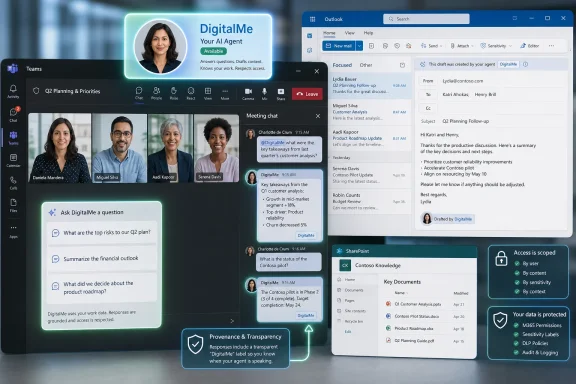
DigitalMe’s design includes a small but important transparency choice: messages begin with a label indicating that they come from the agent. The agent also includes the requester’s original question in quotation marks and @-mentions the recipient so the response lands in the correct context. These details sound minor, but they are the difference between an agent that assists and an agent that impersonates.That distinction will become one of the defining enterprise AI issues of the next few years. A workplace agent that replies in Teams or Outlook on behalf of a person can save time, but it also changes the social contract of communication. If a colleague receives a reply from “you,” they need to know whether they are getting your considered answer, your agent’s best retrieval-augmented approximation, or something that should be treated as provisional.
Microsoft appears to understand that problem, at least in this implementation. DigitalMe is not presented as a stealth responder. It is a visible participant, a virtual proxy that discloses itself and can flag gaps for human follow-up.
That does not eliminate the risk. It shifts the risk from deception to trust calibration. Employees and managers will still have to learn when an agent’s answer is enough, when it requires confirmation, and when the presence of an agent should be interpreted as a delegation rather than a decision.
Low-Code Is the Strategic Point, Not a Footnote
Microsoft says DigitalMe was built in Copilot Studio with a strong low-code bias, with only about 15 to 20 percent of the agent requiring code and the rest shaped through natural language prompts and configuration. That is not a technical aside. It is the strategic heart of the product story.For decades, enterprise automation has been gated by scarce developer time, brittle integrations, and a long queue of departmental requests that IT could never fully satisfy. Copilot Studio changes Microsoft’s pitch from “we will build an app for you” to “you can build a bounded agent yourself.” DigitalMe is being turned into a template inside Microsoft’s Agent Starter Kit, allowing employees to import a ready-made agent, connect knowledge sources, and modify it for their own workflows.
This is classic Microsoft platform strategy. The company is not only demonstrating an internal tool; it is demonstrating a repeatable pattern that makes Copilot Studio more credible as a workplace automation layer. The individual agent matters less than the template model around it.
For WindowsForum readers, the implication is familiar. This is the same Microsoft that built ecosystems around Office macros, SharePoint workflows, Power Platform apps, Teams bots, and now Copilot agents. The productivity gain comes with the same perennial enterprise problem: once everyone can build, someone has to govern what gets built.
The Frontier Firm Slogan Hides a Real Operating Model
Microsoft frames DigitalMe through its broader “Frontier Firm” language, a term the company uses for organizations that redesign work around human-led, agent-operated processes. The phrase has the usual conference-keynote sheen, but beneath it is a real operating model. Humans set direction, agents execute bounded tasks, and workflows improve as feedback exposes gaps.DigitalMe fits that model almost too neatly. A human expert defines the knowledge scope and remains accountable for the domain. The agent answers routine or repeated questions, handles meeting overflow, and flags cases where it lacks sufficient knowledge. Over time, the employee or team expands the source material so the agent becomes more useful.
This is not autonomous AI in the dramatic sense. It is more like a persistent layer of delegated responsiveness. The agent does not need to invent strategy; it needs to reduce the number of times a human has to type the same explanation, hunt for the same document, or apologize for being offline.
That is why the use cases Microsoft highlights are not exotic. Moderating live sessions, answering repetitive readiness questions, bridging time zones, supporting handoffs, and helping during out-of-office periods are painfully normal problems. The future of agentic work may arrive first not as a robot coworker, but as a better office autoresponder with access to the right files.
The Security Story Is Both Reassuring and Incomplete
Microsoft emphasizes that DigitalMe draws from knowledge sources the employee can access. That is the right starting point, because workplace agents become dangerous when they flatten permission boundaries or launder restricted information through conversational interfaces. If an agent can only use what the user can use, the blast radius is at least bounded by existing identity and access controls.But “bounded” is not the same as “safe.” Many organizations already suffer from overshared SharePoint sites, sprawling Teams channels, and documents whose permissions were set casually years ago. An agent connected to that environment may not create the original access problem, but it can make the problem more visible and more consequential by retrieving information faster than humans would.
This is where the DigitalMe pattern intersects with an uncomfortable truth about Microsoft 365 AI deployments. Copilot and Copilot Studio can reward organizations that have done the unglamorous work of information governance, classification, retention, and permissions hygiene. They can also punish organizations that treated those disciplines as optional.
Admins should not read DigitalMe as a plug-and-play miracle. They should read it as a reminder that AI agents inherit the quality of the tenant they live in. If your Microsoft 365 environment is clean, scoped, and well-governed, an agent can be a force multiplier. If it is a swamp of stale permissions and ambiguous ownership, an agent may simply become the fastest thing ever built for finding your mistakes.
Outlook and Teams Are Becoming Agent Surfaces
The choice of Teams and Outlook is not accidental. These are the places where modern Microsoft work already happens, and they are also the places where attention is most fragmented. If Microsoft wants agents to feel less like a separate app and more like an ambient layer, it has to put them inside chat, email, calendars, meetings, and documents.DigitalMe’s Outlook role is especially important. Email has always had delegation mechanisms, from shared mailboxes to executive assistants to out-of-office replies. An agent that monitors incoming messages, drafts or generates context-aware replies, and surfaces relevant knowledge is a natural evolution of that model. It also raises the stakes because email remains a system of record in many organizations.
Teams, meanwhile, is the collaboration sprawl engine Microsoft both created and now has to tame. A DigitalMe-style agent in Teams can answer questions in a meeting chat, keep distributed teams moving, and provide a kind of searchable proxy for a subject matter expert. That could reduce interruptions, but it could also normalize a world where every channel contains semi-autonomous actors speaking with partial authority.
The user interface problem will be enormous. Workers will need to know which agent is speaking, whose knowledge it represents, whether the answer is grounded in approved content, and whether a human has reviewed it. The more agents become ordinary participants in Teams and Outlook, the more Microsoft will need to make provenance feel as natural as a sender name or file permission icon.
Human-in-the-Loop Is Not Optional Decoration
Microsoft’s article makes a point of saying DigitalMe includes human-in-the-loop capabilities. When the agent encounters gaps in its knowledge, it can flag those moments for follow-up, prompting users to refine and expand the knowledge base. That is more than a product feature; it is a concession that workplace agents cannot be left to drift.The best version of DigitalMe is a learning loop. Employees deploy an agent, watch where it fails, add or correct knowledge sources, and gradually reduce repetitive work. The worst version is a neglected agent that continues answering with stale or incomplete material because nobody owns its upkeep.
This ownership question is where many enterprise AI projects will live or die. Who is accountable for a DigitalMe agent’s responses? The employee it represents? The team that imported the template? The platform owner? The compliance office? Microsoft’s internal story can assume a relatively mature environment, but customers will need sharper operating rules.
There is also a cultural issue. Employees may appreciate an agent that saves them from repetitive questions, but they may resent being expected to maintain a digital proxy as yet another workplace chore. Agent upkeep will need to be treated as part of knowledge management, not as invisible labor tacked onto already overloaded teams.
DigitalMe Is a Productivity Tool With a Labor Politics Shadow
Microsoft’s framing is careful: DigitalMe extends employee responsiveness and reach; it does not replace employees. That is likely true in the immediate implementation. The agent is handling meeting questions, out-of-office knowledge access, and workflow triggers such as task creation or FAQ capture.Still, the rhetoric of a “digital twin” will make some workers uneasy. A tool that speaks on your behalf, learns your working style, and eventually gains memory and behavioral context can sound less like an assistant and more like a measurable substitute. Microsoft says the goal is to evolve DigitalMe into a more complete digital representative, and that phrase will land differently depending on whether you are a manager, a frontline employee, a compliance officer, or a union negotiator.
The pragmatic view is that organizations have always tried to scale expertise. Documentation, recorded trainings, shared mailboxes, knowledge bases, and internal portals are all attempts to make one person’s knowledge available to many. DigitalMe is a more interactive version of that impulse.
The sharper concern is that agents could change expectations around availability. If your DigitalMe can answer when you are out of office, does that protect your time or erode it? Does it reduce interruptions, or does it create a new standard that every employee must have a proxy capable of keeping the machine running while they sleep?
The Early Metrics Are Useful, but They Are Not the Whole Story
Microsoft’s early figures are strong enough to explain why the company is expanding DigitalMe internally. A single one-hour session reportedly produced 158 handled questions, roughly 90 percent satisfactory answers, more than 60 chat messages, and a reusable FAQ record. For a readiness session or training event, those are meaningful operational gains.But the metrics also reveal what remains hard to measure. A satisfactory answer in a meeting chat may not be the same as a correct answer in a regulated workflow. Time saved for a presenter may become time spent later by someone auditing agent responses. More engagement may mean better participation, or it may mean attendees have learned to interrogate the bot because doing so is easier than reading the source material.
None of this invalidates the experiment. It simply places it in the correct category. DigitalMe is a promising internal pattern, not a universal proof point.
The true enterprise test will be repeatability. Can the same approach work outside Microsoft’s unusually AI-literate environment? Can nontechnical employees configure agents safely without turning every department into its own shadow automation shop? Can IT give users enough freedom to innovate without allowing agent sprawl to become the next version of unmanaged macros?
The Windows Angle Is the Microsoft 365 Control Plane
DigitalMe is not a Windows feature, but Windows users should still pay attention because the agent economy Microsoft is building will increasingly run through the endpoints, identities, and productivity surfaces that define the Windows workplace. The PC is no longer just where Office runs. It is the local window into a cloud-managed, identity-bound, agent-mediated workspace.For sysadmins, that means the old boundary between endpoint management and information governance continues to blur. A user’s Windows device, Entra identity, Teams presence, Outlook mailbox, SharePoint permissions, and Copilot agents are all part of the same practical security story. If an agent is replying on behalf of a user, the endpoint is only one piece of the trust chain.
For developers and power users, DigitalMe is another sign that Microsoft wants agent creation to feel like the next stage of Power Platform. The company is nudging organizations toward a model where business users assemble workflows in natural language, connect them to Microsoft 365 data, and publish them into familiar collaboration tools. That could unlock a wave of small, useful automations that traditional software teams would never prioritize.
It could also recreate every governance headache Microsoft customers have seen before. Low-code systems thrive because they reduce friction. They fail when reduced friction becomes reduced accountability.
The Agent Starter Kit Turns One Experiment Into a Pattern
The most important detail in Microsoft’s DigitalMe story may be that the agent has been templatized and added to the company’s Agent Starter Kit. That moves it from clever internal hack to organizational distribution mechanism. Employees can import a ready-made version, connect it to their knowledge sources, and adapt it to their workflows.That is how internal innovations become platform narratives. Microsoft can show customers not only that an agent works, but that the agent can be packaged, repeated, and taught. The company has also tied the kit into its Agent Launchpad skilling program, reinforcing the idea that agent fluency is becoming a workplace competency.
This matters because enterprise AI adoption is often less limited by model capability than by translation. Workers may have ideas for useful agents but assume building one is too complex. Templates collapse that distance by giving people something concrete to modify rather than a blank canvas.
The risk is that templates can make deployment feel safer than it is. A prebuilt agent pattern still needs local judgment about data sources, permissions, tone, escalation, retention, and acceptable use. DigitalMe may be easy to import, but a digital representative of an employee should never be casually deployed.
Microsoft’s Clone Is Really a Mirror Held Up to IT
DigitalMe’s most concrete lesson is not that every employee needs a digital twin tomorrow. It is that enterprises are drowning in collaboration work that can be partially automated if the knowledge is trustworthy and the boundaries are clear. Microsoft’s internal experiment shows how quickly a small agent can become valuable when it is aimed at a specific bottleneck.The practical reading is narrower and stronger than the marketing line. Do not start with the ambition to clone a worker. Start with the recurring work that keeps that worker from doing higher-value tasks.
- DigitalMe is an internal Microsoft Digital agent built with Copilot Studio to respond in Teams and Outlook using scoped workplace knowledge.
- Its strongest early use case is live meeting moderation, where it can answer repetitive questions while preserving presenter focus.
- Microsoft’s reported early results are promising, but they come from internal experiments and should not be treated as universal benchmarks.
- The agent’s transparency label is essential because workplace proxies must not blur the line between human judgment and automated response.
- The biggest deployment risk is not the model alone, but the state of the organization’s permissions, knowledge sources, and governance practices.
- The Agent Starter Kit signals that Microsoft wants DigitalMe-style agents to become repeatable employee-built patterns, not bespoke IT projects.
References
- Primary source: Microsoft
Published: 2026-06-11T16:42:12.362501
Meet DigitalMe: Our AI digital twin that works on our behalf - Inside Track Blog
DigitalMe is our templatized, personal digital twin that can act on our behalf while we’re presenting or out of the office.www.microsoft.com - Official source: support.microsoft.com
Chat with Copilot in Outlook | Microsoft Support
Copilot in Outlook offers fully integrated contextual help, email summarization, and task automation like drafting, auto-replies, and rule creation for Windows and Web.support.microsoft.com - Related coverage: tomshardware.com
Microsoft unveils Project Solara AI, a chip-to-cloud platform built to power a new generation of 'agent-first' enterprise devices — hardware designed to run AI agents instead of traditional apps | Tom's Hardware
Microsoft ditches Windows to build OS on Androidwww.tomshardware.com - Official source: blogs.microsoft.com
AI alone won't change your business. The system running it will. - The Official Microsoft Blog
Become an AI-first enterprise with Microsoft’s agent platform.blogs.microsoft.com - Official source: developer.microsoft.com
Build agents, your way | Microsoft Developer
From low-code to pro-code, choose the right tool for the task. Build with familiar workflows, integrate with your stack, and deploy to a trusted platform.developer.microsoft.com - Related coverage: windowscentral.com
Microsoft launches seven in‑house AI models to cut developer costs and reduce reliance on OpenAI | Windows Central
Microsoft’s new MAI model family includes a flagship reasoning model, zero distillation, and lower developer costs.www.windowscentral.com
- Official source: adoption.microsoft.com
Microsoft Copilot Studio – Microsoft Adoption
Deliver value and employee satisfaction with our tools for Microsoft 365 Copilot Chat, Microsoft 365 Copilot, and agent deployment and adoption.adoption.microsoft.com - Official source: learn.microsoft.com
Agents, Actions, and Connectors in the Microsoft 365 Ecosystem | Microsoft Learn
Agents, actions, and connectors run across the Microsoft 365 ecosystem. Learn how the Microsoft 365 ecosystem extends the reach of your apps, services, and data.learn.microsoft.com - Related coverage: geekwire.com
Inside Microsoft’s Project Solara: A new platform for devices that run AI agents instead of apps – GeekWire
A team inside Microsoft has been quietly building a platform for devices that run AI agents instead of apps, based on Android instead of Windows. The first two concept devices, a desktop hub and a wearable badge, are headed to pilots with some big-name businesses.www.geekwire.com - Related coverage: symphonyai.com
Manufacturing Digital Twin Agent for Teams & M365 Copilot
Delivers real-time digital twin insights and operational data in Teams and Copilot for faster decisions and seamless collaboration.www.symphonyai.com - Official source: info.microsoft.com
- Official source: techcommunity.microsoft.com
- Official source: download.microsoft.com
