

Nissan has reportedly cut development of the next-generation Skyline to 26 months, with a winter 2026 reveal planned in Japan, by using artificial intelligence, standardized platforms, and faster China-inspired engineering methods under CEO Ivan Espinosa’s product turnaround push. That makes the new Skyline more than another nostalgic badge revival. It is the first visible test of whether a wounded Japanese automaker can compress its industrial clock without draining the meaning from one of its most emotionally loaded nameplates. The promise is speed; the risk is that speed becomes the product.
The Skyline has always carried more weight than its sales figures alone could justify. In Japan, it is a long-running sedan lineage with roots stretching back decades. Globally, it is a mythology machine, inseparable from GT-R folklore, gray-market import culture, video games, tuners, and a generation of enthusiasts who learned the word Skyline before they understood Nissan’s corporate structure.
That is why this development story matters. Nissan is not merely saying it can build a new sedan more quickly. It is saying that a badge associated with patience, engineering seriousness, and obsessive refinement can now be used to prove that the company has learned to move at Chinese-market speed.
The reported 26-month development cycle is startling because traditional Japanese automaking has often presented slowness as a virtue. Consensus, validation, iteration, supplier coordination, and conservative product planning were not bugs in the system; they were how a company avoided putting half-baked machines into the world. Nissan’s message now is that the old calendar has become a liability.
The next Skyline is therefore being asked to do two jobs at once. It must satisfy drivers who expect heritage, proportion, power, and character. It must also convince investors, dealers, and internal skeptics that Nissan’s engineering bureaucracy can be bent into a sharper commercial weapon.
That is a lot to hang on a sedan in 2026.
For legacy automakers, this is culturally uncomfortable. The car industry was built around long gestation periods because metal, crash structures, production tooling, and regulatory compliance punish mistakes more brutally than app stores do. A bad software update can be rolled back; a bad body-in-white or thermal-management decision can haunt a model for years.
Yet the Chinese market has changed the meaning of pace. New-energy vehicles, infotainment systems, cockpit software, driver-assistance features, and digital services evolve so quickly that a five-year cycle can make a car feel old before it reaches showrooms. Nissan’s decision to treat the Skyline as an early product of its faster process suggests the company understands that the competitive benchmark has moved.
The lesson, then, is not simply “build cars faster.” It is “make the organization capable of learning faster.” Artificial intelligence is part of that story, but the more important shift is process design. AI can help model, simulate, compare, automate, and accelerate decisions; it cannot by itself decide what a Skyline should feel like at 80 mph on a wet mountain road.
That distinction matters. When automakers talk about AI, they often imply magic. In practice, the strongest uses are duller and more consequential: reducing repetitive engineering loops, surfacing conflicts earlier, simulating design trade-offs, shortening documentation cycles, and helping teams evaluate more variants before committing to expensive physical prototypes.
If Nissan has genuinely shortened the Skyline’s development time by reorganizing the work, that is meaningful. If it has merely sprinkled AI branding over a cost-cutting program, enthusiasts and engineers will notice.
That can be valuable. Simulation-driven engineering has been central to automotive development for years, and machine-learning methods can make some of those simulations faster or more predictive. Generative design can propose structures that meet strength and weight targets. AI-assisted analysis can help engineers evaluate noise, vibration, aerodynamics, thermal behavior, and manufacturing constraints before parts are locked.
But AI also creates a new temptation: treating optimization as identity. A Skyline is not only a set of metrics. It is steering weight, throttle response, body control, seating position, sightlines, braking confidence, and the emotional contract created by a name that still echoes through the enthusiast world.
The danger is not that AI will make the car soulless by default. The danger is that a management team under pressure will confuse a shorter development loop with a better product. A sedan that arrives quickly but feels like a spreadsheet will not be forgiven because its program milestones were elegant.
The best-case scenario is more interesting. AI could free engineers from low-value work and give them more time to tune the human parts of the car. A faster process could mean fewer bureaucratic dead ends and more decisive product leadership. In that version, technology does not replace the old craft; it protects it from corporate drag.
That is the argument Nissan needs the Skyline to make.
The Skyline is a convenient symbol because it speaks to two audiences. To mainstream buyers in Japan and potentially related luxury-sedan markets, it can represent a modern sedan with recognizable character. To enthusiasts, it signals that Nissan has not completely surrendered the emotional territory that made cars like the GT-R, Z, Silvia, and earlier Skylines matter.
That symbolic value is useful, but also dangerous. If Nissan uses the Skyline badge merely as a morale banner while delivering a compromised product, the backlash will be sharper than it would be for an anonymous crossover. Heritage gives a company attention; it does not guarantee forgiveness.
The reported timing also matters. A winter 2026 reveal would land just before the Skyline nameplate’s 70th anniversary year, giving Nissan an obvious marketing runway. Anniversaries are useful launch scaffolding, but they also invite comparison with the past. Every grille line, taillight cue, drivetrain choice, and interior decision will be read as a statement about what Nissan thinks its history is worth.
That may be why early reporting around the car has leaned on aggression, combustion, and possible continuity with the current twin-turbo V6 formula rather than a clean break into pure EV nostalgia. An electric Skyline would be defensible in the long arc of the industry, but a rushed-feeling electric reinterpretation would be a particularly high-risk way to handle the name.
For now, the most plausible read is that Nissan wants the new Skyline to be familiar enough to calm loyalists and modern enough to prove the new process. That is a narrow lane.
That is precisely why it can function as a credibility vehicle. Automakers often rediscover “brand” when their mainstream products become too interchangeable. A well-executed sedan can say something about stance, balance, and driver connection that a crossover struggles to communicate, even when the crossover pays the bills.
Nissan knows this. The Z and GT-R have long acted as emotional anchors even when they were not the corporate center of gravity. The Skyline can serve a similar role, especially in markets where the name still carries cultural force.
But the sedan format also removes excuses. Buyers who choose a performance-leaning sedan over a crossover are more likely to care about dynamics, proportion, and control feel. They are less likely to forgive a car that merely looks aggressive but drives generically.
That is where the compressed development schedule will face its hardest test. Fast product development can produce excellent vehicles, but it leaves less room for indecision. The earlier Nissan defines the car’s priorities, the better its odds. If the Skyline tries to be heritage sedan, luxury replacement, performance icon, technology showcase, and turnaround mascot all at once, 26 months will not feel fast. It will feel thin.
Reports that Nissan is also working on a future R36 GT-R complicate the picture further. If a new GT-R is coming, the Skyline does not need to carry the entire performance burden. It can be a sharper, more usable, perhaps more traditional sporting sedan rather than a supercar-adjacent halo product.
That would be sensible. The current market has room for performance sedans with personality, but very little room for confused identity. A Skyline that tries to impersonate a GT-R will disappoint. A Skyline that knows it is a sedan first, with enough power and handling credibility to honor the badge, could be far more compelling.
The drivetrain rumors point in that direction. A version of Nissan’s 3.0-liter twin-turbo V6 would create continuity with the existing Skyline and Z family, while keeping the car emotionally legible to buyers who are not ready to see the badge go fully electric. A manual transmission, if it materializes, would be a stronger statement still, though such reports should be treated cautiously until Nissan confirms specifications.
There is a business logic to combustion continuity, too. Developing an all-new electric performance sedan would be expensive, risky, and difficult to reconcile with Nissan’s broader cost pressures. Reusing or evolving known hardware allows the company to spend its compressed development time on packaging, calibration, design, and differentiation.
But reuse cuts both ways. Enthusiasts will accept evolved hardware if the result feels intentional. They will be less generous if the car looks like a reskinned old platform sold under an anniversary banner.
That gives Nissan room to maneuver. A modern Skyline does not need to mimic an R34 to be legitimate. It needs a disciplined relationship with the past: enough cues to signal continuity, enough modernity to avoid cosplay, and enough mechanical seriousness to make the design feel earned.
Round taillight references, a distinctive badge, muscular shoulders, and a planted sedan profile can do some of that work. But surface nostalgia cannot substitute for engineering identity. The old cars were loved because they felt like platforms for ambition. They were tunable, durable, purposeful, and slightly illicit in the markets where they were forbidden fruit.
A 2026 Skyline cannot recreate that exact context. Import laws, emissions rules, market segmentation, and digital culture have changed the car’s aura. What Nissan can recreate is the sense that the car was developed by people who understand why the badge still matters.
That is why the AI angle is so fascinating. The more Nissan talks about machine-assisted speed, the more important it becomes to show human judgment in the final product. The car has to feel authored, not generated.
Legacy automakers have spent the last decade discovering that brand equity is not a moat against speed. Chinese firms can refresh interiors, software, battery configurations, driver-assistance packages, and exterior details at a pace that makes traditional mid-cycle updates look ceremonial. Tesla trained buyers to expect over-the-air evolution. Smartphone culture trained them to judge screens, interfaces, and update velocity as core product attributes.
Nissan cannot become a Chinese startup by declaration, and it should not try to become one in every respect. Automotive speed without quality discipline produces warranty pain, safety risk, and brand damage. But the company also cannot survive on the assumption that slow consensus is inherently safer.
The Skyline program appears to be Nissan’s attempt to split the difference. Use AI and standardization to remove wasted time. Develop related vehicles and shared components more simultaneously. Push decisions earlier. Accept that some old habits were not quality controls but delay mechanisms.
That is a serious industrial question. If Nissan can compress development while maintaining reliability, regulatory compliance, and dynamic polish, the implications reach well beyond one sedan. If it cannot, the Skyline becomes a cautionary tale about trying to graft software-era rhythms onto hardware-era obligations.
The truth will not be visible in the reveal photos. It will appear in panel gaps, software stability, brake feel, dealer service bulletins, owner forums, long-term tests, and whether the car still feels coherent after the launch spotlight fades.
The automotive industry is now walking through a similar transition, only with heavier consequences. Cars are becoming software-defined machines, but they remain safety-critical products made of steel, glass, rubber, batteries, fuel systems, sensors, and human trust. A bad driver-assistance decision is not the same as a broken Start menu.
That makes the Skyline a useful case study in a broader industrial shift. AI is entering product development not as a novelty but as management infrastructure. It promises fewer delays, richer simulation, faster decision-making, and tighter integration between design, engineering, and manufacturing. It also gives executives a new vocabulary for demanding more output from fewer people in less time.
The question is not whether AI belongs in vehicle development. It already does, and the industry will only use more of it. The question is whether companies deploy it to strengthen engineering judgment or to launder schedule pressure through technological optimism.
That distinction will define the next decade of cars just as surely as battery chemistry or autonomy. The winners will not be the companies that say “AI” most often. They will be the companies that know where the machine should stop and the test driver, manufacturing engineer, safety analyst, and product chief must take responsibility.
Here is what matters most as the car moves toward its expected winter 2026 debut:
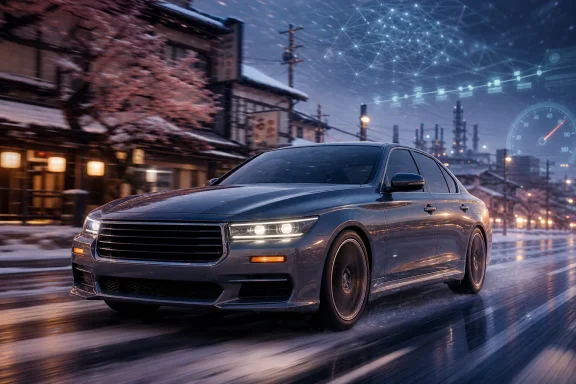 Nissan Turns the Skyline Into a Stopwatch
The Skyline has always carried more weight than its sales figures alone could justify. In Japan, it is a long-running sedan lineage with roots stretching back decades. Globally, it is a mythology machine, inseparable from GT-R folklore, gray-market import culture, video games, tuners, and a generation of enthusiasts who learned the word Skyline before they understood Nissan’s corporate structure.That is why this development story matters. Nissan is not merely saying it can build a new sedan more quickly. It is saying that a badge associated with patience, engineering seriousness, and obsessive refinement can now be used to prove that the company has learned to move at Chinese-market speed.
The reported 26-month development cycle is startling because traditional Japanese automaking has often presented slowness as a virtue. Consensus, validation, iteration, supplier coordination, and conservative product planning were not bugs in the system; they were how a company avoided putting half-baked machines into the world. Nissan’s message now is that the old calendar has become a liability.
The next Skyline is therefore being asked to do two jobs at once. It must satisfy drivers who expect heritage, proportion, power, and character. It must also convince investors, dealers, and internal skeptics that Nissan’s engineering bureaucracy can be bent into a sharper commercial weapon.
That is a lot to hang on a sedan in 2026.
The Chinese Lesson Is Not About Copying Cars
The easy headline is that Nissan is “copying China,” but that undersells the strategic point. Chinese automakers have not merely become fast because they work harder or because their domestic market tolerates risk. They are fast because they have reorganized the product cycle around software habits: parallel development, rapid feedback, modular architectures, compressed supplier loops, and a willingness to revise products after launch.For legacy automakers, this is culturally uncomfortable. The car industry was built around long gestation periods because metal, crash structures, production tooling, and regulatory compliance punish mistakes more brutally than app stores do. A bad software update can be rolled back; a bad body-in-white or thermal-management decision can haunt a model for years.
Yet the Chinese market has changed the meaning of pace. New-energy vehicles, infotainment systems, cockpit software, driver-assistance features, and digital services evolve so quickly that a five-year cycle can make a car feel old before it reaches showrooms. Nissan’s decision to treat the Skyline as an early product of its faster process suggests the company understands that the competitive benchmark has moved.
The lesson, then, is not simply “build cars faster.” It is “make the organization capable of learning faster.” Artificial intelligence is part of that story, but the more important shift is process design. AI can help model, simulate, compare, automate, and accelerate decisions; it cannot by itself decide what a Skyline should feel like at 80 mph on a wet mountain road.
That distinction matters. When automakers talk about AI, they often imply magic. In practice, the strongest uses are duller and more consequential: reducing repetitive engineering loops, surfacing conflicts earlier, simulating design trade-offs, shortening documentation cycles, and helping teams evaluate more variants before committing to expensive physical prototypes.
If Nissan has genuinely shortened the Skyline’s development time by reorganizing the work, that is meaningful. If it has merely sprinkled AI branding over a cost-cutting program, enthusiasts and engineers will notice.
AI Is the Tool, Not the Alibi
The phrase “AI-developed car” is dangerously imprecise. No serious automaker is handing a brand-defining vehicle to a chatbot and asking it to invent suspension geometry. What AI can do is compress parts of the development process that once depended on slower human coordination and repeated physical testing.That can be valuable. Simulation-driven engineering has been central to automotive development for years, and machine-learning methods can make some of those simulations faster or more predictive. Generative design can propose structures that meet strength and weight targets. AI-assisted analysis can help engineers evaluate noise, vibration, aerodynamics, thermal behavior, and manufacturing constraints before parts are locked.
But AI also creates a new temptation: treating optimization as identity. A Skyline is not only a set of metrics. It is steering weight, throttle response, body control, seating position, sightlines, braking confidence, and the emotional contract created by a name that still echoes through the enthusiast world.
The danger is not that AI will make the car soulless by default. The danger is that a management team under pressure will confuse a shorter development loop with a better product. A sedan that arrives quickly but feels like a spreadsheet will not be forgiven because its program milestones were elegant.
The best-case scenario is more interesting. AI could free engineers from low-value work and give them more time to tune the human parts of the car. A faster process could mean fewer bureaucratic dead ends and more decisive product leadership. In that version, technology does not replace the old craft; it protects it from corporate drag.
That is the argument Nissan needs the Skyline to make.
A Faster Skyline Arrives Because Nissan Has No Time to Waste
Nissan’s urgency is not abstract. The company has spent years trying to recover momentum in a global market that has become less patient, more software-driven, and more punishing of middling products. Its alliance politics, product delays, uneven electrification strategy, and regional challenges have left it needing visible proof of renewal.The Skyline is a convenient symbol because it speaks to two audiences. To mainstream buyers in Japan and potentially related luxury-sedan markets, it can represent a modern sedan with recognizable character. To enthusiasts, it signals that Nissan has not completely surrendered the emotional territory that made cars like the GT-R, Z, Silvia, and earlier Skylines matter.
That symbolic value is useful, but also dangerous. If Nissan uses the Skyline badge merely as a morale banner while delivering a compromised product, the backlash will be sharper than it would be for an anonymous crossover. Heritage gives a company attention; it does not guarantee forgiveness.
The reported timing also matters. A winter 2026 reveal would land just before the Skyline nameplate’s 70th anniversary year, giving Nissan an obvious marketing runway. Anniversaries are useful launch scaffolding, but they also invite comparison with the past. Every grille line, taillight cue, drivetrain choice, and interior decision will be read as a statement about what Nissan thinks its history is worth.
That may be why early reporting around the car has leaned on aggression, combustion, and possible continuity with the current twin-turbo V6 formula rather than a clean break into pure EV nostalgia. An electric Skyline would be defensible in the long arc of the industry, but a rushed-feeling electric reinterpretation would be a particularly high-risk way to handle the name.
For now, the most plausible read is that Nissan wants the new Skyline to be familiar enough to calm loyalists and modern enough to prove the new process. That is a narrow lane.
The Sedan Form Is Its Own Defiance
The reported next Skyline is expected to remain a sedan, and that alone makes it an outlier. The global market has spent years migrating toward SUVs and crossovers, while traditional sedans have become either low-cost transport, premium status objects, or enthusiast holdouts. A Skyline sedan in 2026 is not a volume play in the way a Rogue, Qashqai, or X-Trail is.That is precisely why it can function as a credibility vehicle. Automakers often rediscover “brand” when their mainstream products become too interchangeable. A well-executed sedan can say something about stance, balance, and driver connection that a crossover struggles to communicate, even when the crossover pays the bills.
Nissan knows this. The Z and GT-R have long acted as emotional anchors even when they were not the corporate center of gravity. The Skyline can serve a similar role, especially in markets where the name still carries cultural force.
But the sedan format also removes excuses. Buyers who choose a performance-leaning sedan over a crossover are more likely to care about dynamics, proportion, and control feel. They are less likely to forgive a car that merely looks aggressive but drives generically.
That is where the compressed development schedule will face its hardest test. Fast product development can produce excellent vehicles, but it leaves less room for indecision. The earlier Nissan defines the car’s priorities, the better its odds. If the Skyline tries to be heritage sedan, luxury replacement, performance icon, technology showcase, and turnaround mascot all at once, 26 months will not feel fast. It will feel thin.
The GT-R Shadow Still Falls Across Every Skyline
Nissan’s modern problem is that the Skyline and GT-R are both connected and separated in the public imagination. The GT-R became its own model line after the R34 era, but enthusiasts never stopped treating Skyline mythology as GT-R mythology. That makes every new Skyline vulnerable to expectations it may not be designed to meet.Reports that Nissan is also working on a future R36 GT-R complicate the picture further. If a new GT-R is coming, the Skyline does not need to carry the entire performance burden. It can be a sharper, more usable, perhaps more traditional sporting sedan rather than a supercar-adjacent halo product.
That would be sensible. The current market has room for performance sedans with personality, but very little room for confused identity. A Skyline that tries to impersonate a GT-R will disappoint. A Skyline that knows it is a sedan first, with enough power and handling credibility to honor the badge, could be far more compelling.
The drivetrain rumors point in that direction. A version of Nissan’s 3.0-liter twin-turbo V6 would create continuity with the existing Skyline and Z family, while keeping the car emotionally legible to buyers who are not ready to see the badge go fully electric. A manual transmission, if it materializes, would be a stronger statement still, though such reports should be treated cautiously until Nissan confirms specifications.
There is a business logic to combustion continuity, too. Developing an all-new electric performance sedan would be expensive, risky, and difficult to reconcile with Nissan’s broader cost pressures. Reusing or evolving known hardware allows the company to spend its compressed development time on packaging, calibration, design, and differentiation.
But reuse cuts both ways. Enthusiasts will accept evolved hardware if the result feels intentional. They will be less generous if the car looks like a reskinned old platform sold under an anniversary banner.
Heritage Design Is a Trap With a Prize Inside
Nissan’s designers reportedly want the new Skyline to look to the past, and that is both inevitable and hazardous. Retro design can create instant recognition, but it can also become costume work. The Skyline’s visual history is not a single shape like a Beetle or a Mini. It is a lineage of sedans and coupes whose meaning comes from proportion, restraint, lamps, stance, and motorsport association rather than one cartoon silhouette.That gives Nissan room to maneuver. A modern Skyline does not need to mimic an R34 to be legitimate. It needs a disciplined relationship with the past: enough cues to signal continuity, enough modernity to avoid cosplay, and enough mechanical seriousness to make the design feel earned.
Round taillight references, a distinctive badge, muscular shoulders, and a planted sedan profile can do some of that work. But surface nostalgia cannot substitute for engineering identity. The old cars were loved because they felt like platforms for ambition. They were tunable, durable, purposeful, and slightly illicit in the markets where they were forbidden fruit.
A 2026 Skyline cannot recreate that exact context. Import laws, emissions rules, market segmentation, and digital culture have changed the car’s aura. What Nissan can recreate is the sense that the car was developed by people who understand why the badge still matters.
That is why the AI angle is so fascinating. The more Nissan talks about machine-assisted speed, the more important it becomes to show human judgment in the final product. The car has to feel authored, not generated.
The Real Rival Is the Development System, Not One Competitor
It is tempting to ask what the new Skyline will compete against. That answer depends on market, price, drivetrain, and whether the car remains Japan-focused or becomes a template for a future Infiniti sedan elsewhere. But strategically, Nissan’s most important rival is not a BMW, Lexus, Tesla, BYD, or Xiaomi model. It is its own old development system.Legacy automakers have spent the last decade discovering that brand equity is not a moat against speed. Chinese firms can refresh interiors, software, battery configurations, driver-assistance packages, and exterior details at a pace that makes traditional mid-cycle updates look ceremonial. Tesla trained buyers to expect over-the-air evolution. Smartphone culture trained them to judge screens, interfaces, and update velocity as core product attributes.
Nissan cannot become a Chinese startup by declaration, and it should not try to become one in every respect. Automotive speed without quality discipline produces warranty pain, safety risk, and brand damage. But the company also cannot survive on the assumption that slow consensus is inherently safer.
The Skyline program appears to be Nissan’s attempt to split the difference. Use AI and standardization to remove wasted time. Develop related vehicles and shared components more simultaneously. Push decisions earlier. Accept that some old habits were not quality controls but delay mechanisms.
That is a serious industrial question. If Nissan can compress development while maintaining reliability, regulatory compliance, and dynamic polish, the implications reach well beyond one sedan. If it cannot, the Skyline becomes a cautionary tale about trying to graft software-era rhythms onto hardware-era obligations.
The truth will not be visible in the reveal photos. It will appear in panel gaps, software stability, brake feel, dealer service bulletins, owner forums, long-term tests, and whether the car still feels coherent after the launch spotlight fades.
Windows People Should Recognize the Pattern
For WindowsForum readers, the Nissan story may sound oddly familiar. Microsoft has spent years trying to reconcile legacy reliability with cloud-era velocity. Windows users have lived through the benefits and bruises of faster release cycles, telemetry-driven iteration, AI branding, and features that arrive before every corner case has been domesticated.The automotive industry is now walking through a similar transition, only with heavier consequences. Cars are becoming software-defined machines, but they remain safety-critical products made of steel, glass, rubber, batteries, fuel systems, sensors, and human trust. A bad driver-assistance decision is not the same as a broken Start menu.
That makes the Skyline a useful case study in a broader industrial shift. AI is entering product development not as a novelty but as management infrastructure. It promises fewer delays, richer simulation, faster decision-making, and tighter integration between design, engineering, and manufacturing. It also gives executives a new vocabulary for demanding more output from fewer people in less time.
The question is not whether AI belongs in vehicle development. It already does, and the industry will only use more of it. The question is whether companies deploy it to strengthen engineering judgment or to launder schedule pressure through technological optimism.
That distinction will define the next decade of cars just as surely as battery chemistry or autonomy. The winners will not be the companies that say “AI” most often. They will be the companies that know where the machine should stop and the test driver, manufacturing engineer, safety analyst, and product chief must take responsibility.
The New Skyline Will Prove Whether Fast Can Still Feel Deliberate
The concrete facts around the next Skyline are still limited, but the shape of Nissan’s wager is already clear. The company is using one of its most resonant badges to demonstrate that it can build desirable vehicles on a dramatically shorter clock. That is either brave, desperate, or both.Here is what matters most as the car moves toward its expected winter 2026 debut:
- Nissan has reportedly reduced the next Skyline’s development window to 26 months, roughly half the traditional cycle cited in recent coverage.
- Artificial intelligence appears to be part of a larger process change that also includes platform standardization, parallel workstreams, and China-inspired speed.
- The Skyline badge raises the stakes because buyers will judge the car emotionally as well as technically.
- A combustion-powered, performance-leaning sedan would be a safer heritage play than a rushed reinvention, but Nissan has not yet confirmed final specifications.
- The program’s real test will come after launch, when build quality, software behavior, driving feel, and reliability reveal whether the compressed process held together.
- If Nissan succeeds, the Skyline could become evidence that legacy automakers can move faster without becoming careless.
References
- Primary source: Torquecafe
Published: Mon, 15 Jun 2026 23:24:39 GMT
New Nissan Skyline fast-tracked thanks to AI
Nissan is claiming the development time for the new Skyline sedan has been reduced by using AI tools. torquecafe.com
- Independent coverage: Carscoops
Published: Mon, 15 Jun 2026 20:37:36 GMT
Nissan Built The Next Skyline In Half The Time By Copying China | Carscoops
The next-generation Skyline arrives this winter after a development cycle Nissan nearly halved using AI and digital design toolswww.carscoops.com - Related coverage: motor1.com
When Is The New Nissan Skyline Going To Be Revealed?
Nissan CEO Ivan Espinosa has announced that the next-generation Skyline will break cover sometime this winter, following a development phase of only 26 months. www.motor1.com
- Related coverage: autos.yahoo.com
Nissan Used AI To Bring The New Skyline Back In Half The Usual Time
Earlier this year, Nissan teased the new Skyline sedan, and according to a new report, it could be here by the end of the year. Company CEO Ivan Espinosa told Nikkei Asia that the new sedan will be unveiled in the winter, which means it could arrive before 2026 comes to a close. While the...autos.yahoo.com - Related coverage: caranddriver.com
Nissan Teases New Skyline That May Preview the Next Infiniti Q50
A new Skyline with expressive styling is on the way, and it'll likely reach the U.S. badged as the next-gen Infiniti Q50 sedan.www.caranddriver.com
- Related coverage: laregione.ch
Nissan punta a dimezzare i tempi di sviluppo seguendo il modello cinese | laRegione.ch
Ivan Espinosa fissa l'obiettivo a 30 mesi in media: la nuova Skyline in 26 mesi, estensione al 90% della gamma e piattaforme standardizzatewww.laregione.ch
- Related coverage: autoevolution.com
2024 nissan gt r us lineup welcomes limited run skyline edition and t spec takumi edition 230880
PDF documentwww.autoevolution.com
- Related coverage: nissan.com.my
- Related coverage: nissan.com.cn
