

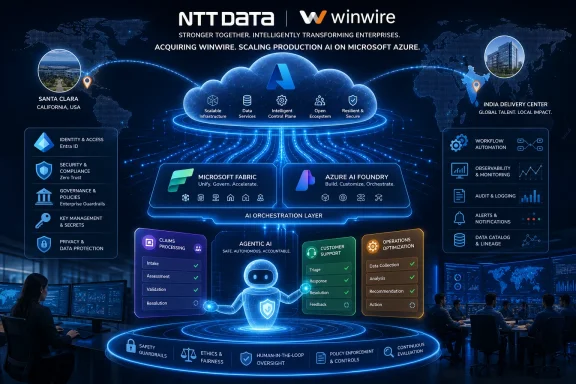
NTT DATA announced on May 18, 2026, that it has signed a definitive agreement to acquire WinWire, a Santa Clara-based Microsoft partner with delivery centers in India, adding more than 1,000 Azure engineers and AI specialists to expand enterprise AI and Microsoft cloud transformation services. The deal is less about another systems integrator bulking up headcount than about the new center of gravity in enterprise AI: Microsoft’s cloud, data, and agent tooling stack. For WindowsForum readers, the significance is not simply corporate consolidation. It is a signal that the Microsoft partner ecosystem is being rebuilt around production AI, not pilot projects.
The past two years of enterprise AI have been full of contradiction. Boards want automation, business units want copilots, developers want APIs, security teams want governance, and CIOs are left trying to turn demos into platforms that survive audits, budget cycles, and production traffic.
That is the space NTT DATA is trying to occupy with WinWire. The company already has global scale, managed services reach, and a major Microsoft practice. What WinWire adds is narrower but strategically useful: hands-on engineering depth in Azure-native application modernization, data engineering, Microsoft Fabric, Azure AI Foundry, and agentic AI frameworks that promise to embed autonomous software agents inside business workflows.
That phrase, agentic AI, has been stretched by marketers to the edge of meaning. In practical enterprise terms, it usually means AI systems that can do more than respond to prompts. They can reason over data, call tools, trigger workflows, and operate with some degree of supervised autonomy across applications. That is precisely where large organizations stop asking “Can the model answer a question?” and start asking “Can this system safely do work?”
NTT DATA’s acquisition pitch is that WinWire helps close that gap. The company is not buying a frontier model lab or a consumer AI brand. It is buying implementation capacity: the people and frameworks needed to connect Microsoft’s fast-changing AI platform to the messy reality of enterprise systems.
Unlike a shrink-wrapped software sale, an enterprise AI deployment is not done when the license is signed. It has to be wired into identity systems, data estates, compliance boundaries, line-of-business applications, and operational support processes. The value proposition of Microsoft cloud transformation increasingly depends on partners who can make those pieces work together.
NTT DATA already had strong Microsoft credentials, including recognition as Microsoft’s 2025 Global System Integrator Growth Champion Partner of the Year. WinWire gives it more specialist capacity in the parts of the stack that Microsoft is pushing hardest: Fabric for data unification, Azure AI Foundry for AI development and orchestration, and cloud-native application modernization for workloads that were never designed for an AI-driven operating model.
This matters because Microsoft’s AI strategy is not merely to sell model access. It is to make Azure the default control plane for enterprise intelligence. That control plane spans data ingestion, model selection, prompt and agent development, observability, security, app deployment, and managed operations. The partner that can stitch all of that together becomes more than a reseller. It becomes the translator between Microsoft’s roadmap and the customer’s risk register.
For NTT DATA, WinWire is a way to move further up that translation chain. It wants to be seen not as a labor pool for cloud migrations, but as a strategic implementation partner for AI-led transformation. That is a more lucrative story, and in 2026, it is also the story nearly every large integrator is trying to tell.
The next wave is harder. It is about taking AI into claims processing, customer service triage, supply chain planning, financial operations, software development, healthcare workflows, and regulated decision support. These are not environments where “move fast and break things” is a serious operating philosophy.
That is why the phrase “production-ready AI” appears so prominently in the announcement. It is a vendor phrase, but it points to a real market shift. The enterprise buyer is no longer impressed by a model that can summarize a PDF. The buyer wants role-based access, data lineage, model monitoring, exception handling, cost controls, audit trails, rollback plans, and integration with existing systems of record.
WinWire’s value to NTT DATA lies in that unglamorous middle layer. Its stated strengths in data engineering, modern applications, and AI frameworks are exactly the disciplines that determine whether AI stays in the innovation lab or becomes part of daily operations. A model may be the flashy component, but the durable work is in architecture.
This is also why Microsoft benefits from the transaction. The more Azure-based specialists there are in the field, the easier it becomes for Microsoft to convert AI enthusiasm into cloud consumption. Every successful Fabric deployment, Foundry project, or Azure-native modernization effort can deepen platform dependency. That is not accidental. It is the cloud business model.
Enterprise customers increasingly want industry-specific accelerators rather than blank-slate AI consulting. A bank does not want a generic chatbot demo. It wants risk-aware workflows, customer onboarding automation, fraud investigation tools, and controls that map to regulatory obligations. A healthcare organization wants clinical and administrative workflow support without creating privacy disasters. A manufacturer wants predictive maintenance and supply chain intelligence that can survive plant-floor realities.
WinWire’s pitch has been that it can help organizations establish AI-ready digital foundations and then scale intelligent cloud-based solutions. NTT DATA can now wrap those capabilities in a larger global delivery machine. That combination is what big integrators are racing to assemble: reusable frameworks plus enough consulting capacity to deploy them across industries and geographies.
There is also a sales-channel advantage. WinWire’s long-standing Microsoft partnership and Microsoft award history give NTT DATA more credibility in joint selling. In the Microsoft world, co-sell motions matter. Customers often look for partners with validated specializations and a close working relationship with Microsoft product teams. The stronger the partner alignment, the less risky the deployment appears to the buyer.
That does not guarantee success. Integrating a specialist firm into a global services company can dilute the very culture that made the specialist valuable. But the acquisition thesis is clear: NTT DATA wants WinWire’s technical depth, Microsoft alignment, and agentic AI positioning to become force multipliers inside a much larger organization.
That is where the Microsoft stack is both powerful and complicated. Azure, Microsoft 365, Entra ID, Power Platform, Dynamics, Fabric, Defender, Sentinel, and developer tooling can create a rich environment for AI-driven workflows. They can also create a labyrinth of licensing, governance, dependency, and configuration decisions.
WinWire’s Agentic AI @ Scale framework is being positioned as a way to design and deploy autonomous systems inside enterprise workflows. The phrase sounds ambitious, but the implementation challenge is brutally practical. An agent that drafts a response is one thing. An agent that updates a customer record, initiates a refund, changes a service ticket, or triggers a procurement process is another.
For sysadmins and IT architects, this is the layer to watch. The most consequential AI deployments will not necessarily be the most visible ones. They will be the systems quietly granted authority to act across business processes. That makes identity, access management, data classification, and observability more important than ever.
If NTT DATA and WinWire can make agentic AI safe enough for conservative enterprises, the acquisition will look prescient. If the market discovers that agent frameworks are still too brittle, too opaque, or too expensive to operate at scale, the deal will look more like a bet on a buzzword. The truth will probably fall somewhere in between.
For AI adoption, this is foundational. An enterprise agent is only as useful as the data it can reach and the rules that govern that access. Without a coherent data platform, AI systems become either shallow assistants or risky improvisers.
This is why the WinWire acquisition is not just about AI specialists in the abstract. It is about the convergence of data engineering and AI engineering. The companies that can modernize data estates, build governance models, and then layer AI systems on top will have an advantage over firms that treat AI as a standalone application project.
Microsoft has been pushing that convergence aggressively. Fabric, Foundry, Copilot Studio, and Azure’s model ecosystem all point toward a future where enterprises build AI-infused workflows on top of Microsoft-managed data and identity foundations. NTT DATA is positioning itself as one of the firms that can make that vision real for large customers.
There is a lock-in question here, too. The more an organization standardizes its AI, data, and workflow automation around Microsoft, the more value it may extract from platform integration. But it also becomes more dependent on Microsoft’s pricing, roadmap, and architectural assumptions. A good integrator should help customers understand that tradeoff rather than bury it under transformation language.
By acquiring WinWire, NTT DATA gains a ready-made pool of Microsoft cloud and AI specialists. That is faster than hiring one engineer at a time, and likely more reliable than trying to retrain generalist consultants at scale. In the services business, capability often follows talent density.
The India delivery center component is also important. Global systems integrators rely on distributed delivery models to support large customers across time zones and cost structures. WinWire’s global delivery footprint gives NTT DATA additional scale in a market where customers want speed but still expect disciplined execution.
This is particularly relevant for Azure modernization work. Many enterprises are still carrying legacy Windows Server estates, SQL Server deployments, .NET applications, on-premises integrations, and custom business systems that must be refactored or wrapped before AI can add meaningful value. The boring migration work has not disappeared. It has become the prerequisite for the AI work.
That is the inconvenient truth behind many AI announcements. Before a company can build intelligent agents, it often has to clean up identity, data, application architecture, security policy, and cloud operations. The acquisition gives NTT DATA more people to do that work under a more fashionable banner.
The first question is whether NTT DATA can preserve WinWire’s specialist edge after integration. Large consulting organizations are good at scale, account management, and process. Smaller specialist firms are often better at speed, technical focus, and direct engineering culture. Acquisitions can combine those strengths, but they can also smother one with the other.
The second question is whether the combined company can deliver measurable outcomes rather than platform activity. Cloud migrations, Fabric deployments, and agent frameworks are not business results by themselves. Customers should ask what cycle time improved, what manual work disappeared, what error rates dropped, what compliance burden decreased, and what cost model changed.
The third question is security. Agentic AI raises a new class of operational risk because it moves AI from recommendation toward action. Enterprises will need clear boundaries for what agents can do, how decisions are reviewed, and how failures are investigated. The partner’s ability to build guardrails may matter more than its ability to build flashy demos.
The fourth question is portability. Microsoft’s integrated stack can accelerate deployment, but it can also concentrate dependency. Customers should know which parts of an AI workflow are tied to Azure-specific services, which can be abstracted, and what switching costs would look like if strategy changes later.
Windows endpoints, Entra identities, Microsoft 365 data, Teams workflows, Power Platform apps, Azure services, Defender telemetry, and legacy line-of-business applications all sit in the orbit of Microsoft’s enterprise cloud. If agentic AI becomes operationally significant, it will need to interact with that environment safely and consistently.
This has implications for administrators. AI adoption will not be confined to a few developer projects in Azure subscriptions. It will touch permissions, data access, endpoint security, information protection, compliance policies, and user training. The admin’s job will be less about saying yes or no to AI and more about defining where AI is allowed to act.
It also has implications for developers. The center of gravity is moving from standalone apps toward workflows that combine models, tools, data sources, and governed actions. Developers working in Microsoft environments will increasingly need to understand orchestration, retrieval, identity, telemetry, and policy enforcement alongside conventional application code.
And it has implications for procurement. The AI bill will not show up in one place. It may be spread across Azure consumption, Microsoft 365 licensing, Fabric capacity, security add-ons, consulting services, and managed operations. A partner promising “enterprise AI at scale” should also be able to explain enterprise AI at cost.
That is why systems integrators are buying, hiring, and rebranding around AI delivery. They see that the bottleneck is shifting from model availability to enterprise implementation. Models are increasingly accessible. Good architecture, clean data, secure workflows, and organizational adoption are not.
This is not a small shift. For years, cloud transformation was often measured by migration volume: how many workloads moved, how much infrastructure was retired, how much cloud consumption grew. AI transformation will require a different scorecard. The question is not simply whether workloads run in Azure, but whether business processes become more intelligent, responsive, and measurable without becoming less governable.
The risk is that “AI transformation” becomes the new “digital transformation,” a phrase broad enough to justify anything and precise enough to mean nothing. NTT DATA’s challenge is to prove that the WinWire acquisition produces repeatable value, not just a larger slide deck. Customers should welcome more capability but remain allergic to vague outcomes.
If handled well, WinWire could become a specialist engine inside NTT DATA’s Microsoft cloud business. It could help standardize agentic AI delivery patterns, accelerate Fabric and Foundry adoption, and give NTT DATA a stronger voice in Microsoft co-sell motions. That would make the acquisition more than a regional or headcount expansion.
If handled poorly, WinWire could become another acquired services brand absorbed into a larger machine. The engineers would still be valuable, but the distinctive expertise could become harder for customers to see. In consulting, the difference between “we acquired capability” and “we scaled capability” is often visible only after the first few major projects.
Microsoft will be watching, too. Its AI strategy depends heavily on partners who can turn product ambition into customer deployments. The more that NTT DATA can deliver successful Azure AI projects, the stronger Microsoft’s enterprise AI flywheel becomes. This is why the deal matters beyond the two companies involved.
 NTT DATA Is Buying the Missing Middle of Enterprise AI
The past two years of enterprise AI have been full of contradiction. Boards want automation, business units want copilots, developers want APIs, security teams want governance, and CIOs are left trying to turn demos into platforms that survive audits, budget cycles, and production traffic.That is the space NTT DATA is trying to occupy with WinWire. The company already has global scale, managed services reach, and a major Microsoft practice. What WinWire adds is narrower but strategically useful: hands-on engineering depth in Azure-native application modernization, data engineering, Microsoft Fabric, Azure AI Foundry, and agentic AI frameworks that promise to embed autonomous software agents inside business workflows.
That phrase, agentic AI, has been stretched by marketers to the edge of meaning. In practical enterprise terms, it usually means AI systems that can do more than respond to prompts. They can reason over data, call tools, trigger workflows, and operate with some degree of supervised autonomy across applications. That is precisely where large organizations stop asking “Can the model answer a question?” and start asking “Can this system safely do work?”
NTT DATA’s acquisition pitch is that WinWire helps close that gap. The company is not buying a frontier model lab or a consumer AI brand. It is buying implementation capacity: the people and frameworks needed to connect Microsoft’s fast-changing AI platform to the messy reality of enterprise systems.
Microsoft’s Cloud Stack Has Become the New Consulting Battlefield
The deal lands at a moment when Microsoft’s enterprise AI strategy has become inseparable from Azure. Copilot may be the brand that executives recognize, but Azure is where the infrastructure, data, identity, governance, and developer tooling come together. That makes Microsoft’s partner ecosystem unusually important.Unlike a shrink-wrapped software sale, an enterprise AI deployment is not done when the license is signed. It has to be wired into identity systems, data estates, compliance boundaries, line-of-business applications, and operational support processes. The value proposition of Microsoft cloud transformation increasingly depends on partners who can make those pieces work together.
NTT DATA already had strong Microsoft credentials, including recognition as Microsoft’s 2025 Global System Integrator Growth Champion Partner of the Year. WinWire gives it more specialist capacity in the parts of the stack that Microsoft is pushing hardest: Fabric for data unification, Azure AI Foundry for AI development and orchestration, and cloud-native application modernization for workloads that were never designed for an AI-driven operating model.
This matters because Microsoft’s AI strategy is not merely to sell model access. It is to make Azure the default control plane for enterprise intelligence. That control plane spans data ingestion, model selection, prompt and agent development, observability, security, app deployment, and managed operations. The partner that can stitch all of that together becomes more than a reseller. It becomes the translator between Microsoft’s roadmap and the customer’s risk register.
For NTT DATA, WinWire is a way to move further up that translation chain. It wants to be seen not as a labor pool for cloud migrations, but as a strategic implementation partner for AI-led transformation. That is a more lucrative story, and in 2026, it is also the story nearly every large integrator is trying to tell.
The Deal Shows How AI Services Are Moving Past the Demo Economy
The first wave of generative AI spending rewarded experimentation. Companies built chatbots, internal assistants, document summarizers, and prototype copilots. Many of those projects were useful, but they often lived on the edge of the enterprise rather than at its operational core.The next wave is harder. It is about taking AI into claims processing, customer service triage, supply chain planning, financial operations, software development, healthcare workflows, and regulated decision support. These are not environments where “move fast and break things” is a serious operating philosophy.
That is why the phrase “production-ready AI” appears so prominently in the announcement. It is a vendor phrase, but it points to a real market shift. The enterprise buyer is no longer impressed by a model that can summarize a PDF. The buyer wants role-based access, data lineage, model monitoring, exception handling, cost controls, audit trails, rollback plans, and integration with existing systems of record.
WinWire’s value to NTT DATA lies in that unglamorous middle layer. Its stated strengths in data engineering, modern applications, and AI frameworks are exactly the disciplines that determine whether AI stays in the innovation lab or becomes part of daily operations. A model may be the flashy component, but the durable work is in architecture.
This is also why Microsoft benefits from the transaction. The more Azure-based specialists there are in the field, the easier it becomes for Microsoft to convert AI enthusiasm into cloud consumption. Every successful Fabric deployment, Foundry project, or Azure-native modernization effort can deepen platform dependency. That is not accidental. It is the cloud business model.
WinWire Gives NTT DATA More Than Bodies on a Bench
The headline number is more than 1,000 Azure engineers and AI specialists. In a services acquisition, headcount is always part of the story. But reducing the deal to staff augmentation misses the strategic logic.Enterprise customers increasingly want industry-specific accelerators rather than blank-slate AI consulting. A bank does not want a generic chatbot demo. It wants risk-aware workflows, customer onboarding automation, fraud investigation tools, and controls that map to regulatory obligations. A healthcare organization wants clinical and administrative workflow support without creating privacy disasters. A manufacturer wants predictive maintenance and supply chain intelligence that can survive plant-floor realities.
WinWire’s pitch has been that it can help organizations establish AI-ready digital foundations and then scale intelligent cloud-based solutions. NTT DATA can now wrap those capabilities in a larger global delivery machine. That combination is what big integrators are racing to assemble: reusable frameworks plus enough consulting capacity to deploy them across industries and geographies.
There is also a sales-channel advantage. WinWire’s long-standing Microsoft partnership and Microsoft award history give NTT DATA more credibility in joint selling. In the Microsoft world, co-sell motions matter. Customers often look for partners with validated specializations and a close working relationship with Microsoft product teams. The stronger the partner alignment, the less risky the deployment appears to the buyer.
That does not guarantee success. Integrating a specialist firm into a global services company can dilute the very culture that made the specialist valuable. But the acquisition thesis is clear: NTT DATA wants WinWire’s technical depth, Microsoft alignment, and agentic AI positioning to become force multipliers inside a much larger organization.
The Agentic AI Pitch Will Live or Die in Workflow Plumbing
Agentic AI has become one of the most fashionable terms in enterprise technology, but its success depends on some very old-fashioned IT work. Agents need permissions. They need data boundaries. They need reliable APIs. They need logging, monitoring, and human escalation paths. They need to fail safely.That is where the Microsoft stack is both powerful and complicated. Azure, Microsoft 365, Entra ID, Power Platform, Dynamics, Fabric, Defender, Sentinel, and developer tooling can create a rich environment for AI-driven workflows. They can also create a labyrinth of licensing, governance, dependency, and configuration decisions.
WinWire’s Agentic AI @ Scale framework is being positioned as a way to design and deploy autonomous systems inside enterprise workflows. The phrase sounds ambitious, but the implementation challenge is brutally practical. An agent that drafts a response is one thing. An agent that updates a customer record, initiates a refund, changes a service ticket, or triggers a procurement process is another.
For sysadmins and IT architects, this is the layer to watch. The most consequential AI deployments will not necessarily be the most visible ones. They will be the systems quietly granted authority to act across business processes. That makes identity, access management, data classification, and observability more important than ever.
If NTT DATA and WinWire can make agentic AI safe enough for conservative enterprises, the acquisition will look prescient. If the market discovers that agent frameworks are still too brittle, too opaque, or too expensive to operate at scale, the deal will look more like a bet on a buzzword. The truth will probably fall somewhere in between.
Microsoft Fabric Is the Quiet Center of the Story
The acquisition announcement mentions Microsoft Fabric alongside Azure AI Foundry, and that detail is worth lingering on. AI projects fail when the data layer is fragmented, stale, poorly governed, or locked away in systems that cannot be queried safely. Fabric is Microsoft’s attempt to give enterprises a more unified analytics and data platform across data engineering, warehousing, real-time analytics, and business intelligence.For AI adoption, this is foundational. An enterprise agent is only as useful as the data it can reach and the rules that govern that access. Without a coherent data platform, AI systems become either shallow assistants or risky improvisers.
This is why the WinWire acquisition is not just about AI specialists in the abstract. It is about the convergence of data engineering and AI engineering. The companies that can modernize data estates, build governance models, and then layer AI systems on top will have an advantage over firms that treat AI as a standalone application project.
Microsoft has been pushing that convergence aggressively. Fabric, Foundry, Copilot Studio, and Azure’s model ecosystem all point toward a future where enterprises build AI-infused workflows on top of Microsoft-managed data and identity foundations. NTT DATA is positioning itself as one of the firms that can make that vision real for large customers.
There is a lock-in question here, too. The more an organization standardizes its AI, data, and workflow automation around Microsoft, the more value it may extract from platform integration. But it also becomes more dependent on Microsoft’s pricing, roadmap, and architectural assumptions. A good integrator should help customers understand that tradeoff rather than bury it under transformation language.
The Acquisition Is Also a Talent Grab in a Scarce Market
The labor market for credible enterprise AI talent remains tight, especially for engineers who understand both cloud architecture and production governance. It is not enough to know how to call a model API. Enterprises need people who can build durable systems around that API.By acquiring WinWire, NTT DATA gains a ready-made pool of Microsoft cloud and AI specialists. That is faster than hiring one engineer at a time, and likely more reliable than trying to retrain generalist consultants at scale. In the services business, capability often follows talent density.
The India delivery center component is also important. Global systems integrators rely on distributed delivery models to support large customers across time zones and cost structures. WinWire’s global delivery footprint gives NTT DATA additional scale in a market where customers want speed but still expect disciplined execution.
This is particularly relevant for Azure modernization work. Many enterprises are still carrying legacy Windows Server estates, SQL Server deployments, .NET applications, on-premises integrations, and custom business systems that must be refactored or wrapped before AI can add meaningful value. The boring migration work has not disappeared. It has become the prerequisite for the AI work.
That is the inconvenient truth behind many AI announcements. Before a company can build intelligent agents, it often has to clean up identity, data, application architecture, security policy, and cloud operations. The acquisition gives NTT DATA more people to do that work under a more fashionable banner.
Enterprise Buyers Should Read the Fine Print Behind the Vision
The announcement frames the deal as a way to help clients move from experimentation to enterprise-wide deployment. That is exactly the right aspiration, but it is also where customers should become more demanding.The first question is whether NTT DATA can preserve WinWire’s specialist edge after integration. Large consulting organizations are good at scale, account management, and process. Smaller specialist firms are often better at speed, technical focus, and direct engineering culture. Acquisitions can combine those strengths, but they can also smother one with the other.
The second question is whether the combined company can deliver measurable outcomes rather than platform activity. Cloud migrations, Fabric deployments, and agent frameworks are not business results by themselves. Customers should ask what cycle time improved, what manual work disappeared, what error rates dropped, what compliance burden decreased, and what cost model changed.
The third question is security. Agentic AI raises a new class of operational risk because it moves AI from recommendation toward action. Enterprises will need clear boundaries for what agents can do, how decisions are reviewed, and how failures are investigated. The partner’s ability to build guardrails may matter more than its ability to build flashy demos.
The fourth question is portability. Microsoft’s integrated stack can accelerate deployment, but it can also concentrate dependency. Customers should know which parts of an AI workflow are tied to Azure-specific services, which can be abstracted, and what switching costs would look like if strategy changes later.
The Windows Angle Is Bigger Than Copilot
For a Windows-focused audience, the temptation is to see this deal through the lens of Microsoft 365 Copilot or Windows endpoint productivity. That is part of the picture, but not the whole picture. The more important story is how the Microsoft enterprise environment becomes an execution layer for AI.Windows endpoints, Entra identities, Microsoft 365 data, Teams workflows, Power Platform apps, Azure services, Defender telemetry, and legacy line-of-business applications all sit in the orbit of Microsoft’s enterprise cloud. If agentic AI becomes operationally significant, it will need to interact with that environment safely and consistently.
This has implications for administrators. AI adoption will not be confined to a few developer projects in Azure subscriptions. It will touch permissions, data access, endpoint security, information protection, compliance policies, and user training. The admin’s job will be less about saying yes or no to AI and more about defining where AI is allowed to act.
It also has implications for developers. The center of gravity is moving from standalone apps toward workflows that combine models, tools, data sources, and governed actions. Developers working in Microsoft environments will increasingly need to understand orchestration, retrieval, identity, telemetry, and policy enforcement alongside conventional application code.
And it has implications for procurement. The AI bill will not show up in one place. It may be spread across Azure consumption, Microsoft 365 licensing, Fabric capacity, security add-ons, consulting services, and managed operations. A partner promising “enterprise AI at scale” should also be able to explain enterprise AI at cost.
Consolidation Is the Market’s Vote for Implementation Over Invention
The NTT DATA-WinWire deal fits a broader pattern in the technology services market. The first phase of generative AI rewarded model makers and platform vendors. The next phase is rewarding firms that can operationalize those capabilities for large organizations.That is why systems integrators are buying, hiring, and rebranding around AI delivery. They see that the bottleneck is shifting from model availability to enterprise implementation. Models are increasingly accessible. Good architecture, clean data, secure workflows, and organizational adoption are not.
This is not a small shift. For years, cloud transformation was often measured by migration volume: how many workloads moved, how much infrastructure was retired, how much cloud consumption grew. AI transformation will require a different scorecard. The question is not simply whether workloads run in Azure, but whether business processes become more intelligent, responsive, and measurable without becoming less governable.
The risk is that “AI transformation” becomes the new “digital transformation,” a phrase broad enough to justify anything and precise enough to mean nothing. NTT DATA’s challenge is to prove that the WinWire acquisition produces repeatable value, not just a larger slide deck. Customers should welcome more capability but remain allergic to vague outcomes.
The Real Test Will Come After the Close
The transaction still has to close, and the announcement does not make the integration plan the story. That is typical, but integration will determine whether the acquisition becomes strategically meaningful. The easy part is announcing combined capability. The hard part is aligning sales incentives, delivery methods, technical standards, and customer promises.If handled well, WinWire could become a specialist engine inside NTT DATA’s Microsoft cloud business. It could help standardize agentic AI delivery patterns, accelerate Fabric and Foundry adoption, and give NTT DATA a stronger voice in Microsoft co-sell motions. That would make the acquisition more than a regional or headcount expansion.
If handled poorly, WinWire could become another acquired services brand absorbed into a larger machine. The engineers would still be valuable, but the distinctive expertise could become harder for customers to see. In consulting, the difference between “we acquired capability” and “we scaled capability” is often visible only after the first few major projects.
Microsoft will be watching, too. Its AI strategy depends heavily on partners who can turn product ambition into customer deployments. The more that NTT DATA can deliver successful Azure AI projects, the stronger Microsoft’s enterprise AI flywheel becomes. This is why the deal matters beyond the two companies involved.
The WinWire Deal Draws a Map for Microsoft-Centric AI Buyers
For IT leaders, the acquisition is less a reason to change strategy overnight than a marker of where the market is heading. The practical lesson is that enterprise AI is becoming a platform, data, and services problem all at once.- NTT DATA is using the WinWire acquisition to deepen its Microsoft Azure, data engineering, cloud-native development, and agentic AI delivery capacity.
- WinWire’s more than 1,000 Azure engineers and AI specialists give NTT DATA a faster route to scaling Microsoft-focused enterprise AI services.
- Microsoft Fabric and Azure AI Foundry are central to the deal because data readiness and AI orchestration are becoming the foundations of production AI.
- Enterprise customers should judge the combined company by measurable operational outcomes, not by the number of AI frameworks or partner awards attached to the announcement.
- Administrators and security teams should treat agentic AI as an identity, governance, and workflow-control challenge rather than merely another productivity feature.
- The acquisition reinforces the broader shift from AI experimentation to implementation, where systems integrators compete on their ability to make AI safe, useful, and repeatable.
References
- Primary source: Intelligent CIO
Published: Mon, 18 May 2026 06:19:22 GMT
- Related coverage: co.nttdata.com
NTT DATA nombrada Socio del Año 2025 por Microsoft en la categoría GSI Growth Champion | NTT DATA
NTT DATA gana el premio Microsoft Partner of the Year 2025 por su innovación y liderazgo global.co.nttdata.com - Related coverage: pt.nttdata.com
NTT DATA é Global System Integrator Growth Champion 2025 | NTT DATA
Esta distinção reconhece a excelência dos projetos desenvolvidos pela empresa e a sua capacidade de inovar através da tecnologia e de gerar impacto positivo.pt.nttdata.com - Related coverage: it.nttdata.com
NTT DATA nominata Microsoft 2025 Global GSI Growth Champion | NTT DATA
NTT DATA è stata premiata come Microsoft 2025 Global System Integrator Growth Champion Partner of the Year per innovazione ed eccellenza globale.it.nttdata.com - Related coverage: fr.nttdata.com
NTT DATA remporte le prix Microsoft GSI Growth Champion 2025 | NTT DATA
NTT DATA est nommée Microsoft 2025 Global System Integrator Growth Champion, avec trois autres prix et quatre nominations aux Microsoft Partner Awards.fr.nttdata.com - Related coverage: nttdata-solutions.com
NTT DATA Named Microsoft’s 2025 Global System Integrator…
NTT DATA has been named the 2025 Microsoft Global System Integrator (GSI) Growth Champion Partner of the Year. It also received three additional Partner…nttdata-solutions.com

- Related coverage: nttdata.com
Microsoft | NTT DATA Group
Modernize your IT environment to optimize your operations, increase profitability and prepare your data for transformative technologies. www.nttdata.com
- Related coverage: services.global.ntt
Microsoft | NTT DATA
Modernize your IT environment to optimize your operations, increase profitability and prepare your data for transformative technologies.services.global.ntt
- Related coverage: channel360mea.com
NTT DATA Named Microsoft’s 2025 Global System Integrator...
NTT DATA, a global leader in AI, digital business, and technology services, has been recognized as the 2025 Microsoft Global Systemwww.channel360mea.com - Related coverage: unite.ai
NTT DATA Acquires WinWire to Expand Agentic AI and Microsoft Azure Enterprise Transformation Capabilities – Unite.AI
NTT DATA has announced plans to acquire WinWire, a Santa Clara-based Microsoft partner focused on agentic AI, Azure-native development, cloud modernization, and enterprise data engineering. The deal reflects a broader sh...www.unite.ai
- Related coverage: s21.q4cdn.com
TD SYNNEX Recognized as the Winner of 2025 Microsoft Global Device Partner of the Year 2025
PDF documents21.q4cdn.com
