

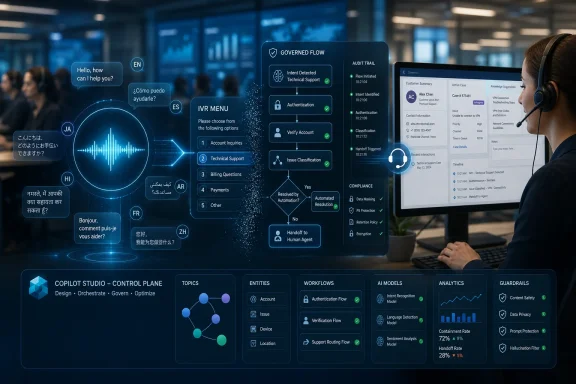
Microsoft on June 5, 2026, described Customer Assist Agent for Dynamics 365 Contact Center as a generative AI voice system managed in Copilot Studio that can handle customer calls end to end while preserving traditional IVR controls. The pitch is not simply that phone trees are old and AI is new. It is that Microsoft wants the enterprise contact center to stop treating automation and human support as separate kingdoms. If the company is right, IVR becomes less of a menu system and more of a governed reasoning layer at the front door of customer service.
For decades, interactive voice response has been the technology customers encounter before they reach the people they actually want to talk to. It asks them to press one for billing, say “representative” three times, confirm information they will later repeat to a human, and endure the strange ritual of fitting a messy real-world problem into a rigid decision tree. IVR has survived not because customers love it, but because businesses need scale, routing, verification, containment, and auditable control.
Microsoft’s new argument is that those enterprise requirements should not require the customer experience to remain trapped in 1998. Customer Assist Agent is positioned as the middle path between brittle scripted IVR and free-form AI voice bots that may sound impressive in demos but make compliance teams reach for the red pen. It is a familiar Microsoft move: do not burn down the enterprise stack; absorb the new thing into it.
That framing matters. The contact center is one of the places where generative AI has the clearest economic appeal and the least tolerance for improvisational chaos. A voice agent that can answer a question is interesting. A voice agent that can verify identity, check an account, apply a policy, execute a workflow, transfer with context, and leave an auditable trail is something a CIO might actually buy.
The test, then, is not whether Customer Assist Agent can sound natural. The test is whether Microsoft can make generative voice behave like enterprise software without draining the generative part of its value.
The problem is that real customer conversations rarely stay in those neat lanes. A billing dispute can involve travel charges, mid-cycle plan changes, device upgrades, promotional credits, and confusion about taxes. A delivery question can become a cancellation request before the first answer is complete. A customer may interrupt, correct themselves, change topics, or express three intents in a single sentence.
Legacy IVR systems handle that by multiplying paths. Each new policy, product, exception, intent, and escalation route adds another branch. Over time, the menu becomes a sedimentary record of organizational history: one layer for a billing change, another for a regulatory disclosure, another for a new product line, another for a workaround nobody wants to touch because it still handles 8 percent of calls.
That is why IVR maintenance is so expensive. The system does not understand the conversation as a whole; it executes a map. When the map no longer matches customer behavior, companies either expand the tree again or route more calls to human agents. The first option increases complexity. The second option raises cost. Customers experience both as friction.
Customer Assist Agent is Microsoft’s attempt to replace that brittle middle layer with something that can reason across turns while still invoking deterministic logic when the business demands it. That is the right architectural target. It is also much harder than putting a friendly voice on top of a chatbot.
But enterprises do not run contact centers on vibes. They need predictable execution, controlled language, secure transfers, policy enforcement, data protection, monitoring, analytics, and integration with the systems of record that actually resolve customer issues. In many industries, the most valuable parts of the call are precisely the parts where a model should not be allowed to freelance.
That is the gap Microsoft is trying to occupy. Customer Assist Agent is described as combining structured voice processing with generative reasoning. In practice, that means the AI can interpret a caller’s messy request, decide which steps are relevant, retrieve data, and move the interaction forward, while still handing specific moments to deterministic workflows.
This distinction is crucial. Generative AI is well suited to ambiguity: figuring out what the caller means, handling corrections, summarizing context, and adapting when the conversation changes. Deterministic automation is better for identity verification, payment handling, refunds, eligibility checks, regulatory disclosures, and hard business rules. A modern contact center needs both, and the trick is deciding where one ends and the other begins.
Microsoft’s message is that Copilot Studio becomes the control plane for that boundary. Business teams can author and manage the agent, connect it to enterprise workflows, and decide which parts of the interaction are governed by rules rather than model discretion. That makes the product less of a voice bot and more of an orchestration system.
For Microsoft customers, this is both the appeal and the lock-in. If a company already runs Dynamics 365 for customer service, uses Power Platform for workflows, and is standardizing on Copilot Studio for agent development, Customer Assist Agent fits the procurement narrative beautifully. The same environment can govern AI behavior, connect to business policies, and pass context into the service representative workspace.
This is where Microsoft has an advantage over more glamorous AI voice vendors. It does not need to win purely on conversational naturalness. It can win on integration, governance, procurement simplicity, identity, data access, and administrative familiarity. In enterprise software, those unglamorous features often decide the deal.
But that also raises the bar. If Microsoft claims that voice agents are part of the enterprise fabric, customers will expect enterprise-grade observability. They will want to know why the agent took an action, which data it used, which policy constrained it, when it escalated, and whether its behavior changed after a model update. A convincing demo is not enough; the runtime has to be inspectable.
This is where Copilot Studio’s role becomes strategic. Microsoft is not just offering a conversational surface. It is trying to give organizations a place to design, test, deploy, measure, and refine AI voice behavior without handing every change to a specialized development team. If that works, the economics of IVR modernization change substantially.
There will always be contact center scenarios where the right answer is a fixed path. A bank does not want a model inventing an explanation of a regulatory disclosure. An insurer does not want a model improvising claim eligibility. A healthcare provider does not want voice automation wandering beyond approved language when protected information is involved. Deterministic flows remain valuable because they are narrow, testable, repeatable, and defensible.
The upgrade is that deterministic flows no longer have to own the entire customer journey. A caller can describe a problem naturally, and the AI can determine that part of the answer requires a governed workflow. After that workflow completes, the same conversation can continue. The customer should not feel the seam.
That is why Microsoft’s example of a customer asking about an order and then changing the request to cancellation is more significant than it looks. A legacy system might treat “where is my order?” and “cancel my order” as separate intents with separate paths. A better system understands the relationship between them, checks the order status, determines whether cancellation is still allowed, executes the cancellation through controlled logic, and confirms the result.
The customer experiences one conversation. The business gets a mix of model flexibility and process control. That is the architectural promise.
A front-end bot that answers FAQs can be wrong in annoying ways. An end-to-end voice agent connected to account data and enterprise workflows can be wrong in operationally meaningful ways. It might misunderstand intent, trigger the wrong process, reveal information inappropriately, fail to escalate, or handle an edge case with more confidence than competence.
That does not mean the product is a bad idea. It means the governance model is the product’s credibility. Microsoft emphasizes secure, governed connections to enterprise systems, workflow execution, context preservation, and measurement. Those are the right words. Customers will need to validate the implementation in detail.
The handoff to human representatives is especially important. In the worst version of AI self-service, the customer gets trapped in a loop and then starts over with a person. In the better version, the AI performs useful triage, gathers facts, attempts resolution, and then transfers a clean summary with relevant context, prior steps, and suggested next actions. Microsoft is clearly aiming for the latter.
For IT leaders, the question is not whether AI will reduce call volume in the abstract. It is which call types can be automated safely, which should be assisted but not owned by AI, and which should remain human-led. Customer Assist Agent may make those boundaries easier to manage, but it does not remove the need to define them.
MAS is presented as a standardized way to measure and track AI agent performance across real interactions. That matters because contact center leaders need more than anecdotal confidence. They need to compare models, evaluate prompting strategies, monitor resolution quality, identify failure patterns, and decide whether changes improve outcomes or merely change the style of failure.
This is also where the old IVR world had an underappreciated advantage. Deterministic systems are painful to maintain, but they are relatively easy to test. Given input X, path Y occurs. Generative systems require a different evaluation discipline. They must be judged across distributions of conversations, not just scripted test cases.
If Microsoft can make evaluation accessible to business operators rather than only data science teams, it could change the cadence of contact center improvement. Instead of quarterly IVR redesign projects, teams could tune behavior continuously based on production evidence. That is powerful, but it introduces its own governance challenge: continuous improvement must not become uncontrolled drift.
The best deployments will treat measurement as a change-management system, not just a dashboard. When the agent changes, the organization should know what changed, why it changed, who approved it, and how the effect was measured. AI that improves over time is valuable. AI that changes in ways nobody can explain is a liability.
Traditional language routing is often clumsy. Customers choose a language at the beginning of a call, get routed into a queue, and then remain in that lane even if the conversation shifts. Multilingual households, code-switching callers, and customers with partial fluency all expose the artificiality of that model. The menu asks the caller to classify themselves before the service interaction even starts.
A voice agent that can follow language changes within a single conversation could remove a surprising amount of friction. It could also reduce routing pressure in organizations that struggle to staff every language queue at every hour. For global companies and U.S. businesses serving multilingual communities, that is not a cosmetic improvement.
But here again, the enterprise issue is not only language recognition. It is policy consistency across languages. If the English response is controlled but the Spanish, French, or Hindi response is a model-generated paraphrase with subtle differences, compliance teams will care. Microsoft’s hybrid approach will need to ensure that language flexibility does not weaken governed content.
This is another reason deterministic and generative components need to work together. The model can understand and converse fluidly, but the policy-sensitive substance may still need to come from approved content, structured workflows, or constrained responses. Natural language should not mean variable obligation.
If Customer Assist Agent resolves the issue autonomously, the value is obvious. But many valuable interactions will still end with a human representative. The key is whether the AI’s work carries forward. Did it authenticate the caller? Did it capture the relevant facts? Did it identify the likely issue? Did it attempt the correct workflow? Did it summarize the conversation in a way the representative can trust?
This is where Dynamics 365 integration matters. A generic AI voice product can collect information, but a contact center system tied to case management, customer records, routing, and representative tools can make that information operational. The human agent should not receive a blob of transcript. They should receive context.
There is also a morale angle. Service representatives are often the shock absorbers for bad automation. When self-service fails, the human gets an angrier customer and less time to solve the problem. A well-designed Customer Assist Agent could reduce that burden by doing useful prep work. A poorly designed one could make the representative the cleanup crew for AI mistakes.
That means organizations should measure not only containment and average handle time, but also representative trust. If agents ignore the AI summary because it is unreliable, the system has failed quietly. If they rely on it and it is wrong, the system has failed dangerously.
That is the only plausible enterprise adoption path. Contact center infrastructure is entangled with telephony, compliance, workforce management, CRM, analytics, reporting, and customer expectations. A monolithic migration to AI voice would be irresponsible for many organizations. A staged approach lets teams learn where generative reasoning helps and where it introduces unacceptable risk.
The first good candidates will probably be interactions with high volume, moderate variability, and clear back-end actions. Think order status plus modification, appointment changes, plan explanations, troubleshooting intake, claims pre-checks, and billing clarification. These are scenarios where traditional IVR is often too rigid but full human handling is too expensive.
The wrong first candidates are equally obvious. Highly regulated disclosures, emotionally charged disputes, complex exceptions, and interactions involving severe consequences should not be used as the sandbox. The most mature organizations will build an automation portfolio, not an automation ideology.
This is also where WindowsForum’s IT pro audience should read past the product language. The real project is not “turn on AI voice.” It is inventorying intents, mapping data dependencies, defining escalation thresholds, testing language behavior, building evaluation sets, and creating operational ownership. The AI interface is new; the implementation discipline is old-fashioned.
For contact center vendors, that is a direct challenge. The market has long been split among telephony platforms, CCaaS providers, CRM systems, workforce tools, analytics vendors, and automation specialists. Microsoft is arguing that AI collapses some of those boundaries. If the agent can understand the customer, call workflows, update records, assist representatives, and feed quality measurement, the orchestration layer becomes more valuable than the dial tone.
That does not mean Microsoft automatically wins. Contact centers are heterogeneous, and many enterprises have deep investments in Genesys, NICE, Five9, Salesforce, ServiceNow, Amazon Connect, Twilio, or custom telephony stacks. Microsoft will need to prove interoperability, reliability, and feature depth in environments that do not look like a pristine Dynamics demo tenant.
Still, the direction is clear. AI voice turns the front end of the contact center into a strategic control point. Whoever owns that layer can influence routing, self-service, agent assist, analytics, quality management, and workflow automation. Microsoft wants that layer to be Copilot Studio plus Dynamics 365 Contact Center.
For customers, the competitive upside is that vendors are being forced to modernize quickly. The risk is that “AI-native” becomes the new “cloud-native”: a label that can hide enormous variation in maturity. Buyers should demand proof in their own call types, languages, policies, and data environments.
A voice agent that gathers context, checks systems, executes low-risk steps, and prepares the representative can reduce handle time without pretending every customer should be self-served. It can also improve first-contact resolution by ensuring the right information is collected before escalation. In complex organizations, that may matter more than raw deflection.
There is a customer experience argument here too. People do not hate automation because it is automation. They hate automation that blocks progress, misunderstands them, or makes them repeat themselves. If AI voice can make the first contact more capable, customers may accept it. If it becomes a more fluent gatekeeper, they will resent it faster than they resented IVR.
This is why Microsoft’s “from answers to outcomes” framing is important. The contact center does not need another answer machine. It needs systems that can complete tasks. Checking status is useful; changing the appointment is better. Explaining a bill is useful; applying the correct adjustment through a governed process is better. Summarizing a problem is useful; creating the case and routing it with the right priority is better.
The winners in this transition will not be the companies that make their IVR sound human. They will be the ones that remove work from the customer’s side of the call.
The phrase “speech-to-speech” deserves particular scrutiny in production evaluations. Direct audio interaction with a model can make conversations feel more natural, but contact centers are hostile audio environments. Background noise, speakerphones, accents, poor cellular connections, and emotional callers all test the system. Enterprises should benchmark with real recordings and real edge cases, not showroom prompts.
Data access is another concern. An AI voice agent becomes more useful as it connects to more systems, but every integration expands the risk surface. Permissions, audit logs, data minimization, retention policies, and role-based controls should be designed before the agent is allowed to act. The safest architecture is not the one where the model can do everything; it is the one where the model can request the right governed action at the right time.
There is also the issue of vendor language. Microsoft says business users can tune and optimize experiences through governed tooling. That may be true, but “business user” platforms often drift into complexity once real exception handling begins. Organizations should plan for a mixed operating model involving contact center leaders, process owners, compliance staff, data teams, and IT.
Finally, buyers should separate current capability from roadmap gravity. Microsoft’s release-wave material shows a fast-moving product area, with features arriving across real-time voice, transfers, redaction, translation, recording controls, and IVR enhancements. Fast movement is encouraging, but it also means customers need to track availability, region support, licensing, and preview versus general availability with care.
 Microsoft Is Trying to Retire the Phone Tree Without Admitting It
For decades, interactive voice response has been the technology customers encounter before they reach the people they actually want to talk to. It asks them to press one for billing, say “representative” three times, confirm information they will later repeat to a human, and endure the strange ritual of fitting a messy real-world problem into a rigid decision tree. IVR has survived not because customers love it, but because businesses need scale, routing, verification, containment, and auditable control.Microsoft’s new argument is that those enterprise requirements should not require the customer experience to remain trapped in 1998. Customer Assist Agent is positioned as the middle path between brittle scripted IVR and free-form AI voice bots that may sound impressive in demos but make compliance teams reach for the red pen. It is a familiar Microsoft move: do not burn down the enterprise stack; absorb the new thing into it.
That framing matters. The contact center is one of the places where generative AI has the clearest economic appeal and the least tolerance for improvisational chaos. A voice agent that can answer a question is interesting. A voice agent that can verify identity, check an account, apply a policy, execute a workflow, transfer with context, and leave an auditable trail is something a CIO might actually buy.
The test, then, is not whether Customer Assist Agent can sound natural. The test is whether Microsoft can make generative voice behave like enterprise software without draining the generative part of its value.
The Old IVR Model Broke Under the Weight of Real Conversations
Traditional IVR is deterministic by design. It converts speech or keypad input into a known intent, maps that intent to a predefined flow, and steps through a carefully authored script. In simple cases, that model is still useful. A caller who wants store hours, account balance, claim status, or payment confirmation does not need a philosophical exchange with a language model.The problem is that real customer conversations rarely stay in those neat lanes. A billing dispute can involve travel charges, mid-cycle plan changes, device upgrades, promotional credits, and confusion about taxes. A delivery question can become a cancellation request before the first answer is complete. A customer may interrupt, correct themselves, change topics, or express three intents in a single sentence.
Legacy IVR systems handle that by multiplying paths. Each new policy, product, exception, intent, and escalation route adds another branch. Over time, the menu becomes a sedimentary record of organizational history: one layer for a billing change, another for a regulatory disclosure, another for a new product line, another for a workaround nobody wants to touch because it still handles 8 percent of calls.
That is why IVR maintenance is so expensive. The system does not understand the conversation as a whole; it executes a map. When the map no longer matches customer behavior, companies either expand the tree again or route more calls to human agents. The first option increases complexity. The second option raises cost. Customers experience both as friction.
Customer Assist Agent is Microsoft’s attempt to replace that brittle middle layer with something that can reason across turns while still invoking deterministic logic when the business demands it. That is the right architectural target. It is also much harder than putting a friendly voice on top of a chatbot.
Generative Voice Is Not Enough on Its Own
The current wave of AI voice startups has shown how quickly expectations can change. A synthetic agent that responds in near real time, handles interruptions, and speaks naturally makes legacy IVR feel instantly obsolete. Once customers experience a fluid voice interface, “please listen carefully, as our menu options have changed” sounds less like process and more like punishment.But enterprises do not run contact centers on vibes. They need predictable execution, controlled language, secure transfers, policy enforcement, data protection, monitoring, analytics, and integration with the systems of record that actually resolve customer issues. In many industries, the most valuable parts of the call are precisely the parts where a model should not be allowed to freelance.
That is the gap Microsoft is trying to occupy. Customer Assist Agent is described as combining structured voice processing with generative reasoning. In practice, that means the AI can interpret a caller’s messy request, decide which steps are relevant, retrieve data, and move the interaction forward, while still handing specific moments to deterministic workflows.
This distinction is crucial. Generative AI is well suited to ambiguity: figuring out what the caller means, handling corrections, summarizing context, and adapting when the conversation changes. Deterministic automation is better for identity verification, payment handling, refunds, eligibility checks, regulatory disclosures, and hard business rules. A modern contact center needs both, and the trick is deciding where one ends and the other begins.
Microsoft’s message is that Copilot Studio becomes the control plane for that boundary. Business teams can author and manage the agent, connect it to enterprise workflows, and decide which parts of the interaction are governed by rules rather than model discretion. That makes the product less of a voice bot and more of an orchestration system.
Copilot Studio Becomes the Real Contact Center Battleground
The most important part of Microsoft’s announcement may not be the voice interface at all. It is the insistence that Customer Assist Agent is managed in Microsoft Copilot Studio and integrated natively into Dynamics 365 Contact Center. That turns the product into another tile in Microsoft’s broader platform strategy: AI agents are not standalone novelties, but governed components of a business application stack.For Microsoft customers, this is both the appeal and the lock-in. If a company already runs Dynamics 365 for customer service, uses Power Platform for workflows, and is standardizing on Copilot Studio for agent development, Customer Assist Agent fits the procurement narrative beautifully. The same environment can govern AI behavior, connect to business policies, and pass context into the service representative workspace.
This is where Microsoft has an advantage over more glamorous AI voice vendors. It does not need to win purely on conversational naturalness. It can win on integration, governance, procurement simplicity, identity, data access, and administrative familiarity. In enterprise software, those unglamorous features often decide the deal.
But that also raises the bar. If Microsoft claims that voice agents are part of the enterprise fabric, customers will expect enterprise-grade observability. They will want to know why the agent took an action, which data it used, which policy constrained it, when it escalated, and whether its behavior changed after a model update. A convincing demo is not enough; the runtime has to be inspectable.
This is where Copilot Studio’s role becomes strategic. Microsoft is not just offering a conversational surface. It is trying to give organizations a place to design, test, deploy, measure, and refine AI voice behavior without handing every change to a specialized development team. If that works, the economics of IVR modernization change substantially.
The Hybrid Model Is the Product, Not a Transitional Compromise
One easy mistake is to see Customer Assist Agent as a bridge from old IVR to fully autonomous AI service. That is probably not how the enterprise market will evolve. The hybrid model is not merely a transitional compromise; it is the product.There will always be contact center scenarios where the right answer is a fixed path. A bank does not want a model inventing an explanation of a regulatory disclosure. An insurer does not want a model improvising claim eligibility. A healthcare provider does not want voice automation wandering beyond approved language when protected information is involved. Deterministic flows remain valuable because they are narrow, testable, repeatable, and defensible.
The upgrade is that deterministic flows no longer have to own the entire customer journey. A caller can describe a problem naturally, and the AI can determine that part of the answer requires a governed workflow. After that workflow completes, the same conversation can continue. The customer should not feel the seam.
That is why Microsoft’s example of a customer asking about an order and then changing the request to cancellation is more significant than it looks. A legacy system might treat “where is my order?” and “cancel my order” as separate intents with separate paths. A better system understands the relationship between them, checks the order status, determines whether cancellation is still allowed, executes the cancellation through controlled logic, and confirms the result.
The customer experiences one conversation. The business gets a mix of model flexibility and process control. That is the architectural promise.
End-to-End Ownership Is Where the Risk Lives
Microsoft says Customer Assist Agent can own the customer interaction end to end. That phrase should get attention. In software marketing, “end to end” sounds like convenience. In contact center operations, it means the AI is touching the most sensitive parts of the customer relationship.A front-end bot that answers FAQs can be wrong in annoying ways. An end-to-end voice agent connected to account data and enterprise workflows can be wrong in operationally meaningful ways. It might misunderstand intent, trigger the wrong process, reveal information inappropriately, fail to escalate, or handle an edge case with more confidence than competence.
That does not mean the product is a bad idea. It means the governance model is the product’s credibility. Microsoft emphasizes secure, governed connections to enterprise systems, workflow execution, context preservation, and measurement. Those are the right words. Customers will need to validate the implementation in detail.
The handoff to human representatives is especially important. In the worst version of AI self-service, the customer gets trapped in a loop and then starts over with a person. In the better version, the AI performs useful triage, gathers facts, attempts resolution, and then transfers a clean summary with relevant context, prior steps, and suggested next actions. Microsoft is clearly aiming for the latter.
For IT leaders, the question is not whether AI will reduce call volume in the abstract. It is which call types can be automated safely, which should be assisted but not owned by AI, and which should remain human-led. Customer Assist Agent may make those boundaries easier to manage, but it does not remove the need to define them.
Measurement Is Microsoft’s Answer to the AI Trust Problem
Microsoft’s mention of Model Assessment Score, or MAS, points to a broader truth about enterprise AI: deployment is only the beginning. A voice agent that performs well in a pilot can degrade when it meets real customers, unusual phrasing, policy exceptions, noisy audio, regional accents, mixed languages, and business changes. Accuracy is not a one-time certification.MAS is presented as a standardized way to measure and track AI agent performance across real interactions. That matters because contact center leaders need more than anecdotal confidence. They need to compare models, evaluate prompting strategies, monitor resolution quality, identify failure patterns, and decide whether changes improve outcomes or merely change the style of failure.
This is also where the old IVR world had an underappreciated advantage. Deterministic systems are painful to maintain, but they are relatively easy to test. Given input X, path Y occurs. Generative systems require a different evaluation discipline. They must be judged across distributions of conversations, not just scripted test cases.
If Microsoft can make evaluation accessible to business operators rather than only data science teams, it could change the cadence of contact center improvement. Instead of quarterly IVR redesign projects, teams could tune behavior continuously based on production evidence. That is powerful, but it introduces its own governance challenge: continuous improvement must not become uncontrolled drift.
The best deployments will treat measurement as a change-management system, not just a dashboard. When the agent changes, the organization should know what changed, why it changed, who approved it, and how the effect was measured. AI that improves over time is valuable. AI that changes in ways nobody can explain is a liability.
Multilingual Voice Makes the Old Routing Logic Look Tired
One of the more practical claims in Microsoft’s post is support for multilingual interactions and dynamic language switching, especially through speech-to-speech real-time audio interaction. This is the kind of feature that sounds like a flourish until you have run a real contact center.Traditional language routing is often clumsy. Customers choose a language at the beginning of a call, get routed into a queue, and then remain in that lane even if the conversation shifts. Multilingual households, code-switching callers, and customers with partial fluency all expose the artificiality of that model. The menu asks the caller to classify themselves before the service interaction even starts.
A voice agent that can follow language changes within a single conversation could remove a surprising amount of friction. It could also reduce routing pressure in organizations that struggle to staff every language queue at every hour. For global companies and U.S. businesses serving multilingual communities, that is not a cosmetic improvement.
But here again, the enterprise issue is not only language recognition. It is policy consistency across languages. If the English response is controlled but the Spanish, French, or Hindi response is a model-generated paraphrase with subtle differences, compliance teams will care. Microsoft’s hybrid approach will need to ensure that language flexibility does not weaken governed content.
This is another reason deterministic and generative components need to work together. The model can understand and converse fluidly, but the policy-sensitive substance may still need to come from approved content, structured workflows, or constrained responses. Natural language should not mean variable obligation.
The Agent Handoff Is Where Customers Will Judge the System
For customers, the success of AI voice will be judged less by how futuristic the first minute feels and more by whether the last minute requires repetition. Contact centers have trained people to expect that automation is a toll booth before real service begins. Microsoft’s claim of continuity across self-service and assisted service is therefore central to the product’s credibility.If Customer Assist Agent resolves the issue autonomously, the value is obvious. But many valuable interactions will still end with a human representative. The key is whether the AI’s work carries forward. Did it authenticate the caller? Did it capture the relevant facts? Did it identify the likely issue? Did it attempt the correct workflow? Did it summarize the conversation in a way the representative can trust?
This is where Dynamics 365 integration matters. A generic AI voice product can collect information, but a contact center system tied to case management, customer records, routing, and representative tools can make that information operational. The human agent should not receive a blob of transcript. They should receive context.
There is also a morale angle. Service representatives are often the shock absorbers for bad automation. When self-service fails, the human gets an angrier customer and less time to solve the problem. A well-designed Customer Assist Agent could reduce that burden by doing useful prep work. A poorly designed one could make the representative the cleanup crew for AI mistakes.
That means organizations should measure not only containment and average handle time, but also representative trust. If agents ignore the AI summary because it is unreliable, the system has failed quietly. If they rely on it and it is wrong, the system has failed dangerously.
Incremental Modernization Is the Sensible Sales Pitch
Microsoft is wisely not telling customers to rip out their IVR investments overnight. The company’s suggested path is incremental: create a Customer Assist Agent using existing policies, data, and tools; experiment with real scenarios; identify high-value voice use cases; refine in Copilot Studio; deploy alongside existing IVR and agent workflows; measure and improve.That is the only plausible enterprise adoption path. Contact center infrastructure is entangled with telephony, compliance, workforce management, CRM, analytics, reporting, and customer expectations. A monolithic migration to AI voice would be irresponsible for many organizations. A staged approach lets teams learn where generative reasoning helps and where it introduces unacceptable risk.
The first good candidates will probably be interactions with high volume, moderate variability, and clear back-end actions. Think order status plus modification, appointment changes, plan explanations, troubleshooting intake, claims pre-checks, and billing clarification. These are scenarios where traditional IVR is often too rigid but full human handling is too expensive.
The wrong first candidates are equally obvious. Highly regulated disclosures, emotionally charged disputes, complex exceptions, and interactions involving severe consequences should not be used as the sandbox. The most mature organizations will build an automation portfolio, not an automation ideology.
This is also where WindowsForum’s IT pro audience should read past the product language. The real project is not “turn on AI voice.” It is inventorying intents, mapping data dependencies, defining escalation thresholds, testing language behavior, building evaluation sets, and creating operational ownership. The AI interface is new; the implementation discipline is old-fashioned.
The Contact Center Becomes Another Front in Microsoft’s Platform War
Customer Assist Agent is not an isolated product story. It fits Microsoft’s larger effort to make Copilot Studio the place where organizations build and govern business agents, and to make Dynamics 365 the operational system where those agents do useful work. This is the same strategic pattern Microsoft has used across productivity, security, developer tools, and cloud: put AI where the data and workflows already live.For contact center vendors, that is a direct challenge. The market has long been split among telephony platforms, CCaaS providers, CRM systems, workforce tools, analytics vendors, and automation specialists. Microsoft is arguing that AI collapses some of those boundaries. If the agent can understand the customer, call workflows, update records, assist representatives, and feed quality measurement, the orchestration layer becomes more valuable than the dial tone.
That does not mean Microsoft automatically wins. Contact centers are heterogeneous, and many enterprises have deep investments in Genesys, NICE, Five9, Salesforce, ServiceNow, Amazon Connect, Twilio, or custom telephony stacks. Microsoft will need to prove interoperability, reliability, and feature depth in environments that do not look like a pristine Dynamics demo tenant.
Still, the direction is clear. AI voice turns the front end of the contact center into a strategic control point. Whoever owns that layer can influence routing, self-service, agent assist, analytics, quality management, and workflow automation. Microsoft wants that layer to be Copilot Studio plus Dynamics 365 Contact Center.
For customers, the competitive upside is that vendors are being forced to modernize quickly. The risk is that “AI-native” becomes the new “cloud-native”: a label that can hide enormous variation in maturity. Buyers should demand proof in their own call types, languages, policies, and data environments.
The Real Cost Savings Will Come From Redesign, Not Deflection
The contact center industry loves containment metrics. If the AI resolves more calls without a human, costs go down. That is true, but it is also a narrow way to think about this technology. The bigger opportunity is redesigning the service journey so that calls become shorter, cleaner, and less repetitive even when humans remain involved.A voice agent that gathers context, checks systems, executes low-risk steps, and prepares the representative can reduce handle time without pretending every customer should be self-served. It can also improve first-contact resolution by ensuring the right information is collected before escalation. In complex organizations, that may matter more than raw deflection.
There is a customer experience argument here too. People do not hate automation because it is automation. They hate automation that blocks progress, misunderstands them, or makes them repeat themselves. If AI voice can make the first contact more capable, customers may accept it. If it becomes a more fluent gatekeeper, they will resent it faster than they resented IVR.
This is why Microsoft’s “from answers to outcomes” framing is important. The contact center does not need another answer machine. It needs systems that can complete tasks. Checking status is useful; changing the appointment is better. Explaining a bill is useful; applying the correct adjustment through a governed process is better. Summarizing a problem is useful; creating the case and routing it with the right priority is better.
The winners in this transition will not be the companies that make their IVR sound human. They will be the ones that remove work from the customer’s side of the call.
Where IT Should Be Skeptical
There is plenty to like in Microsoft’s approach, but the skepticism should be practical and specific. Real-time voice systems depend on latency, speech recognition quality, interruption handling, telephony integration, model reliability, and back-end responsiveness. Any one of those can make an otherwise impressive system feel broken.The phrase “speech-to-speech” deserves particular scrutiny in production evaluations. Direct audio interaction with a model can make conversations feel more natural, but contact centers are hostile audio environments. Background noise, speakerphones, accents, poor cellular connections, and emotional callers all test the system. Enterprises should benchmark with real recordings and real edge cases, not showroom prompts.
Data access is another concern. An AI voice agent becomes more useful as it connects to more systems, but every integration expands the risk surface. Permissions, audit logs, data minimization, retention policies, and role-based controls should be designed before the agent is allowed to act. The safest architecture is not the one where the model can do everything; it is the one where the model can request the right governed action at the right time.
There is also the issue of vendor language. Microsoft says business users can tune and optimize experiences through governed tooling. That may be true, but “business user” platforms often drift into complexity once real exception handling begins. Organizations should plan for a mixed operating model involving contact center leaders, process owners, compliance staff, data teams, and IT.
Finally, buyers should separate current capability from roadmap gravity. Microsoft’s release-wave material shows a fast-moving product area, with features arriving across real-time voice, transfers, redaction, translation, recording controls, and IVR enhancements. Fast movement is encouraging, but it also means customers need to track availability, region support, licensing, and preview versus general availability with care.
The Old Phone Menu Is Giving Way to a Governed AI Front Door
Microsoft’s Customer Assist Agent announcement is less about replacing IVR with a chatbot and more about changing where contact center logic lives. The most concrete implications for Windows and Microsoft-stack organizations are straightforward:- Customer Assist Agent brings generative voice into Dynamics 365 Contact Center while keeping deterministic workflows available for tasks that require precision and auditability.
- Copilot Studio is becoming the authoring and management layer for voice agents, making governance and integration as important as conversational quality.
- The strongest early use cases are high-volume calls with enough variability to frustrate traditional IVR but enough structure to execute safely.
- Human handoff remains central, because the value of AI voice depends on whether context transfers cleanly into the representative’s workspace.
- Measurement tools such as Model Assessment Score matter because generative contact center systems must be evaluated continuously, not certified once and forgotten.
- IT teams should test latency, language handling, permissions, escalation behavior, and workflow execution under realistic production conditions before expanding deployment.
References
- Primary source: Microsoft
Published: 2026-06-05T18:50:15.950852
Modernize IVR with AI Voice in Dynamics 365 Contact Center
How AI voice and Copilot Studio modernize IVR in Dynamics 365 Contact Center: improving resolution, flexibility, and customer experience.www.microsoft.com - Official source: learn.microsoft.com
Set up IVR agents in the voice channel using Copilot Studio | Microsoft Learn
Learn about how to add a Copilot agent to use in the voice channel in Dynamics 365 Contact Center.learn.microsoft.com - Related coverage: randgroup.com
What are AI agents in Dynamics 365 Contact Center? | Microsoft | Rand Group
Read our guide on AI agents in Dynamics 365 Contact Center. Learn what they are, how they work, use cases, pricing, and how to get started. www.randgroup.com
- Official source: cdn-dynmedia-1.microsoft.com
- Related coverage: synoptek.com
- Related coverage: dynamicscon.com
- Official source: techcommunity.microsoft.com
Business Applications Partner Alert Announcing Microsoft Dynamics 365 Contact Center
PDF documenttechcommunity.microsoft.com
