

Applus Idiada showcased the Volar-e at the Circuit de Catalunya outside Barcelona earlier today, presenting a four-motor electric concept with a claimed 1,000 horsepower, 737 pound-feet of torque, a 38-kilowatt-hour lithium-ion battery, and a special fast-charge time of 15 to 20 minutes. Despite the Tesla-shaped framing that accompanied some discussion of the car, the Volar-e is not a Tesla product, preview, or announced production model. It is a European-backed technology demonstrator developed by Applus Idiada with Croatia’s Rimac Automobili—and its most important specification is the one its makers did not provide: driving range.
The Volar-e therefore lands as two stories at once. It is a spectacular proof that electric propulsion can deliver supercar power, but it is also a reminder that dramatic acceleration and a short laboratory-style charging claim do not, by themselves, answer the questions that determine whether an electric vehicle can become useful commercial transportation.
The headline question—whether a 1,000-horsepower Tesla concept is coming soon—invites an answer more complicated than the car underneath it. Nothing in the available material identifies Tesla as the manufacturer, technology supplier, development partner, or intended production brand behind the Volar-e. The companies attached to the project are Applus Idiada and Rimac Automobili.
Teslarati’s account, drawing from Motor Authority’s reporting, uses the Volar-e as a prompt for thinking about the future of ultra-powerful electric cars. That is reasonable as industry speculation, particularly because Tesla had already made high-performance electric propulsion central to the public imagination. But it should not be mistaken for evidence that Tesla planned to adopt the Volar-e, rebadge it, or produce an equivalent car.
The distinction matters because concept-car coverage often collapses three very different things into a single promise. A company can demonstrate a technology, propose a design direction, or announce a vehicle intended for production; only the third creates a credible expectation that customers might eventually buy it. The Volar-e, on the evidence presented, belongs firmly in the demonstrator category.
Motor Authority described it as an electric racer concept formally presented by Spanish industrial-design and vehicle-engineering specialist Applus Idiada. Applus Idiada’s own subsequent description called it an advanced electric supercar, emphasizing four independent power sources, regenerative braking and rapid charging. Neither description turns it into a Tesla, and neither establishes a production plan.
That does not make the Volar-e irrelevant. On the contrary, demonstrators can matter precisely because they are not burdened by dealership networks, warranty costs, passenger-car regulations, cargo requirements or the compromises required for daily use. They let engineers exaggerate one set of capabilities to discover what survives contact with reality.
The Volar-e exaggerates power, charging speed and drivetrain control. What it leaves unresolved is how those capabilities would fit into a car expected to travel meaningful distances, recharge from accessible infrastructure and retain acceptable battery performance over years rather than laps.
That architecture is more significant than the round-number power figure. A 1,000-horsepower claim is excellent publicity, but four independently controlled motors point toward an entirely different way of making a high-performance car corner, accelerate and recover stability.
An electric motor can respond quickly to changes in requested torque. Put one at each wheel, coordinate them through software, and the powertrain becomes part of the vehicle’s active handling system. Instead of merely reducing engine output or applying a brake after a loss of traction is detected, the controller can potentially alter the driving force at individual wheels.
Green Car Reports highlighted the torque-vectoring possibilities of the four-motor system, describing a car able to vary power across its wheels for greater control through corners. The practical value is not limited to lap times. The same underlying idea can support traction management, stability intervention, regenerative braking and more precise control on low-grip surfaces.
This is where the Volar-e looks less like an isolated publicity stunt and more like an engineering preview. The path from a track demonstrator to a road car rarely involves transferring every specification unchanged. It more often involves taking the control strategy, thermal knowledge, power electronics or motor-management techniques and adapting them to a less extreme product.
Applus Idiada claims the Volar-e can accelerate from rest to 62 mph in 3.4 seconds and reach a governed top speed of 186 mph. Those numbers position it in supercar territory, but they also expose an interesting tension: the car has much more headline power than its acceleration time alone might suggest.
That is not necessarily an engineering failure. Peak power, usable traction, vehicle mass, gearing, motor characteristics, battery output and control calibration all influence acceleration. A concept optimized to demonstrate multiple technologies may also be deliberately limited to protect components that have not been engineered for production-level durability.
A governed top speed similarly says less than it first appears to say. It indicates that the car is electronically restrained at 186 mph, not necessarily that it could sustain that speed for long or that its battery and cooling systems were designed for repeated maximum-velocity runs. In an electric vehicle, reaching a speed and remaining there are separate thermal and energy-management problems.
The Volar-e can thus be fast without proving that it is ready. Its figures demonstrate that battery-electric propulsion can produce the instantaneous force expected of an exotic car. They do not yet demonstrate that the complete vehicle can deliver that performance repeatedly, predictably and economically.
A 38-kilowatt-hour battery paired with a 1,000-horsepower drivetrain is an intentionally aggressive combination. It provides enough stored energy to demonstrate the powertrain without carrying the larger battery that might be required for substantial road range, but it also means that sustained high-output driving can consume the available energy very quickly.
That trade-off is fundamental to performance EVs. Electric motors can produce enormous power, but every burst of acceleration draws from a finite energy store. Aerodynamic drag also rises sharply as speed increases, making the governed 186-mph capability especially expensive in energy terms.
Track use compounds the problem. The car repeatedly accelerates, brakes and accelerates again, while its tires, motors, power electronics and battery operate under high thermal loads. Regenerative braking can recover part of the kinetic energy that would otherwise become heat at the brakes, but it cannot make the process lossless.
Motor Authority noted that the Volar-e includes regenerative braking to help maintain charge. That is useful, particularly on a circuit, but regeneration should not be confused with perpetual energy recycling. Each conversion—from stored electrical energy to wheel motion and then back into the battery—introduces losses, while aerodynamic drag and tire resistance remain unrecoverable.
Regeneration is also constrained by available traction, motor capability, battery temperature and the amount of charging power the battery can accept at a given moment. A driver may brake hard enough that the friction brakes must supplement the electric motors, particularly during repeated high-speed track use. Once the battery approaches its charge or thermal limits, the system may also have to reduce regenerative power.
This makes the missing range figure impossible to treat as a minor omission. It is the variable that connects the claimed performance to the stated public purpose of the project.
The source commentary puts the issue plainly: “It doesn’t really matter how fast an electric vehicle can charge and accelerate” if it cannot complete useful work before losing power. That is the central test the Volar-e leaves unanswered.
A concept car does not necessarily need a production-style range rating. There may be no standardized consumer configuration to test, and a race-oriented demonstrator may operate under conditions that make a road-cycle result misleading. Even so, the complete absence of a range claim creates a hole at the center of the project’s argument.
Without range, readers cannot estimate how often the 15-to-20-minute charging process would be required. They cannot determine whether the small battery is a clever lightweight choice or a limitation that confines the car to short demonstrations. Nor can they evaluate how aggressively the battery would need to be discharged and recharged during repeated use.
The Volar-e proves that power can be spectacularly visible while energy capacity remains quietly decisive.
But a charging duration without a defined starting charge, ending charge, power level, thermal condition or charging curve is not enough to characterize the experience. It may be an accurate demonstration result while still being difficult to compare with the way a roadgoing EV is normally charged.
Battery charging is not generally performed at one constant maximum rate from empty to full. The system must manage cell voltage and temperature, usually reducing power as the battery fills. The time required therefore depends heavily on whether the claim refers to a broad middle portion of the battery or something closer to its entire usable capacity.
The special charging equipment is equally important. A vehicle that charges quickly only from bespoke hardware at a test facility has demonstrated battery and power-electronics capability, not a complete public charging solution. Commercial transfer would require interoperable connectors, safety systems, reliable grid connections and equipment that can be deployed economically where drivers need it.
The relatively modest energy capacity helps the headline charging time. Smaller batteries contain less energy, so they can theoretically be replenished more quickly than larger packs when charged at comparable power. The catch is that they may also need replenishment more frequently.
This is why charge time and range cannot be separated. A car that travels a long distance and then stops for 20 minutes may be practical. A car that repeatedly stops for 20 minutes after short bursts of high-speed driving is a different proposition, even though the advertised charge time is identical.
Contemporary coverage did not always repeat the same charging window, with one outlet reporting a shorter interval than Motor Authority’s 15-to-20-minute figure. That discrepancy is a useful warning against treating a concept specification as a standardized, independently verified result. Until the test conditions are defined, the responsible reading is that the Volar-e reportedly supports unusually fast charging through dedicated equipment—not that it guarantees a particular road-trip stop.
Thermal management is the unspoken technical challenge behind both charging and performance. Rapidly removing energy from a battery generates heat. Rapidly putting it back generates more. Alternating hard track use with fast charging can create a cycle in which the vehicle’s cooling system becomes just as important as the motors.
A production car must repeat that cycle without excessive degradation, unsafe cell temperatures or dramatic power reduction. It must do so in varying weather, at different battery charge levels and after years of use. A concept can show that the cycle is possible under controlled conditions, but commercialization requires proving that it remains dependable outside them.
Contemporary reports described the Volar-e as having deep Rimac roots, and some coverage regarded it as an evolution or adaptation of technology associated with Rimac’s own electric prototype. The visual and technical relationship was close enough to trigger debate over whether the car was primarily a fresh Spanish concept or a Rimac-derived platform presented under the Applus Idiada name.
That distinction does not invalidate the project. Automotive development is collaborative by nature, and technology demonstrators frequently combine a specialist supplier’s powertrain with another organization’s testing, integration and control work. The relevant question is not whether every component originated inside Applus Idiada, but what the partnership was trying to validate.
Rimac’s expertise appears especially relevant to the four-motor powertrain and high-output electrical system. Applus Idiada, meanwhile, operates in vehicle engineering, development and testing. Combining the two creates a plausible division of labor: one party contributes extreme electric-propulsion capability, while the other turns it into a vehicle-level demonstrator and evaluates how the systems behave together.
It also places the Volar-e in a broader family of electric concepts rather than at the beginning of an entirely separate lineage.
The comparison reveals why the Tesla framing is misleading. The Volar-e did not appear from a vacuum, and its natural context is not one automaker’s future product plan. It belongs to a cluster of experimental electric vehicles testing whether motors and batteries can replace combustion engines at the most demanding end of the performance spectrum.
Rimac’s 1,088-horsepower figure also keeps the Volar-e’s 1,000 horsepower in perspective. The car is extraordinarily powerful, but it is not presented as the single unmatched breakthrough that the number might imply. Its importance lies in the package of four-motor control, battery operation, charging and track demonstration.
The Commission’s stated aim, however, was to address concerns that could discourage consumers from buying electric cars, including limited driving range and lengthy charging. Viewed through that lens, the Volar-e was not funded simply because Europe needed another fast sports car. It was funded as a high-intensity test of electric-vehicle technology.
There is a defensible engineering logic to that approach. Extreme vehicles expose weaknesses quickly. A battery system that survives high discharge power, aggressive regeneration and rapid charging may teach engineers more in a short test program than a low-output demonstrator operated gently.
Motorsport and supercar projects have often functioned as laboratories for materials, braking, aerodynamics, control systems and thermal management. Electric propulsion does not eliminate that model. If anything, battery temperature and software-controlled torque distribution make instrumented track testing especially useful.
The public-policy argument is less straightforward. The Commission said the project was intended to address range and charging anxiety, yet the public specifications omit range altogether. That disconnect makes the Volar-e look highly successful at answering the glamorous half of the electric-car question and incomplete on the half most relevant to ordinary consumers.
Fast charging may help reduce anxiety, but only when the charging method is widely accessible and the battery provides enough range between stops. Performance can improve perceptions of EVs by showing that electrification is not synonymous with slow or joyless transportation. It cannot, on its own, establish affordability, utility or convenience.
The car’s styling reinforces the tension. The source commentary praises the design while observing that its color scheme is unmistakably track-oriented. The Volar-e communicates speed before it communicates practicality, which is effective for attracting attention but less effective for explaining how its technology would improve a commuter car.
That may still be a worthwhile use of a demonstrator. Public acceptance is emotional as well as rational, and an exciting halo vehicle can change what buyers imagine an electric drivetrain is capable of doing. The mistake would be to confuse attention with completion.
If the project’s charging, motor-control and regenerative-braking work can be transferred into other vehicles, its value may not depend on a Volar-e production model ever existing. The most commercially important output could be intellectual property, validation data or engineering experience that disappears into less spectacular cars.
That is why the correct measure of the funding is not whether anyone can buy the concept. It is whether the lessons from the project make subsequent electric vehicles better, easier to charge or more efficient—and whether those lessons could have been developed without subsidizing such an extreme machine.
If the Volar-e can perform repeated track sessions while retaining useful battery capacity, the 38-kilowatt-hour pack begins to look like a demonstration of intelligent energy and thermal management. If it can produce only a brief sequence of full-power laps, it looks more like a rolling power benchmark.
Neither outcome would make the car worthless. A short-duration test platform can still validate motors, inverters and control software. But those outcomes would support very different claims about proximity to commercial use.
Range is also necessary to assess the benefit of regeneration. The car’s four-motor architecture could theoretically recover energy through multiple driven wheels, but the real value depends on calibration, battery acceptance limits and the driving cycle. A percentage or distance improvement would tell readers more than the mere presence of regenerative braking.
The same is true for fast charging. A 15-to-20-minute stop appears impressive until it is placed beside the distance driven before that stop. Commercial usefulness depends on the ratio between driving time and charging time, not the charging number alone.
Applus Idiada’s decision not to provide range may indicate that the demonstrator was never intended to make a road-use claim. Motor Authority reasonably cautioned that race conditions can empty an electric-car battery within minutes. The car’s aggressive design and Circuit de Catalunya debut support the interpretation that it was meant primarily to show what the powertrain could do on a controlled course.
The European Commission’s involvement makes that narrow interpretation harder to sustain. When a publicly supported project explicitly invokes consumer concerns about range, the absence of range data becomes a substantive limitation rather than a missing line in a specification sheet.
Without a disclosed range, the Volar-e demonstrates electric performance but does not yet demonstrate electric usability.
A four-motor layout could inform future torque-vectoring systems even if a commercial version uses fewer motors. Fast-charging research could improve battery cooling or charging controls without preserving the same 38-kilowatt-hour pack. Regeneration strategies developed on a circuit could be recalibrated for road safety and efficiency.
That form of transfer is less visible than announcing a showroom model, but it is often more realistic. A concept’s carbon-fiber body, track setup and dramatic paint may be disposable packaging around the engineering work being tested underneath.
Rimac’s participation strengthens that possibility. The Croatian company’s role shows that specialist electric-powertrain knowledge can be integrated into a vehicle created for another organization. It is an early illustration of a supplier model in which high-performance EV expertise becomes a product in its own right.
Applus Idiada’s position is similarly important. A vehicle-engineering and testing company does not need to become a mass-market automaker for the project to pay off. It can use the demonstrator to build competence, attract development contracts and validate methods that apply to future customer programs.
The gap between a concept and a commercial vehicle remains enormous. Production requires crash validation, regulatory approval, durability testing, service procedures, parts supply, software support, warranties and a business case. None of those is established by a high-speed demonstration.
The Volar-e’s rapid development story and concentrated specifications therefore should not be read as evidence that a 1,000-horsepower production vehicle is just around the corner. They show that a specialist collaboration can assemble and operate such a drivetrain. Industrializing it would be another project entirely.
For Tesla watchers, that is the clearest answer to the original question. The Volar-e makes a 1,000-horsepower electric car feel technologically plausible, but it offers no evidence about when Tesla might build one. Capability in the wider industry is not the same as a product commitment from a particular company.
The Volar-e therefore lands as two stories at once. It is a spectacular proof that electric propulsion can deliver supercar power, but it is also a reminder that dramatic acceleration and a short laboratory-style charging claim do not, by themselves, answer the questions that determine whether an electric vehicle can become useful commercial transportation.
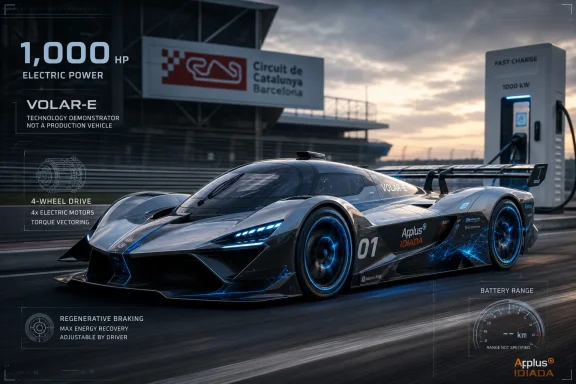 The 1,000-Horsepower Tesla Is Not Actually a Tesla
The headline question—whether a 1,000-horsepower Tesla concept is coming soon—invites an answer more complicated than the car underneath it. Nothing in the available material identifies Tesla as the manufacturer, technology supplier, development partner, or intended production brand behind the Volar-e. The companies attached to the project are Applus Idiada and Rimac Automobili.Teslarati’s account, drawing from Motor Authority’s reporting, uses the Volar-e as a prompt for thinking about the future of ultra-powerful electric cars. That is reasonable as industry speculation, particularly because Tesla had already made high-performance electric propulsion central to the public imagination. But it should not be mistaken for evidence that Tesla planned to adopt the Volar-e, rebadge it, or produce an equivalent car.
The distinction matters because concept-car coverage often collapses three very different things into a single promise. A company can demonstrate a technology, propose a design direction, or announce a vehicle intended for production; only the third creates a credible expectation that customers might eventually buy it. The Volar-e, on the evidence presented, belongs firmly in the demonstrator category.
Motor Authority described it as an electric racer concept formally presented by Spanish industrial-design and vehicle-engineering specialist Applus Idiada. Applus Idiada’s own subsequent description called it an advanced electric supercar, emphasizing four independent power sources, regenerative braking and rapid charging. Neither description turns it into a Tesla, and neither establishes a production plan.
That does not make the Volar-e irrelevant. On the contrary, demonstrators can matter precisely because they are not burdened by dealership networks, warranty costs, passenger-car regulations, cargo requirements or the compromises required for daily use. They let engineers exaggerate one set of capabilities to discover what survives contact with reality.
The Volar-e exaggerates power, charging speed and drivetrain control. What it leaves unresolved is how those capabilities would fit into a car expected to travel meaningful distances, recharge from accessible infrastructure and retain acceptable battery performance over years rather than laps.
Four Motors Turn Electrification Into a Chassis Technology
The headline figure is a claimed combined 1,000 horsepower, accompanied by 737 pound-feet of torque. That output comes from four electric motors, creating a layout that potentially allows propulsion to be managed independently at each wheel rather than distributed mechanically from one engine through a conventional transmission and differentials.That architecture is more significant than the round-number power figure. A 1,000-horsepower claim is excellent publicity, but four independently controlled motors point toward an entirely different way of making a high-performance car corner, accelerate and recover stability.
An electric motor can respond quickly to changes in requested torque. Put one at each wheel, coordinate them through software, and the powertrain becomes part of the vehicle’s active handling system. Instead of merely reducing engine output or applying a brake after a loss of traction is detected, the controller can potentially alter the driving force at individual wheels.
Green Car Reports highlighted the torque-vectoring possibilities of the four-motor system, describing a car able to vary power across its wheels for greater control through corners. The practical value is not limited to lap times. The same underlying idea can support traction management, stability intervention, regenerative braking and more precise control on low-grip surfaces.
This is where the Volar-e looks less like an isolated publicity stunt and more like an engineering preview. The path from a track demonstrator to a road car rarely involves transferring every specification unchanged. It more often involves taking the control strategy, thermal knowledge, power electronics or motor-management techniques and adapting them to a less extreme product.
Applus Idiada claims the Volar-e can accelerate from rest to 62 mph in 3.4 seconds and reach a governed top speed of 186 mph. Those numbers position it in supercar territory, but they also expose an interesting tension: the car has much more headline power than its acceleration time alone might suggest.
That is not necessarily an engineering failure. Peak power, usable traction, vehicle mass, gearing, motor characteristics, battery output and control calibration all influence acceleration. A concept optimized to demonstrate multiple technologies may also be deliberately limited to protect components that have not been engineered for production-level durability.
A governed top speed similarly says less than it first appears to say. It indicates that the car is electronically restrained at 186 mph, not necessarily that it could sustain that speed for long or that its battery and cooling systems were designed for repeated maximum-velocity runs. In an electric vehicle, reaching a speed and remaining there are separate thermal and energy-management problems.
The Volar-e can thus be fast without proving that it is ready. Its figures demonstrate that battery-electric propulsion can produce the instantaneous force expected of an exotic car. They do not yet demonstrate that the complete vehicle can deliver that performance repeatedly, predictably and economically.
The Battery Is Small Enough to Make Every Lap Count
The Volar-e’s lithium-ion battery is described as having 10 individual cells and an energy rating of 38 kilowatt-hours. Whatever the terminology surrounding those individual elements, the total energy figure is the specification that frames the rest of the car.A 38-kilowatt-hour battery paired with a 1,000-horsepower drivetrain is an intentionally aggressive combination. It provides enough stored energy to demonstrate the powertrain without carrying the larger battery that might be required for substantial road range, but it also means that sustained high-output driving can consume the available energy very quickly.
That trade-off is fundamental to performance EVs. Electric motors can produce enormous power, but every burst of acceleration draws from a finite energy store. Aerodynamic drag also rises sharply as speed increases, making the governed 186-mph capability especially expensive in energy terms.
Track use compounds the problem. The car repeatedly accelerates, brakes and accelerates again, while its tires, motors, power electronics and battery operate under high thermal loads. Regenerative braking can recover part of the kinetic energy that would otherwise become heat at the brakes, but it cannot make the process lossless.
Motor Authority noted that the Volar-e includes regenerative braking to help maintain charge. That is useful, particularly on a circuit, but regeneration should not be confused with perpetual energy recycling. Each conversion—from stored electrical energy to wheel motion and then back into the battery—introduces losses, while aerodynamic drag and tire resistance remain unrecoverable.
Regeneration is also constrained by available traction, motor capability, battery temperature and the amount of charging power the battery can accept at a given moment. A driver may brake hard enough that the friction brakes must supplement the electric motors, particularly during repeated high-speed track use. Once the battery approaches its charge or thermal limits, the system may also have to reduce regenerative power.
This makes the missing range figure impossible to treat as a minor omission. It is the variable that connects the claimed performance to the stated public purpose of the project.
The source commentary puts the issue plainly: “It doesn’t really matter how fast an electric vehicle can charge and accelerate” if it cannot complete useful work before losing power. That is the central test the Volar-e leaves unanswered.
A concept car does not necessarily need a production-style range rating. There may be no standardized consumer configuration to test, and a race-oriented demonstrator may operate under conditions that make a road-cycle result misleading. Even so, the complete absence of a range claim creates a hole at the center of the project’s argument.
Without range, readers cannot estimate how often the 15-to-20-minute charging process would be required. They cannot determine whether the small battery is a clever lightweight choice or a limitation that confines the car to short demonstrations. Nor can they evaluate how aggressively the battery would need to be discharged and recharged during repeated use.
The Volar-e proves that power can be spectacularly visible while energy capacity remains quietly decisive.
A 15-Minute Charge Is Only Half a Charging Claim
Applus Idiada says the 38-kilowatt-hour battery can be charged in between 15 and 20 minutes using a special fast-charging system. That sounds transformative, particularly in the context of a European Commission-backed project intended partly to address worries about long charging times.But a charging duration without a defined starting charge, ending charge, power level, thermal condition or charging curve is not enough to characterize the experience. It may be an accurate demonstration result while still being difficult to compare with the way a roadgoing EV is normally charged.
Battery charging is not generally performed at one constant maximum rate from empty to full. The system must manage cell voltage and temperature, usually reducing power as the battery fills. The time required therefore depends heavily on whether the claim refers to a broad middle portion of the battery or something closer to its entire usable capacity.
The special charging equipment is equally important. A vehicle that charges quickly only from bespoke hardware at a test facility has demonstrated battery and power-electronics capability, not a complete public charging solution. Commercial transfer would require interoperable connectors, safety systems, reliable grid connections and equipment that can be deployed economically where drivers need it.
The relatively modest energy capacity helps the headline charging time. Smaller batteries contain less energy, so they can theoretically be replenished more quickly than larger packs when charged at comparable power. The catch is that they may also need replenishment more frequently.
This is why charge time and range cannot be separated. A car that travels a long distance and then stops for 20 minutes may be practical. A car that repeatedly stops for 20 minutes after short bursts of high-speed driving is a different proposition, even though the advertised charge time is identical.
Contemporary coverage did not always repeat the same charging window, with one outlet reporting a shorter interval than Motor Authority’s 15-to-20-minute figure. That discrepancy is a useful warning against treating a concept specification as a standardized, independently verified result. Until the test conditions are defined, the responsible reading is that the Volar-e reportedly supports unusually fast charging through dedicated equipment—not that it guarantees a particular road-trip stop.
Thermal management is the unspoken technical challenge behind both charging and performance. Rapidly removing energy from a battery generates heat. Rapidly putting it back generates more. Alternating hard track use with fast charging can create a cycle in which the vehicle’s cooling system becomes just as important as the motors.
A production car must repeat that cycle without excessive degradation, unsafe cell temperatures or dramatic power reduction. It must do so in varying weather, at different battery charge levels and after years of use. A concept can show that the cycle is possible under controlled conditions, but commercialization requires proving that it remains dependable outside them.
The Rimac Connection Explains More Than the Styling
The Volar-e was developed by Applus Idiada in collaboration with Croatia’s Rimac Automobili, a specialist already associated with a 1,088-horsepower electric car. That relationship gives the Volar-e technical credibility, but it also raises questions about what, exactly, should be considered new.Contemporary reports described the Volar-e as having deep Rimac roots, and some coverage regarded it as an evolution or adaptation of technology associated with Rimac’s own electric prototype. The visual and technical relationship was close enough to trigger debate over whether the car was primarily a fresh Spanish concept or a Rimac-derived platform presented under the Applus Idiada name.
That distinction does not invalidate the project. Automotive development is collaborative by nature, and technology demonstrators frequently combine a specialist supplier’s powertrain with another organization’s testing, integration and control work. The relevant question is not whether every component originated inside Applus Idiada, but what the partnership was trying to validate.
Rimac’s expertise appears especially relevant to the four-motor powertrain and high-output electrical system. Applus Idiada, meanwhile, operates in vehicle engineering, development and testing. Combining the two creates a plausible division of labor: one party contributes extreme electric-propulsion capability, while the other turns it into a vehicle-level demonstrator and evaluates how the systems behave together.
It also places the Volar-e in a broader family of electric concepts rather than at the beginning of an entirely separate lineage.
| Vehicle | Role in the source material | Power stated | Relationship to the Volar-e |
|---|---|---|---|
| Volar-e | Applus Idiada electric demonstrator | 1,000 horsepower | Four-motor project developed with Rimac Automobili |
| Rimac electric car | High-performance electric reference | 1,088 horsepower | Created by the Volar-e’s Croatian development collaborator |
| Eliica | Earlier electric concept used for comparison | Not specified | Example of an extreme electric concept |
| Ultimate Aero GT | Electric concept used for comparison | Not specified | Reference point for electric-supercar ambition |
| Venturi Volage | Electric concept used for comparison | Not specified | Another performance-focused electric concept |
Rimac’s 1,088-horsepower figure also keeps the Volar-e’s 1,000 horsepower in perspective. The car is extraordinarily powerful, but it is not presented as the single unmatched breakthrough that the number might imply. Its importance lies in the package of four-motor control, battery operation, charging and track demonstration.
European Funding Turns a Supercar Into a Policy Experiment
The most politically provocative detail is that the European Commission provided 50 percent of the project’s funding. Public money supporting a 1,000-horsepower track-oriented concept is an easy target because the vehicle looks more like an exotic indulgence than a solution for ordinary motorists.The Commission’s stated aim, however, was to address concerns that could discourage consumers from buying electric cars, including limited driving range and lengthy charging. Viewed through that lens, the Volar-e was not funded simply because Europe needed another fast sports car. It was funded as a high-intensity test of electric-vehicle technology.
There is a defensible engineering logic to that approach. Extreme vehicles expose weaknesses quickly. A battery system that survives high discharge power, aggressive regeneration and rapid charging may teach engineers more in a short test program than a low-output demonstrator operated gently.
Motorsport and supercar projects have often functioned as laboratories for materials, braking, aerodynamics, control systems and thermal management. Electric propulsion does not eliminate that model. If anything, battery temperature and software-controlled torque distribution make instrumented track testing especially useful.
The public-policy argument is less straightforward. The Commission said the project was intended to address range and charging anxiety, yet the public specifications omit range altogether. That disconnect makes the Volar-e look highly successful at answering the glamorous half of the electric-car question and incomplete on the half most relevant to ordinary consumers.
Fast charging may help reduce anxiety, but only when the charging method is widely accessible and the battery provides enough range between stops. Performance can improve perceptions of EVs by showing that electrification is not synonymous with slow or joyless transportation. It cannot, on its own, establish affordability, utility or convenience.
The car’s styling reinforces the tension. The source commentary praises the design while observing that its color scheme is unmistakably track-oriented. The Volar-e communicates speed before it communicates practicality, which is effective for attracting attention but less effective for explaining how its technology would improve a commuter car.
That may still be a worthwhile use of a demonstrator. Public acceptance is emotional as well as rational, and an exciting halo vehicle can change what buyers imagine an electric drivetrain is capable of doing. The mistake would be to confuse attention with completion.
If the project’s charging, motor-control and regenerative-braking work can be transferred into other vehicles, its value may not depend on a Volar-e production model ever existing. The most commercially important output could be intellectual property, validation data or engineering experience that disappears into less spectacular cars.
That is why the correct measure of the funding is not whether anyone can buy the concept. It is whether the lessons from the project make subsequent electric vehicles better, easier to charge or more efficient—and whether those lessons could have been developed without subsidizing such an extreme machine.
The Missing Range Figure Undercuts the Project’s Best Argument
There is a difference between withholding a number because a concept is unfinished and withholding the number most likely to change the audience’s interpretation of every other claim. Range belongs in the second category.If the Volar-e can perform repeated track sessions while retaining useful battery capacity, the 38-kilowatt-hour pack begins to look like a demonstration of intelligent energy and thermal management. If it can produce only a brief sequence of full-power laps, it looks more like a rolling power benchmark.
Neither outcome would make the car worthless. A short-duration test platform can still validate motors, inverters and control software. But those outcomes would support very different claims about proximity to commercial use.
Range is also necessary to assess the benefit of regeneration. The car’s four-motor architecture could theoretically recover energy through multiple driven wheels, but the real value depends on calibration, battery acceptance limits and the driving cycle. A percentage or distance improvement would tell readers more than the mere presence of regenerative braking.
The same is true for fast charging. A 15-to-20-minute stop appears impressive until it is placed beside the distance driven before that stop. Commercial usefulness depends on the ratio between driving time and charging time, not the charging number alone.
Applus Idiada’s decision not to provide range may indicate that the demonstrator was never intended to make a road-use claim. Motor Authority reasonably cautioned that race conditions can empty an electric-car battery within minutes. The car’s aggressive design and Circuit de Catalunya debut support the interpretation that it was meant primarily to show what the powertrain could do on a controlled course.
The European Commission’s involvement makes that narrow interpretation harder to sustain. When a publicly supported project explicitly invokes consumer concerns about range, the absence of range data becomes a substantive limitation rather than a missing line in a specification sheet.
Without a disclosed range, the Volar-e demonstrates electric performance but does not yet demonstrate electric usability.
The Real Innovation May Never Wear a Volar-e Badge
The pathway from concept to commercialization is not necessarily a production line building identical cars. Technologies can transfer horizontally into suppliers, test programs and unrelated vehicle platforms.A four-motor layout could inform future torque-vectoring systems even if a commercial version uses fewer motors. Fast-charging research could improve battery cooling or charging controls without preserving the same 38-kilowatt-hour pack. Regeneration strategies developed on a circuit could be recalibrated for road safety and efficiency.
That form of transfer is less visible than announcing a showroom model, but it is often more realistic. A concept’s carbon-fiber body, track setup and dramatic paint may be disposable packaging around the engineering work being tested underneath.
Rimac’s participation strengthens that possibility. The Croatian company’s role shows that specialist electric-powertrain knowledge can be integrated into a vehicle created for another organization. It is an early illustration of a supplier model in which high-performance EV expertise becomes a product in its own right.
Applus Idiada’s position is similarly important. A vehicle-engineering and testing company does not need to become a mass-market automaker for the project to pay off. It can use the demonstrator to build competence, attract development contracts and validate methods that apply to future customer programs.
The gap between a concept and a commercial vehicle remains enormous. Production requires crash validation, regulatory approval, durability testing, service procedures, parts supply, software support, warranties and a business case. None of those is established by a high-speed demonstration.
The Volar-e’s rapid development story and concentrated specifications therefore should not be read as evidence that a 1,000-horsepower production vehicle is just around the corner. They show that a specialist collaboration can assemble and operate such a drivetrain. Industrializing it would be another project entirely.
For Tesla watchers, that is the clearest answer to the original question. The Volar-e makes a 1,000-horsepower electric car feel technologically plausible, but it offers no evidence about when Tesla might build one. Capability in the wider industry is not the same as a product commitment from a particular company.
The Numbers That Survive the Spectacle
The Volar-e is most useful when stripped of the assumptions attached to its name, appearance and Tesla-adjacent headline. What remains is a compact set of impressive claims, one major omission and a credible collaboration between organizations with complementary expertise.- The Volar-e is an Applus Idiada concept developed with Croatia’s Rimac Automobili, not an announced Tesla.
- Its four motors reportedly produce a combined 1,000 horsepower and 737 pound-feet of torque.
- Applus Idiada claims 0-to-62-mph acceleration in 3.4 seconds and a governed 186-mph top speed.
- The lithium-ion battery is rated at 38 kilowatt-hours and reportedly fast-charges in 15 to 20 minutes using special equipment.
- The European Commission supplied 50 percent of the funding to support work related to EV range and charging concerns.
- No driving-range figure was disclosed, preventing a meaningful assessment of the relationship between performance, charging frequency and commercial utility.
References
- Primary source: Teslarati
Published: 2026-07-11T21:00:13.526415
1000hp Tesla Concept Car Coming Soon?
From MotorAuthority.com: The Volar-e is one of the most powerful electric cars ever built and was showcased for the first time at a special event at the Circuit de Catalunya just outside of Barcelona, Spain, earlier today. Its makers claim the car delivers a combined output of 1,000 horsepower...www.teslarati.com - Related coverage: autobild.de
EU fördert 1000-PS-Elektro-Sportwagen - AUTO BILD
Die EU fördert einen Super-Sportler mit über 1000 PS. Klingt unglaublich, doch dahinter steckt die EU-Strategie zur Förderung alternativer Antriebe.www.autobild.de - Related coverage: autoblog.com
- Related coverage: motorauthority.com
Tesla Model S Electric GT car ready to race
Formula E may be the premier league for electric car sports, but Electric GT's Electric Production Car Series (EPCS) wants a slice of the budding motorsport. Electric GT together with EPCS race team SPV Racing held a launch ceremony in Barcelona, Spain on Tuesday where the competition-ready...www.motorauthority.com - Related coverage: greencarreports.com
VW reveals ID.Aero concept, previews premium electric flagship sedan
The ID.Aero suggests that VW won't entirely be abandoning the Passat sedan's form factor—but it's switching off to fully electric.www.greencarreports.com
